Hackett Asher, Yossepowitch Orit, Goor Yael, Sheffer Rivka, Schwartz Orna, Sheftel Yonatan, Weiss Yarden, Maor Yasmin
Division of Dermatology, Rabin Medical Center, Petah-Tikva 4941492, Israel.
Infectious Disease Unit, Edith Wolfson Medical Center, Halochamim 62, Holon 5822012, Israel.
J Clin Med. 2024 Aug 21;13(16):4924. doi: 10.3390/jcm13164924.
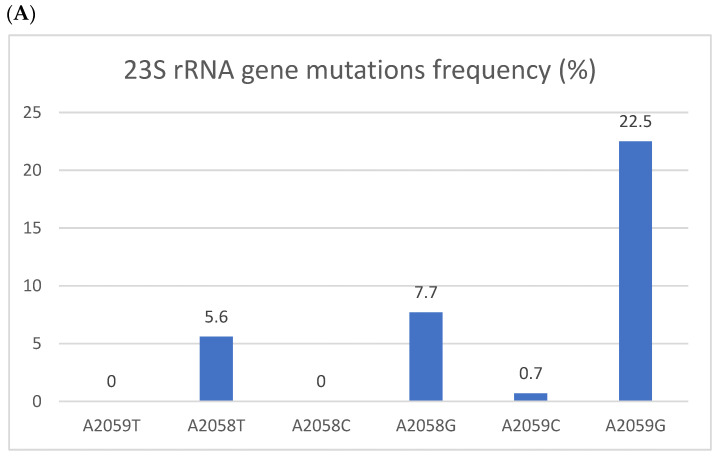
() infections and antibiotic resistance are increasing in prevalence while treatment options are limited. Limited data exist regarding resistance in Israel. Our aim was to study the prevalence of resistance in a sexually transmitted infection (STI) clinic in Israel. We performed a single-center retrospective study among patients attending an STI clinic during 2019-2020. isolates were tested to detect their resistance to azithromycin and fluoroquinolones (FQs) using commercial kits (Allplex™ & AziR Assay, Allplex™ & MoxiR Assay). We collected patient data regarding the risk factors for STIs and resistance. A multivariate logistic regression model was used to identify the risk factors for resistance. Of the 142 patients who tested positive for , 50 (35.2%) and 22 (15.5%) had resistant mutations to azithromycin and FQ, respectively, and 13 (9.2%) showed resistance to both agents. In a multivariate logistic regression model, men who have sex with men (RR 7.01 95% CI 3.00-16.33) and past STIs (RR 2.33 95% CI 1.01-5.34) were independent risk factors for azithromycin resistance. We found a high prevalence of azithromycin resistance and, to a lesser degree, FQ resistance. These findings may help design the treatment guidelines and support routine resistance testing in high-risk populations.
()感染和抗生素耐药性的患病率正在上升,而治疗选择却很有限。以色列关于耐药性的数据有限。我们的目的是研究以色列一家性传播感染(STI)诊所的耐药性患病率。我们对2019 - 2020年期间在一家STI诊所就诊的患者进行了单中心回顾性研究。使用商业试剂盒(Allplex™ & AziR检测法、Allplex™ & MoxiR检测法)对分离株进行检测,以检测它们对阿奇霉素和氟喹诺酮类药物(FQs)的耐药性。我们收集了患者关于性传播感染和耐药性危险因素的数据。使用多变量逻辑回归模型来确定耐药性的危险因素。在142例检测呈阳性的患者中,分别有50例(35.2%)和22例(15.5%)对阿奇霉素和FQ有耐药性突变,13例(9.2%)对两种药物均耐药。在多变量逻辑回归模型中,男男性行为者(相对风险7.01,95%置信区间3.00 - 16.33)和既往性传播感染(相对风险2.33,95%置信区间1.01 - 5.34)是阿奇霉素耐药性的独立危险因素。我们发现阿奇霉素耐药性的患病率很高,氟喹诺酮类药物耐药性的患病率相对较低。这些发现可能有助于制定治疗指南,并支持在高危人群中进行常规耐药性检测。