Copete Angela, Herrera Mariana, Suarez-Ariza Camilo, Gitau Zipporah, Arango-Uribe Maria, Keynan Rotem, Oda Camila, Singh Ameeta E, Skinner Stuart, Spence Cara, Riaño Will, MacKenzie Lauren J, Kasper Ken, Ireland Laurie, Martin Irene, Bullard Jared, Lopez Lucelly, Marin Diana, Haworth-Brockman Margaret, Keynan Yoav, Rueda Zulma Vanessa
Department of Medical Microbiology and Infectious Diseases, University of Manitoba, Winnipeg, MB R3E 0J9, Canada.
Department of Medicine, University of Alberta, Edmonton, AB T6G 2R3, Canada.
Trop Med Infect Dis. 2025 May 19;10(5):139. doi: 10.3390/tropicalmed10050139.
We aimed to describe trends in prevalence and associated resistance in Canada between 1980 and 2022.
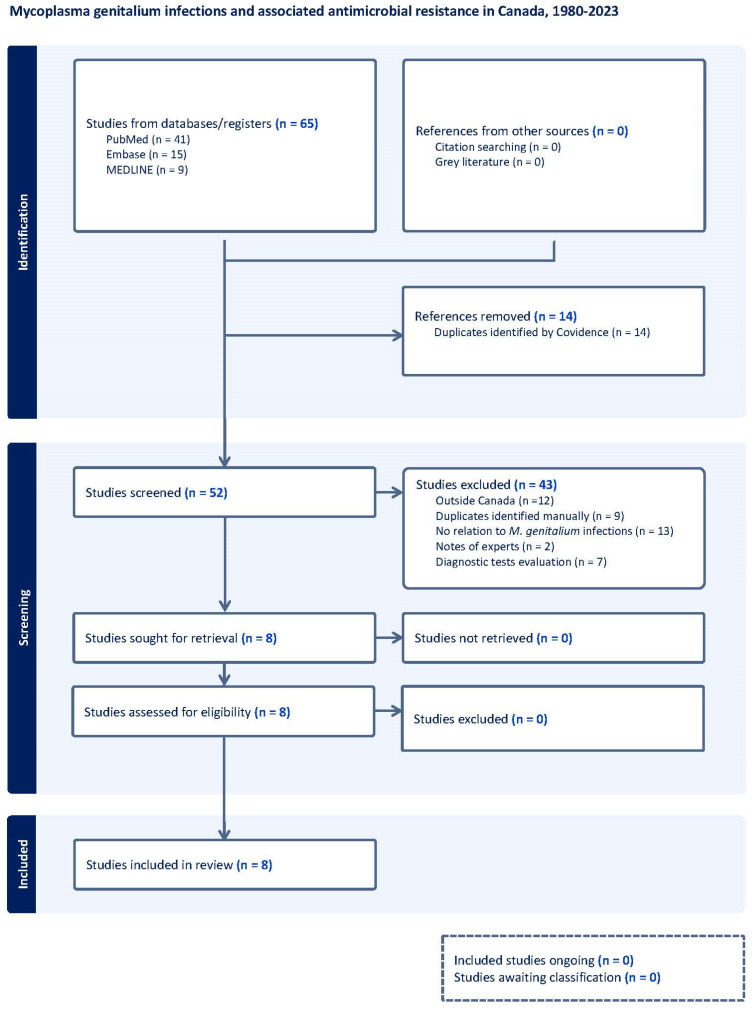
Ecological study and a scoping review. We collected publicly available data published by the governments of all Canadian provinces and territories. We also systematically searched PubMed, Medline, Embase, and grey literature using the keywords '', 'Canada', and all provinces and territories. We reported prevalence, age, sex, gender, symptoms, coinfections, sample types used for diagnosis, and macrolide and fluoroquinolone resistance rates.
National or provincial surveillance systems for are absent. Eight studies reported the epidemiology of The prevalence ranged between 3% in Quebec and 30.3% in Ontario. Half of the patients reported symptoms. The most collected sample for diagnosis was urine, followed by cervical and urethral swabs. Co-infection with was reported in 3.3% to 16.4% of cases and with in 0.0% to 24.0%. Macrolide resistance ranged between 25% and 82.1%, and fluoroquinolone resistance between 0.0% and 29.1%.
prevalence and resistance rates varied by sex, gender, province, and specimen type. In the absence of routine surveillance, incomplete data hinders understanding the bacterium's natural history, its impact on some key groups, and the tracking of antibiotic resistance.
我们旨在描述1980年至2022年期间加拿大的患病率及相关耐药性趋势。
进行生态研究和范围综述。我们收集了加拿大所有省份和地区政府公布的公开数据。我们还使用关键词“”、“加拿大”以及所有省份和地区,系统地检索了PubMed、Medline、Embase和灰色文献。我们报告了患病率、年龄、性别、症状、合并感染、用于诊断的样本类型以及大环内酯类和氟喹诺酮类耐药率。
缺乏针对的国家或省级监测系统。八项研究报告了的流行病学情况。患病率在魁北克为3%,在安大略为30.3%之间。一半的患者报告有症状。用于诊断的最常采集样本是尿液,其次是宫颈和尿道拭子。3.3%至16.4%的病例报告合并感染,0.0%至24.0%的病例报告合并感染。大环内酯类耐药率在25%至82.1%之间,氟喹诺酮类耐药率在0.0%至29.1%之间。
患病率和耐药率因性别、省份和样本类型而异。在缺乏常规监测的情况下,不完整的数据阻碍了对该细菌自然史、其对一些关键群体的影响以及抗生素耐药性追踪的了解。