
水稻二化螟幼虫取食诱导水稻挥发释放挥发性有机化合物并驱避雌成虫产卵。
Infestation of Rice Striped Stem Borer () Larvae Induces Emission of Volatile Organic Compounds in Rice and Repels Female Adult Oviposition.
机构信息
College of Plant Protection, Nanjing Agricultural University, Nanjing 210095, China.
Jiangsu Key Laboratory for Food and Safety-State Key Laboratory Cultivation Base of Ministry of Science and Technology, Institute of Plant Protection, Jiangsu Academy of Agricultural Sciences, Nanjing 210014, China.
出版信息
Int J Mol Sci. 2024 Aug 13;25(16):8827. doi: 10.3390/ijms25168827.
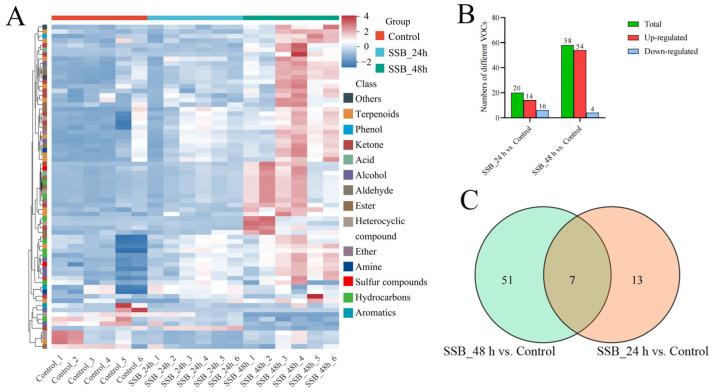
Plants regulate the biosynthesis and emission of metabolic compounds to manage herbivorous stresses. In this study, as a destructive pest, the pre-infestation of rice striped stem borer (SSB, ) larvae on rice () reduced the subsequent SSB female adult oviposition preference. Widely targeted volatilomics and transcriptome sequencing were used to identify released volatile metabolic profiles and differentially expressed genes in SSB-infested and uninfested rice plants. SSB infestation significantly altered the accumulation of 71 volatile organic compounds (VOCs), including 13 terpenoids. A total of 7897 significantly differentially expressed genes were identified, and genes involved in the terpenoid and phenylpropanoid metabolic pathways were highly enriched. Correlation analysis revealed that DEGs in terpenoid metabolism-related pathways were likely involved in the regulation of VOC biosynthesis in SSB-infested rice plants. Furthermore, two terpenoids, (-)-carvone and cedrol, were selected to analyse the behaviour of SSB and predators. Y-tube olfactometer tests demonstrated that both (-)-carvone and cedrol could repel SSB adults at higher concentrations; (-)-carvone could simultaneously attract the natural enemies of SSB, and , and cedrol could only attract at lower concentrations. These findings provide a better understanding of the response of rice plants to SSB and contribute to the development of new strategies to control herbivorous pests.
植物调节代谢化合物的生物合成和排放,以应对食草压力。在这项研究中,稻纵卷叶螟幼虫(SSB)的预侵害会降低随后 SSB 雌成虫的产卵偏好,SSB 是一种具有破坏性的害虫。我们广泛采用靶向挥发物组学和转录组测序技术,以鉴定 SSB 侵害和未侵害水稻植株中释放的挥发性代谢特征和差异表达基因。SSB 侵害显著改变了 71 种挥发性有机化合物(VOCs)的积累,包括 13 种萜类化合物。共鉴定出 7897 个显著差异表达基因,萜类和苯丙烷代谢途径的基因高度富集。相关性分析表明,萜类代谢相关途径中的 DEGs 可能参与了 SSB 侵害水稻植株中 VOC 生物合成的调节。此外,我们选择了两种萜类化合物(-)-蒈烯和柏木脑,来分析 SSB 和捕食者的行为。Y 型嗅觉仪测试表明,(-)-蒈烯和柏木脑在较高浓度下都可以驱避 SSB 成虫;(-)-蒈烯可以同时吸引 SSB 的天敌 和 ,而柏木脑只能在较低浓度下吸引 。这些发现增进了我们对水稻植株对 SSB 反应的理解,并有助于开发控制食草性害虫的新策略。




 Zotero 插件