
翻修髋关节置换术中定制髋臼假体二维与三维成像的评估准确性
Assessment Accuracy of 2D vs. 3D Imaging for Custom-Made Acetabular Implants in Revision Hip Arthroplasty.
作者信息
Nees Timo Albert, Mueller Christian Thomas, Innmann Moritz Maximilian, Spranz David Maximilian, Westhauser Fabian, Renkawitz Tobias, Reiner Tobias, Walker Tilman
机构信息
Department of Orthopaedics, Heidelberg University Hospital, Schlierbacher Landstraße 200a, 69118 Heidelberg, Germany.
出版信息
J Pers Med. 2024 Jul 30;14(8):808. doi: 10.3390/jpm14080808.
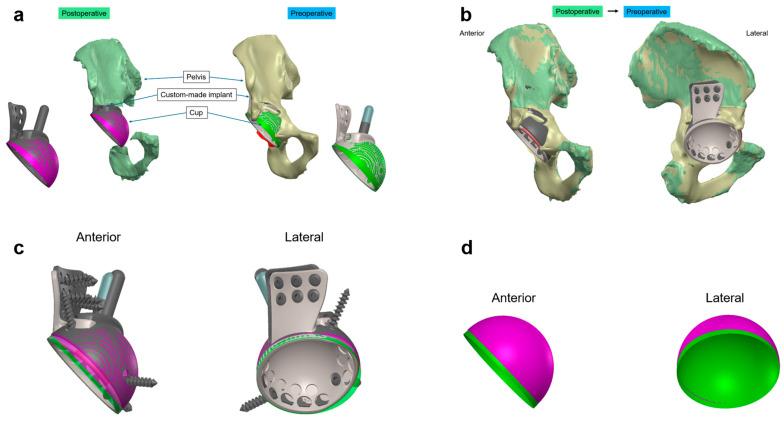
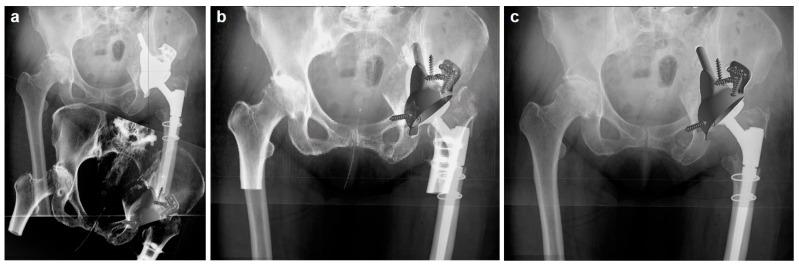
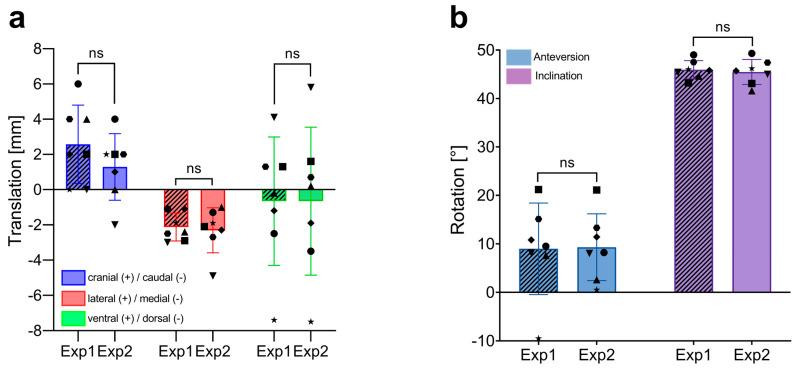
Revision total hip arthroplasty (rTHA) presents significant challenges, particularly in patients with severe acetabular bone defects. Traditional treatment options often fall short, leading to the emergence of custom-made 3D-printed acetabular implants. Accurate assessment of implant positioning is crucial for ensuring optimal postoperative outcomes and for providing feedback to the surgical team. This single-center, retrospective cohort study evaluates the accuracy of standard 2D radiographs versus 3D CT scans in assessing the positioning of these implants, aiming to determine if 2D imaging could serve as a viable alternative for the postoperative evaluation. We analyzed the implant positions of seven rTHA patients with severe acetabular defects (Paprosky ≥ Type IIIA) using an alignment technique that integrates postoperative 2D radiographs with preoperative CT plans. Two independent investigators, one inexperienced and one experienced, measured the positioning accuracy with both imaging modalities. Measurements included translational shifts from the preoperatively templated implant position in the craniocaudal (CC), lateromedial (LM), and ventrodorsal (VD) directions, as well as rotational differences in anteversion (AV) and inclination (INCL). The study demonstrated that 2D radiographs, when aligned with preoperative CT data, could accurately assess implant positions with precision nearly comparable to that of 3D CT scans. Observed deviations were 1.4 mm and 2.7 mm in CC and LM directions, respectively, and 3.6° in AV and 0.7° in INCL using 2D imaging, all within clinically acceptable ranges. For 3D CT assessments, mean interobserver variability was up to 0.9 mm for translational shifts and 1.4° for rotation, while for 2D alignment, observer differences were 1.4 mm and 3.2° for translation and rotation, respectively. Comparative analysis of mean results from both investigators, across all dimensions (CC, LM, AV, and INCL) for 2D and 3D matching, showed no significant differences. In conclusion, conventional anteroposterior 2D radiographs of the pelvis can sufficiently determine the positioning of custom-made acetabular implants in rTHA. This suggests that 2D radiography is a viable alternative to 3D CT scans, potentially enhancing the implementation and quality control of advanced implant technologies.
全髋关节翻修术(rTHA)面临着重大挑战,尤其是在髋臼严重骨缺损的患者中。传统的治疗方法往往效果不佳,从而催生了定制的3D打印髋臼植入物。准确评估植入物的位置对于确保最佳术后效果以及为手术团队提供反馈至关重要。这项单中心回顾性队列研究评估了标准二维X线片与三维CT扫描在评估这些植入物位置方面的准确性,旨在确定二维成像是否可作为术后评估的可行替代方法。我们使用一种将术后二维X线片与术前CT计划相结合的对齐技术,分析了7例髋臼严重缺损(Paprosky≥IIIA型)的rTHA患者的植入物位置。两名独立的研究人员,一名经验不足,一名经验丰富,使用两种成像方式测量了定位准确性。测量内容包括与术前模板化植入物位置在颅尾(CC)、内外侧(LM)和腹背(VD)方向上的平移偏移,以及前倾角(AV)和倾斜度(INCL)的旋转差异。研究表明,当二维X线片与术前CT数据对齐时,能够准确评估植入物位置,其精度与三维CT扫描相近。使用二维成像时,在CC和LM方向上观察到的偏差分别为1.4毫米和2.7毫米,AV为3.6°,INCL为0.7°,均在临床可接受范围内。对于三维CT评估,观察者间平移偏移的平均变异性高达0.9毫米,旋转为1.4°,而对于二维对齐,观察者在平移和旋转方面的差异分别为1.4毫米和3.2°。对两名研究人员在二维和三维匹配的所有维度(CC、LM、AV和INCL)上的平均结果进行比较分析,未发现显著差异。总之,骨盆常规前后位二维X线片能够充分确定rTHA中定制髋臼植入物的位置。这表明二维X线摄影是三维CT扫描的可行替代方法,可能会提高先进植入技术的应用和质量控制。



 Zotero 插件