Carità Enrico, Donadelli Alberto, Laterza Mara, Rossettini Giacomo, Villafañe Jorge Hugo, Perazzini Pier Giuseppe
Clinica San Francesco, Via Monte Ortigara 21, 37127 Verona, Italy.
Department of Physiotherapy, Faculty of Sport Sciences, Universidad Europea de Madrid, 28670 Villaviciosa de Odón, Spain.
Diagnostics (Basel). 2024 Aug 6;14(16):1703. doi: 10.3390/diagnostics14161703.
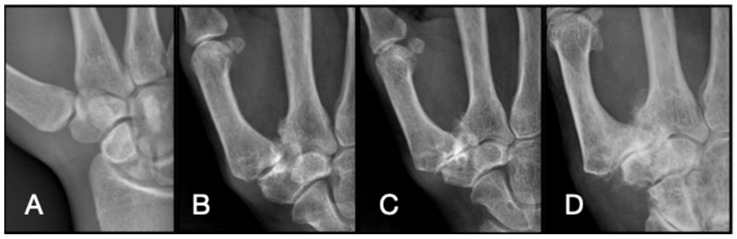
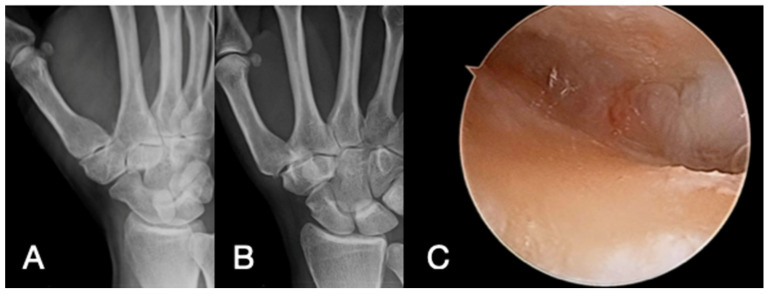
(1) Background: The objective of this study is to evaluate the predictive value of the Eaton-Littler radiologic classification for thumb carpometacarpal osteoarthritis (CMC OA) relating to intra-articular cartilage damage assessed by the Outerbridge arthroscopic classification. (2) Methods: A total of 51 thumb CMC OA arthroscopies were performed on patients classified as Eaton stages 1, 2, or 3. Post-arthroscopic evaluations of cartilage damage were categorized using the Outerbridge classification. Comparative analyses were conducted between the radiological Eaton stages and the arthroscopic Outerbridge stages. (3) Results: Arthroscopic examination revealed Outerbridge stage 3 and 4 cartilage damage in 26 cases classified as Eaton stage 2 and in 18 cases classified as Eaton stage 3. The detection of severe cartilage damage in patients classified as Eaton stage 2 was unexpected. (4) Conclusions: Arthroscopy demonstrated that many patients with mild radiological degenerative signs exhibited significant cartilage destruction. Although the Eaton classification is widely used for staging thumb CMC OA, it may not accurately reflect the severity of intra-articular damage. The Eaton classification does not reliably predict intra-articular damage in Eaton stage 2 cases.
(1) 背景:本研究的目的是评估伊顿-利特勒放射学分类法对拇指腕掌关节骨关节炎(CMC OA)的预测价值,该分类法与通过外布里奇关节镜分类法评估的关节内软骨损伤相关。(2) 方法:对51例被分类为伊顿1期、2期或3期的拇指CMC OA患者进行了关节镜检查。关节镜检查后对软骨损伤的评估采用外布里奇分类法进行分类。对放射学伊顿分期和关节镜外布里奇分期进行了比较分析。(3) 结果:关节镜检查显示,在26例被分类为伊顿2期和18例被分类为伊顿3期的病例中存在外布里奇3期和4期软骨损伤。在被分类为伊顿2期的患者中检测到严重软骨损伤是出乎意料的。(4) 结论:关节镜检查表明,许多具有轻度放射学退变征象的患者表现出明显的软骨破坏。尽管伊顿分类法被广泛用于拇指CMC OA的分期,但它可能无法准确反映关节内损伤的严重程度。伊顿分类法不能可靠地预测伊顿2期病例的关节内损伤。