Department of Anesthesiology and Reanimation, Erol Olçok Training and Research Hospital, 19040 Çorum, Turkey.
Department of Internal Medicine, Hitit University Faculty of Medicine, 19040 Çorum, Turkey.
Medicina (Kaunas). 2024 Aug 16;60(8):1329. doi: 10.3390/medicina60081329.
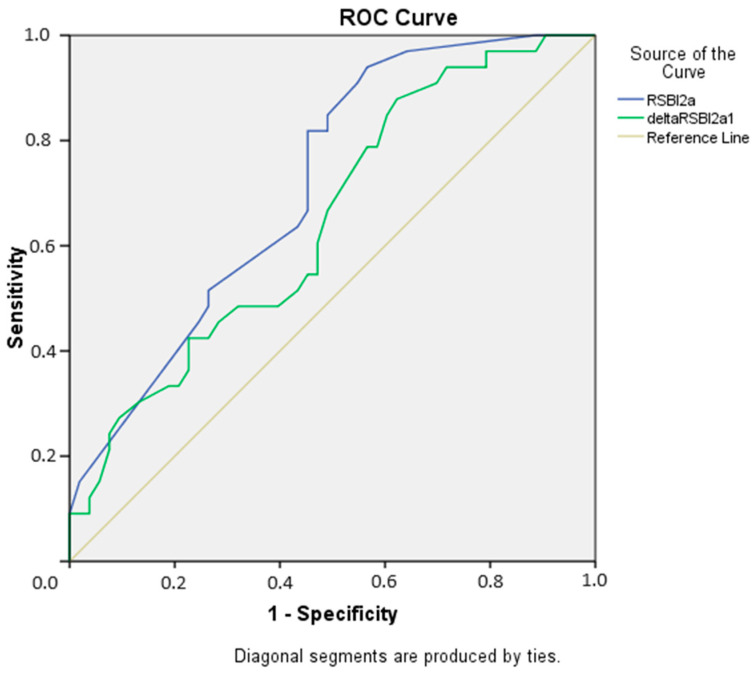
: Extubation success in ICU patients is crucial for reducing ventilator-associated complications, morbidity, and mortality. The Rapid Shallow Breathing Index (RSBI) is a widely used predictor for weaning from mechanical ventilation. This study aims to determine the predictive value of serial RSBI measurements on extubation success in ICU patients on mechanical ventilation. : This prospective observational study was conducted on 86 ICU patients at Hitit University between February 2024 and July 2024. Patients were divided into successful and unsuccessful extubation groups. RSBI values were compared between these groups. : This study included 86 patients (32 females, 54 males) with a mean age of 54.51 ± 12.1 years. Extubation was successful in 53 patients and unsuccessful in 33. There was no significant difference in age and intubation duration between the groups ( = 0.246, = 0.210). Significant differences were found in RSBI-1a and RSBI-2 values ( = 0.013, = 0.011). The median RSBI-2a was 80 in the successful group and 92 in the unsuccessful group ( = 0.001). The ΔRSBI was higher in the unsuccessful group ( = 0.022). ROC analysis identified optimal cut-off values: RSBI-2a ≤ 72 (AUC 0.715) and ΔRSBI ≤ -3 (AUC 0.648). RSBI-2a ≤ 72 increased the likelihood of successful extubation by 10.8 times, while ΔRSBI ≤ -3 increased it by 3.4 times. Using both criteria together increased the likelihood by 28.48 times. : Serial RSBI measurement can be an effective tool for predicting extubation success in patients on IMV. These findings suggest that serially measured RSBI may serve as a potential indicator for extubation readiness.
: 重症监护病房(ICU)患者的拔管成功对于降低呼吸机相关并发症、发病率和死亡率至关重要。快速浅呼吸指数(RSBI)是一种广泛用于预测机械通气撤机的指标。本研究旨在确定连续 RSBI 测量对机械通气 ICU 患者拔管成功的预测价值。: 这是一项前瞻性观察研究,于 2024 年 2 月至 2024 年 7 月在土耳其哈提特大学的 86 名 ICU 患者中进行。患者分为拔管成功组和拔管失败组。比较两组之间的 RSBI 值。: 本研究纳入 86 例患者(女性 32 例,男性 54 例),平均年龄为 54.51 ± 12.1 岁。53 例患者拔管成功,33 例患者拔管失败。两组间的年龄和插管时间无显著差异( = 0.246, = 0.210)。RSBI-1a 和 RSBI-2 值存在显著差异( = 0.013, = 0.011)。成功组的 RSBI-2a 中位数为 80,失败组为 92( = 0.001)。失败组的 ΔRSBI 较高( = 0.022)。ROC 分析确定了最佳截断值:RSBI-2a ≤ 72(AUC 0.715)和 ΔRSBI ≤ -3(AUC 0.648)。RSBI-2a ≤ 72 可使拔管成功的可能性增加 10.8 倍,而 ΔRSBI ≤ -3 可使拔管成功的可能性增加 3.4 倍。同时使用这两个标准可使可能性增加 28.48 倍。: 连续 RSBI 测量可以成为预测 IMV 患者拔管成功的有效工具。这些发现表明,连续测量的 RSBI 可能是拔管准备的潜在指标。