Medical School, Shihezi University, Shihezi 832003, China.
Key Laboratory for Prevention and Control of Emerging Infectious Diseases and Public Health Security, Shihezi 832000, China.
Nutrients. 2024 Aug 6;16(16):2589. doi: 10.3390/nu16162589.
There is growing evidence indicating that environmental endocrine disruptors may influence the development of prostate cancer. Despite this, the connection between BPA and PSA levels is still not fully understood and appears intricate. In this study, we aimed to assess the link between BPA exposure and PSA levels using data from the NHANES database.
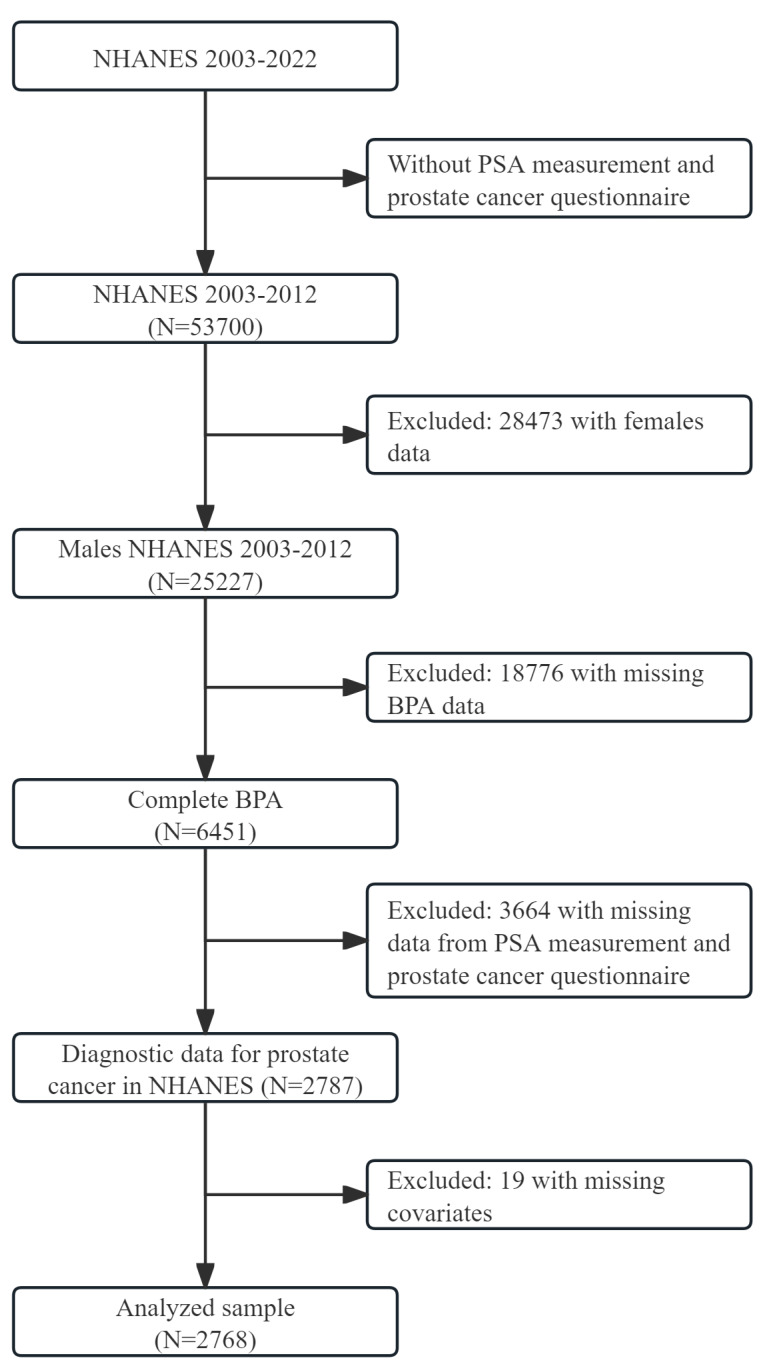
We conducted a weighted linear regression, logistic regression analysis, natural cubic spline (NCS), subgroup analysis, and interaction analysis on 2768 participants. Urinary BPA was considered the independent variable, while PSA was the dependent variable.
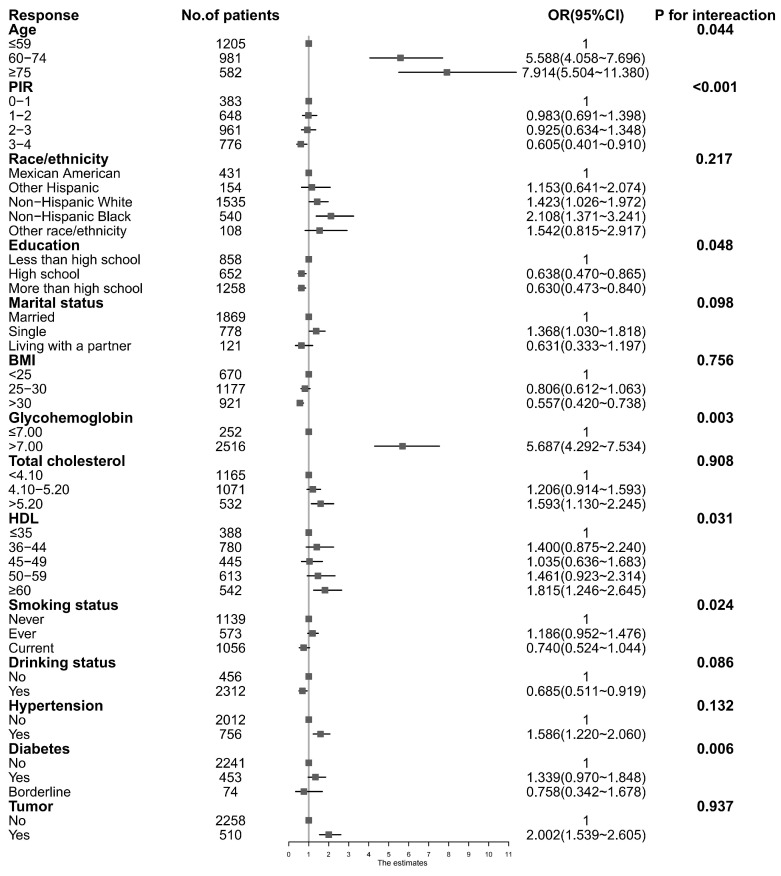
In the study, the average age of the participants selected was 62.70 years (±12.93). Age was negatively correlated with BPA, while PSA and BMI were positively correlated with BPA concentration (all of the -value < 0.05). In the fully adjusted model, the weighted linear and logistic regression results showed that BPA was positively correlated with PSA and prostate cancer. NCS analysis results show that BPA and PSA have a non-linear relationship. Sensitivity and subgroup analyses showed similar results. In addition, there were interactions between BPA and age, PIR, education, HbA1c, high-density lipoprotein, smoking status, and Diabetes.
There was a positive correlation between urinary BPA and PSA in older American males, especially when the BPA concentration was higher than 4.46 ng/mL. In future practical applications of prostate cancer screening, it is crucial to focus on individuals aged 75 years and older, as well as those with a PIR between 0 and 1, non-Hispanic black, and other risk groups to provide reference values for the primary and secondary prevention of prostate cancer.
越来越多的证据表明,环境内分泌干扰物可能会影响前列腺癌的发展。尽管如此,BPA 与 PSA 水平之间的联系仍未被完全理解,而且似乎很复杂。在这项研究中,我们旨在使用 NHANES 数据库中的数据评估 BPA 暴露与 PSA 水平之间的联系。
我们对 2768 名参与者进行了加权线性回归、逻辑回归分析、自然三次样条(NCS)、亚组分析和交互作用分析。尿 BPA 被视为自变量,PSA 为因变量。
在研究中,所选参与者的平均年龄为 62.70 岁(±12.93)。年龄与 BPA 呈负相关,而 PSA 和 BMI 与 BPA 浓度呈正相关(所有 - 值<0.05)。在完全调整的模型中,加权线性和逻辑回归结果表明 BPA 与 PSA 和前列腺癌呈正相关。NCS 分析结果表明 BPA 和 PSA 之间存在非线性关系。敏感性和亚组分析显示出相似的结果。此外,BPA 和年龄、PIR、教育程度、HbA1c、高密度脂蛋白、吸烟状况和糖尿病之间存在交互作用。
在年龄较大的美国男性中,尿液 BPA 与 PSA 呈正相关,尤其是当 BPA 浓度高于 4.46ng/mL 时。在未来前列腺癌筛查的实际应用中,必须关注 75 岁及以上的个体,以及 PIR 在 0 到 1 之间、非西班牙裔黑人以及其他风险群体,为前列腺癌的一级和二级预防提供参考值。