Zhong Liyuan, Xie Zixian, Han Ziping, Fan Junfen, Wang Rongliang, Tao Zhen, Ma Qingfeng, Luo Yumin
Institute of Cerebrovascular Disease Research, Xuanwu Hospital of Capital Medical University, Beijing 100053, China.
Department of Neurology, Xuanwu Hospital of Capital Medical University, Beijing 100053, China.
Pharmaceuticals (Basel). 2024 Jul 31;17(8):1008. doi: 10.3390/ph17081008.
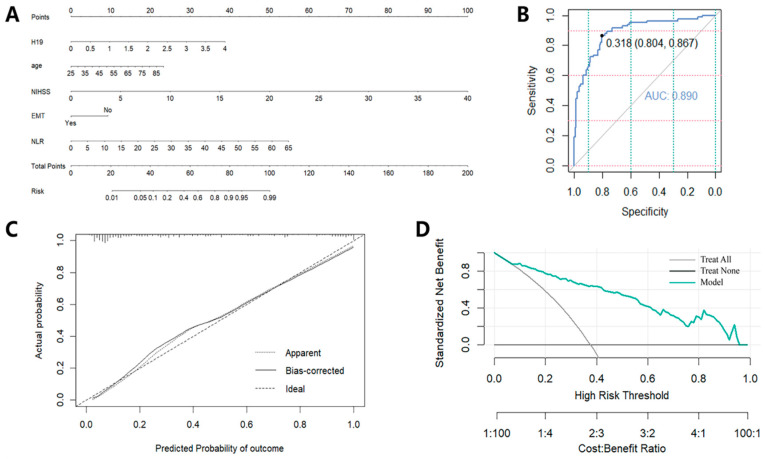
Acute ischemic stroke (AIS) is a cerebrovascular disease that seriously affects the physical and mental health and quality of life of patients. However, there is a lack of reliable prognostic prediction methods. The main objective of this study was to investigate the prognostic value of long non-coding RNA (lncRNA) H19 in lymphocytes of patients with AIS, and to construct a prognostic prediction model for AIS including lncRNA H19 in lymphocytes, which would provide new ideas for the prognostic evaluation of AIS. Poor prognosis was defined when the patient's modified Rankin scale (mRS) score at 3 months after AIS onset was greater than 2. Quantitative real-time polymerase chain reaction (qRT-PCR) was used to measure the level of lncRNA H19 in lymphocytes. Spearman correlation analysis revealed a positive correlation between lncRNA H19 and mRS score at 3 months after AIS onset (r = 0.1977, = 0.0032), while lncRNA H19 was negatively correlated with white blood cells counts, lymphocytes counts, and neutrophils counts. Logistic regression analysis identified lncRNA H19 as an independent predictor of poor prognosis (OR = 3.062 [1.69-5.548], < 0.001). Moreover, a nomogram prediction model incorporating lncRNA H19 in lymphocytes demonstrated effective discrimination, calibration, and clinical applicability in predicting AIS outcomes. The findings suggest that lncRNA H19 in lymphocytes could be a valuable prognostic indicator and a potential pharmacological target for AIS patients, and might be a novel pathway for enhanced prognostic evaluation and targeted therapeutic strategies.
急性缺血性卒中(AIS)是一种严重影响患者身心健康和生活质量的脑血管疾病。然而,目前缺乏可靠的预后预测方法。本研究的主要目的是探讨长链非编码RNA(lncRNA)H19在AIS患者淋巴细胞中的预后价值,并构建一个包含淋巴细胞中lncRNA H19的AIS预后预测模型,这将为AIS的预后评估提供新思路。当AIS发病后3个月患者的改良Rankin量表(mRS)评分大于2时,定义为预后不良。采用定量实时聚合酶链反应(qRT-PCR)检测淋巴细胞中lncRNA H19的水平。Spearman相关性分析显示,AIS发病后3个月时lncRNA H19与mRS评分呈正相关(r = 0.1977,P = 0.0032),而lncRNA H19与白细胞计数、淋巴细胞计数和中性粒细胞计数呈负相关。Logistic回归分析确定lncRNA H19是预后不良的独立预测因子(OR = 3.062 [1.69 - 5.548],P < 0.001)。此外,一个纳入淋巴细胞中lncRNA H19的列线图预测模型在预测AIS结局方面显示出有效的区分度、校准度和临床适用性。研究结果表明,淋巴细胞中的lncRNA H19可能是AIS患者有价值的预后指标和潜在的药物靶点,可能是增强预后评估和靶向治疗策略的新途径。