Morau Mariana Vieira, Seguin Cecilia Souto, Perroud Junior Mauricio Wesley, Dagli-Hernandez Carolina, Pincinato Eder de Carvalho, Moriel Patricia
Faculdade de Ciências Médicas, Universidade Estadual de Campinas, Campinas 13083-887, SP, Brazil.
Faculdade de Ciências Farmacêuticas, Universidade Estadual de Campinas, Campinas 13083-871, SP, Brazil.
Pharmaceuticals (Basel). 2024 Aug 7;17(8):1040. doi: 10.3390/ph17081040.
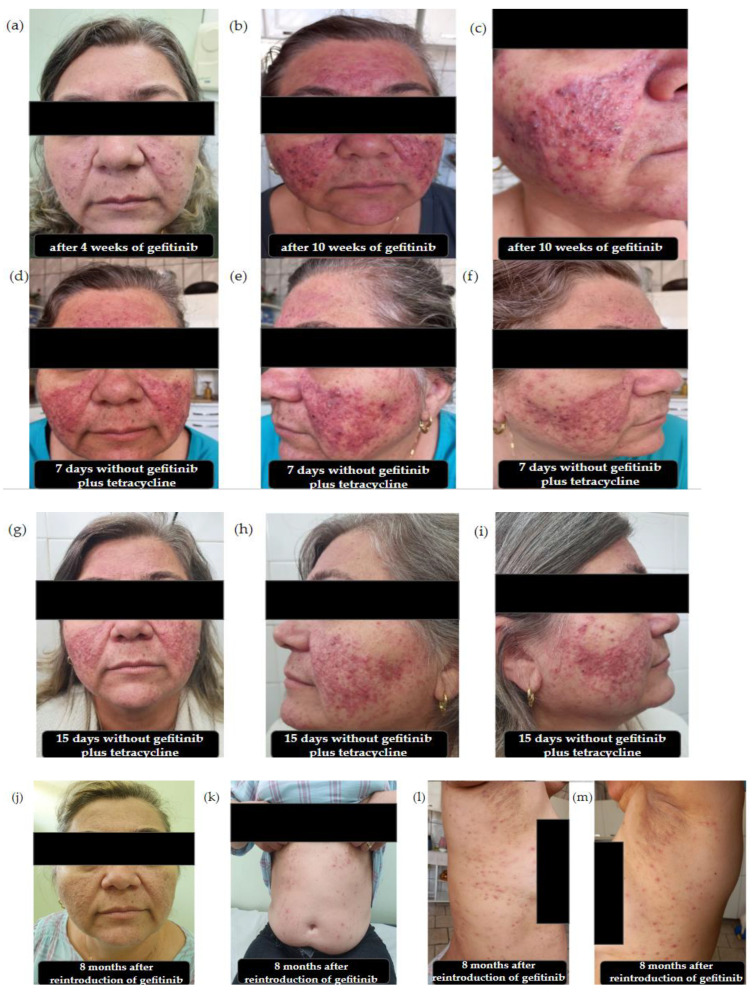
Gefitinib is a selective inhibitor of the epidermal growth factor receptor that is used to treat advanced and metastatic non-small cell lung cancer (NSCLC). Dermatological adverse reactions are most commonly associated with gefitinib treatment. The cause of adverse reactions in individuals is multifactorial. Pharmacogenetics is an effective tool to detect such adverse reactions. This case report describes a female patient with NSCLC who was administered gefitinib at a dose of 250 mg/day. However, due to severe adverse dermatological reactions, the treatment was interrupted for 15 d and antibiotic therapy was administered to manage the skin rashes, maculopapular rashes, and hyperpigmentation. Treatment adherence was adequate, and no drug interactions were detected. A pharmacogenetic analysis revealed homozygosity in the ATP-binding cassette rs1128503 (c.1236A>G), heterozygosity in rs2231142 (c.421G>T) and rs2622604 (c.-20+614T>C), and a non-functional variant of the cytochrome P450 family 3, subfamily A, member 5 (). The relationship between altered genetic variants and the presence of adverse reactions induced by gefitinib is still controversial. Overall, this case report highlights the importance of continuing to study pharmacogenetics as predictors of adverse drug reactions.
吉非替尼是一种表皮生长因子受体的选择性抑制剂,用于治疗晚期和转移性非小细胞肺癌(NSCLC)。皮肤不良反应最常与吉非替尼治疗相关。个体不良反应的原因是多因素的。药物遗传学是检测此类不良反应的有效工具。本病例报告描述了一名患有NSCLC的女性患者,她接受了每天250毫克剂量的吉非替尼治疗。然而,由于严重的皮肤不良反应,治疗中断了15天,并给予抗生素治疗以处理皮疹、斑丘疹和色素沉着。治疗依从性良好,未检测到药物相互作用。药物遗传学分析显示,ATP结合盒rs1128503(c.1236A>G)纯合子,rs2231142(c.421G>T)和rs2622604(c.-20+614T>C)杂合子,以及细胞色素P450家族3亚家族A成员5的无功能变体。基因变体改变与吉非替尼引起的不良反应之间的关系仍存在争议。总体而言,本病例报告强调了继续研究药物遗传学作为药物不良反应预测指标的重要性。