Okutani Akiko, Morikawa Shigeru, Maeda Ken
Department of Veterinary Science, National Institute of Infectious Diseases, 1-23-1 Toyama, Shinjuku-ku, Tokyo 162-8640, Japan.
Pathogens. 2024 Aug 19;13(8):699. doi: 10.3390/pathogens13080699.
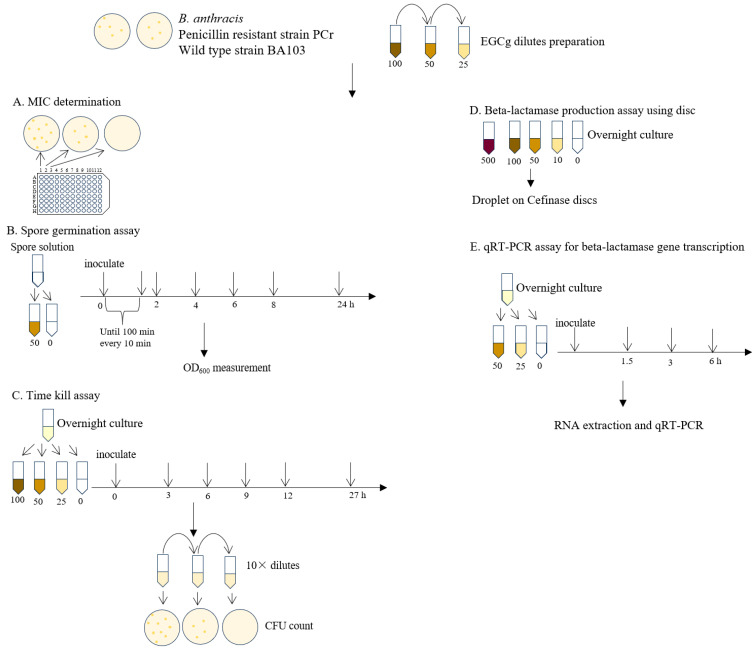
The green tea catechin epigallocatechin gallate (EGCg) has antimicrobial effects on many bacteria. In this study, we investigated the inhibitory effects of EGCg on spores and vegetative cells. The spores were insensitive to EGCg, but the growth of vegetative cells derived from germinated spores was inhibited by EGCg. Moreover, EGCg decreased the minimum inhibitory concentration of penicillin and meropenem for penicillin-resistant . In the penicillin-resistant strain, the transcription levels of the beta-lactamase genes ( and ) decreased significantly following the treatment with 50 µg/mL EGCg. These results suggest that the appropriate application of EGCg may effectively control the penicillin-resistant growth and beta-lactamase production.
绿茶儿茶素表没食子儿茶素没食子酸酯(EGCg)对多种细菌具有抗菌作用。在本研究中,我们调查了EGCg对芽孢和营养细胞的抑制作用。芽孢对EGCg不敏感,但EGCg抑制了由萌发芽孢产生的营养细胞的生长。此外,EGCg降低了青霉素和美罗培南对耐青霉素菌的最低抑菌浓度。在耐青霉素菌株中,用50µg/mL EGCg处理后,β-内酰胺酶基因(和)的转录水平显著降低。这些结果表明,适当应用EGCg可能有效地控制耐青霉素菌的生长和β-内酰胺酶的产生。