Estrada-Camerena Erika, López-Rubalcava Carolina, Vega-Rivera Nelly Maritza, González-Trujano María Eva
Laboratorio de Neuropsicofarmacología, Dirección de Neurociencias, Instituto Nacional de Psiquiatría "Ramón de la Fuente Muñiz", Mexico City 14370, Mexico.
Laboratorio 17, Departamento de Farmacobiología, Centro de Investigación y Estudios Avanzados, Sede Sur, Mexico City 14330, Mexico.
Plants (Basel). 2024 Aug 9;13(16):2205. doi: 10.3390/plants13162205.
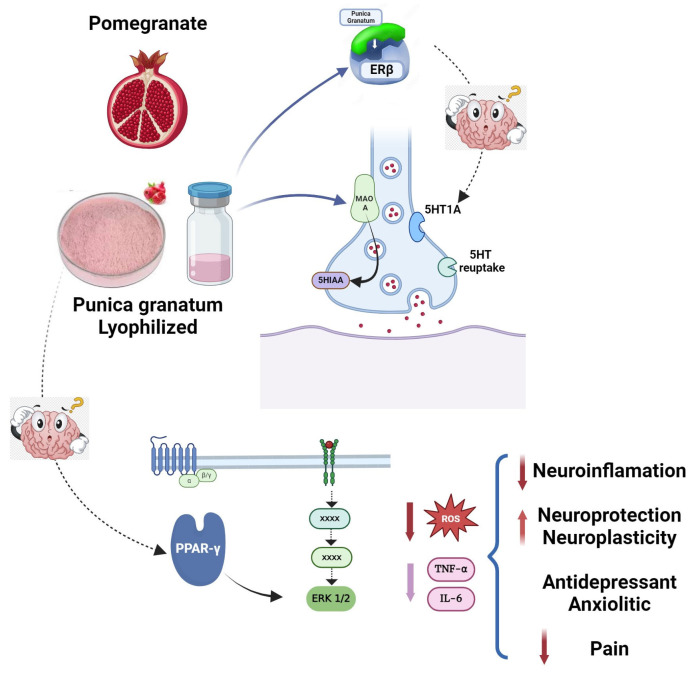
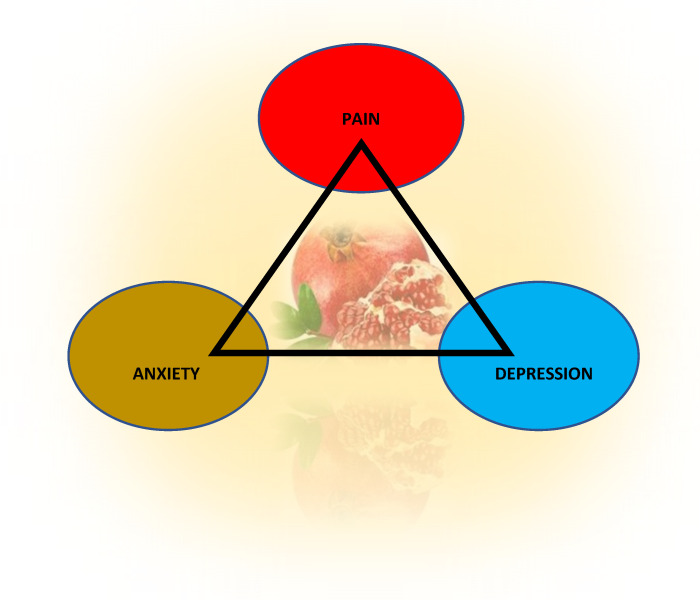
The pharmacological effects of pomegranates have been described considering metabolic aspects such as hypoglycemic and hypolipidemic activities. The pomegranate extract has activity on the central nervous system (CNS) as a natural antidepressant and anxiolytic. The chemical composition of pomegranates is complex since the bioactive compounds are multiple secondary metabolites that have been identified in the extracts derived from the peel, seed, flowers, leaves, or in their combination; so, it has not been easy to identify an individual compound as responsible for its observed pharmacological properties. From this point of view, the present review analyzes the effects of crude extracts or fractions of pomegranates and their possible mechanisms of action concerning antidepressant- and anxiolytic-like effects in animal models. Serotonin receptors, estrogen receptors, the peroxisome proliferator-activated receptor gamma (PPARγ), or monoamine oxidase enzymes, as well as potent antioxidant and neuroplasticity properties, have been described as possible mediators involved in the antidepressant- and anxiolytic-like behaviors after pomegranate treatment. The pharmacological effects observed on the CNS in experimental models associated with a specific stress level suggest that pomegranates could simultaneously modulate the stress response by activating several targets. For the present review, scientific evidence was gathered to integrate it and suggest a possible pathway for mediators to be involved in the mechanisms of action of the pomegranate's antidepressant- and anxiolytic-like effects. Furthermore, the potential benefits are discussed on comorbid conditions with anxiety and depression, such as perimenopause transition and pain.
石榴的药理作用已根据代谢方面进行了描述,如降血糖和降血脂活性。石榴提取物对中枢神经系统(CNS)具有天然抗抑郁和抗焦虑活性。石榴的化学成分很复杂,因为生物活性化合物是多种次生代谢产物,已在从果皮、种子、花朵、叶子或它们的组合中提取的提取物中鉴定出来;因此,很难确定是哪种单一化合物导致了其观察到的药理特性。从这个角度来看,本综述分析了石榴粗提物或馏分的作用及其在动物模型中产生抗抑郁和抗焦虑样作用的可能作用机制。血清素受体、雌激素受体、过氧化物酶体增殖物激活受体γ(PPARγ)或单胺氧化酶,以及强大的抗氧化和神经可塑性特性,已被描述为石榴治疗后参与抗抑郁和抗焦虑样行为的可能介质。在与特定应激水平相关的实验模型中,在中枢神经系统上观察到的药理作用表明,石榴可以通过激活多个靶点同时调节应激反应。在本综述中,收集了科学证据以进行整合,并提出介质参与石榴抗抑郁和抗焦虑样作用机制的可能途径。此外,还讨论了石榴对焦虑和抑郁共病状况(如围绝经期过渡和疼痛)的潜在益处。