Hammoudeh Yasmeen, Suresh Lakshmi, Ong Zun Zheng, Lister Michelle M, Mohammed Imran, Thomas D John I, Cottell Jennifer L, Holden Jennifer M, Said Dalia G, Dua Harminder S, Ting Darren Shu Jeng
Department of Ophthalmology, Queen's Medical Centre, Nottingham, United Kingdom.
New Cross Hospital Eye Infirmary, Wolverhampton, United Kingdom.
Front Med (Lausanne). 2024 Aug 12;11:1393832. doi: 10.3389/fmed.2024.1393832. eCollection 2024.
To compare the diagnostic performance of microbiological culture and 16S/18S rRNA gene polymerase chain reaction (PCR)-Sanger sequencing for infectious keratitis (IK) and to analyse the effect of clinical disease severity on test performance and inter-test concordance.
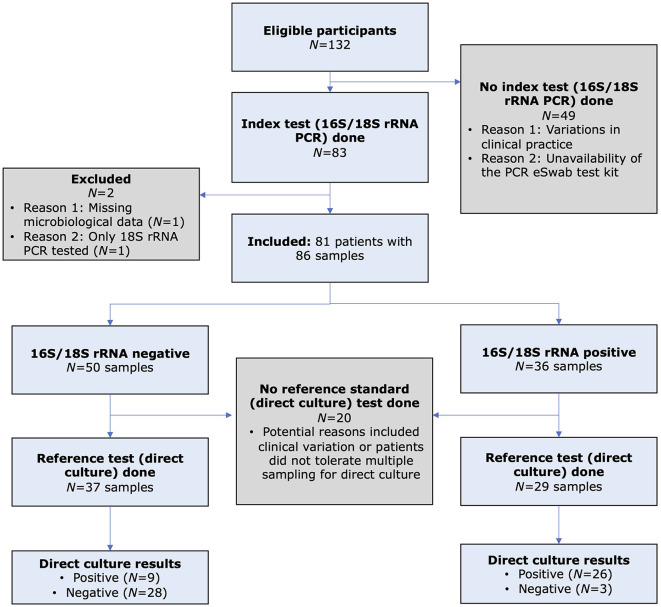
This was a three-arm, diagnostic cross-sectional study. We included all eligible patients who presented with presumed bacterial/fungal keratitis to the Queen's Medical Centre, Nottingham, UK, between June 2021 and September 2022. All patients underwent simultaneous culture (either direct or indirect culture, or both) and 16S (pan-bacterial)/18S (pan-fungal) ribosomal RNA (rRNA) PCR-Sanger sequencing. The bacterial/fungal genus and species identified on culture were confirmed using matrix-assisted laser desorption/ionization-time-of-flight mass spectrometry. Relevant clinical data were also collected to analyze for any potential clinico-microbiological correlation. Main outcome measures included the diagnostic yield, test accuracy (including sensitivity and specificity), and inter-test agreement [including percent agreement and Cohen's kappa ()].
A total of 81 patients (86 episodes of IK) were included in this study. All organisms identified were of bacterial origin. Diagnostic yields were similar among direct culture (52.3%), indirect culture (50.8%), and PCR (43.1%; = 0.13). The addition of PCR enabled a positive diagnostic yield in 3 (9.7%) direct culture-negative cases. Based on composite reference standard, direct culture had the highest sensitivity (87.5%; 95% CI, 72.4-95.3%), followed by indirect culture (85.4%; 95% CI, 71.6-93.5%) and PCR (73.5%; 95% CI, 59.0-84.6%), with 100% specificity noted in all tests. Pairwise comparisons showed substantial agreement among the three tests (percent agreement = 81.8-86.2%, Cohen's = 0.67-0.72). Clinico-microbiological correlation demonstrated higher culture-PCR concordance in cases with greater infection severity.
This study highlights a similar diagnostic performance of direct culture, indirect culture and 16S rRNA PCR for bacterial keratitis, with substantial inter-test concordance. PCR serves as a useful diagnostic adjuvant to culture, particularly in culture-negative cases or those with lesser disease severity (where culture-PCR concordance is lower).
比较微生物培养与16S/18S rRNA基因聚合酶链反应(PCR)-桑格测序对感染性角膜炎(IK)的诊断性能,并分析临床疾病严重程度对检测性能和检测间一致性的影响。
这是一项三臂诊断性横断面研究。我们纳入了2021年6月至2022年9月期间在英国诺丁汉女王医疗中心就诊的所有疑似细菌性/真菌性角膜炎的合格患者。所有患者同时接受培养(直接培养或间接培养,或两者皆有)以及16S(泛细菌)/18S(泛真菌)核糖体RNA(rRNA)PCR-桑格测序。使用基质辅助激光解吸/电离飞行时间质谱法确认培养物中鉴定出的细菌/真菌属和种。还收集了相关临床数据以分析任何潜在的临床-微生物学相关性。主要结局指标包括诊断率、检测准确性(包括敏感性和特异性)以及检测间一致性[包括一致性百分比和科恩kappa系数(κ)]。
本研究共纳入81例患者(86次IK发作)。所有鉴定出的病原体均为细菌来源。直接培养(52.3%)、间接培养(50.8%)和PCR(43.1%;P = 0.13)的诊断率相似。PCR的加入使3例(9.7%)直接培养阴性病例获得了阳性诊断结果。基于综合参考标准,直接培养的敏感性最高(87.5%;95%CI,72.4 - 95.3%),其次是间接培养(85.4%;95%CI,71.6 - 93.5%)和PCR(73.5%;95%CI,59.0 - 84.6%),所有检测的特异性均为100%。两两比较显示三项检测之间具有高度一致性(一致性百分比 = 81.8 - 86.2%,科恩κ系数 = 0.67 - 0.72)。临床-微生物学相关性表明,在感染严重程度较高的病例中,培养与PCR的一致性更高。
本研究强调了直接培养、间接培养和16S rRNA PCR对细菌性角膜炎的诊断性能相似,检测间具有高度一致性。PCR可作为培养的有用诊断辅助手段,特别是在培养阴性的病例或疾病严重程度较低的病例中(培养与PCR的一致性较低)。