Hu Mengdie, Nitsche Michael A, Lv Yanxin, Han Hairong, Lin Xu, Qi Fengxue
School of Sports Medicine and Rehabilitation, Beijing Sport University, Beijing, China.
Department of Psychology and Neurosciences, Leibniz Research Center for Working Environment and Human Factors, Dortmund, Germany.
Front Hum Neurosci. 2024 Aug 13;18:1436448. doi: 10.3389/fnhum.2024.1436448. eCollection 2024.
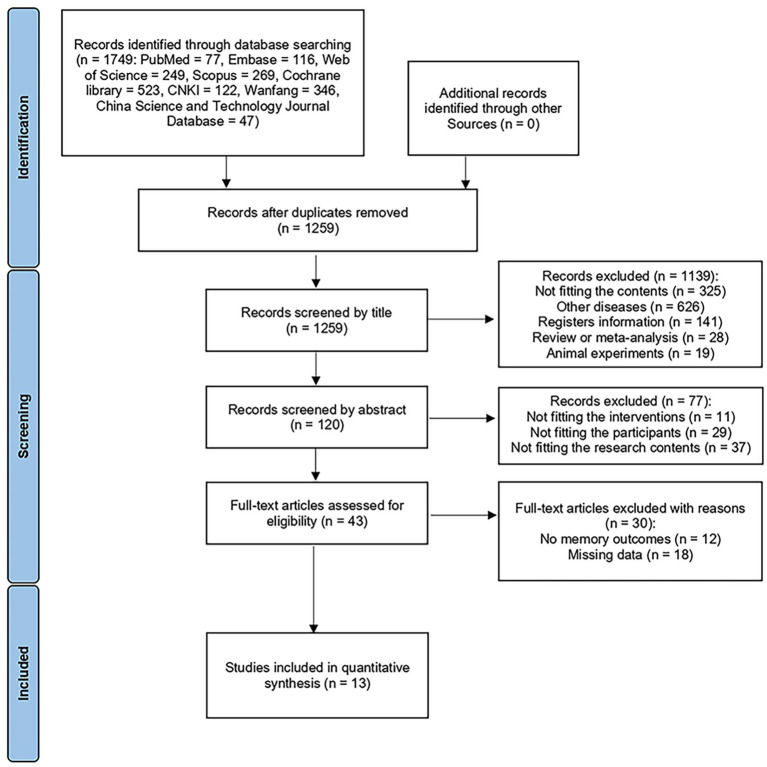
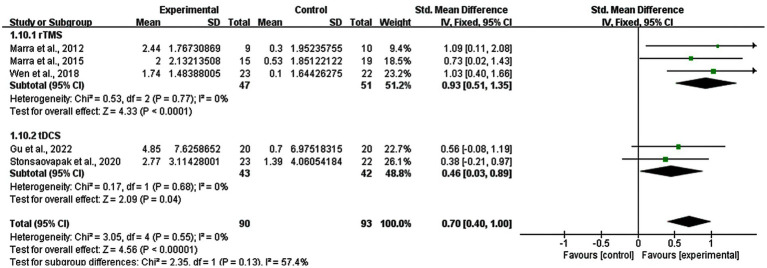
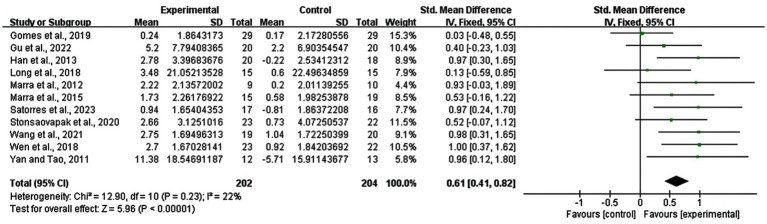
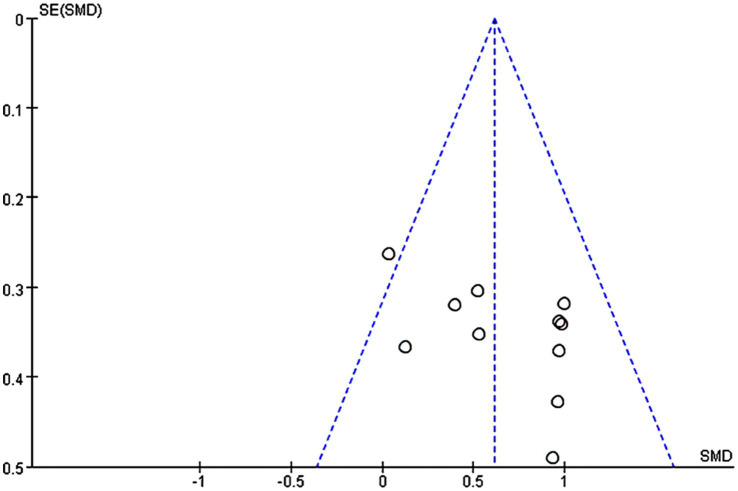
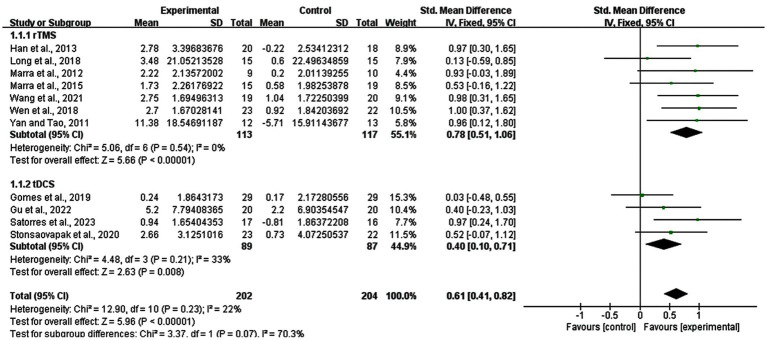
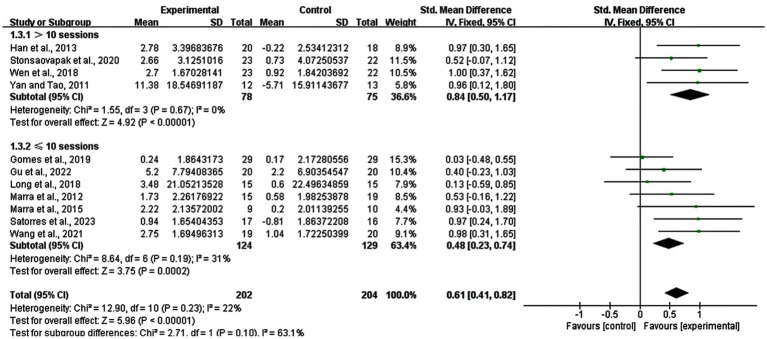
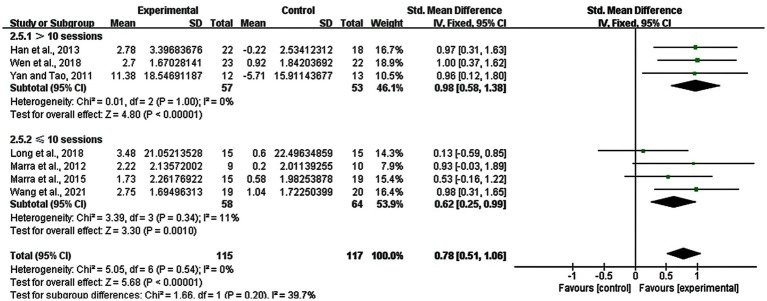
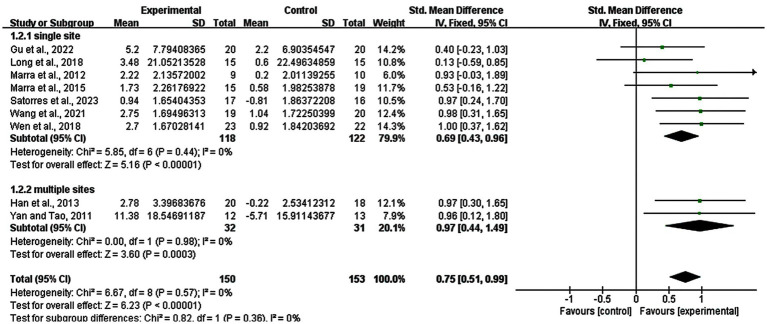
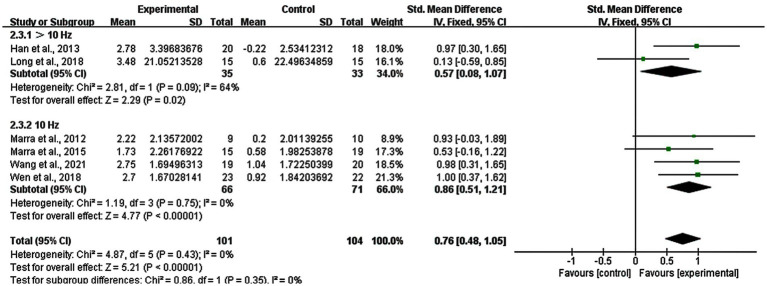
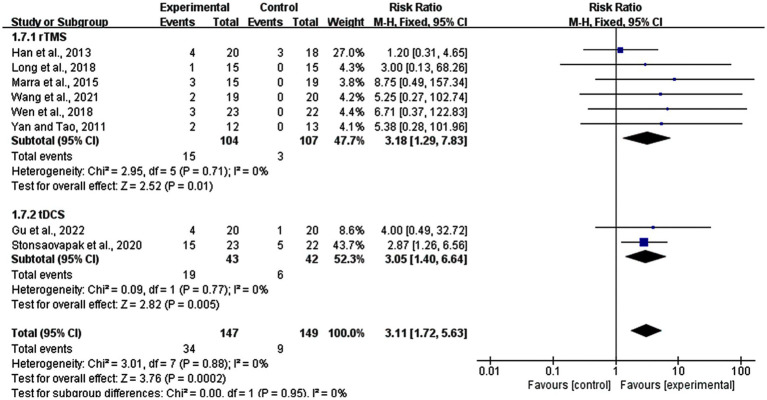
Mild cognitive impairment (MCI) is a condition that impairs activities of daily living, and often transforms to dementia. Repetitive transcranial magnetic stimulation (rTMS) and transcranial direct current stimulation (tDCS) show promise in improving cognitive functions in MCI patients. In this meta-analysis, we aimed to compare the effects of rTMS and tDCS on memory functions in MCI patients. We explored eight databases from their inception to March 16, 2024. We obtained 11 studies with 406 patients with MCI. We used the standardized mean difference (SMD) with a 95% confidence interval (CI) to synthesize the effect size. rTMS and tDCS significantly improved memory functions in MCI patients (SMD = 0.61; 95% CI: 0.41-0.82; < 0.00001; I = 22%). In subgroup analysis of number of stimulation sessions, both rTMS and tDCS over 10 sessions (SMD = 0.84; 95% CI: 0.50-1.17, < 0.00001, I = 0%) significantly improved the memory function in MCI patients. The subgroup analyses on different stimulation types (SMD = 0.78; 95% CI: 0.51-1.06; < 0.00001; I = 0%) and treatment persistent effects (SMD = 0.93; 95% CI: 0.51-1.35, < 0.0001, I = 0%) showed that rTMS was more effective than tDCS. rTMS with a stimulation frequency of 10 Hz (SMD = 0.86; 95% CI: 0.51-1.21; < 0.00001; I = 0%) and over 10 sessions (SMD = 0.98; 95% CI: 0.58-1.38; < 0.00001; I = 0%) at multiple sites (SMD = 0.97; 95% CI: 0.44-1.49; = 0.0003; I = 0%) showed a great improvement in the memory performance of patients with MCI. rTMS was more likely to appear temporary side effects (risk ratio (RR) = 3.18, 95% CI: 1.29-7.83, = 0.01). This meta-analysis suggests that rTMS and tDCS are safe and efficient tools to improve memory functions in patients with MCI, while rTMS had a larger effect than tDCS. rTMS with a stimulation frequency of 10 Hz targeted on multiple sites over 10 sessions showed the greatest effect. We could not conclude parameters of tDCS because of insufficient data.
https://www.crd.york.ac.uk/prospero/display_record.php?ID=CRD42024558991.
轻度认知障碍(MCI)是一种会损害日常生活活动能力的病症,且常常会转变为痴呆症。重复经颅磁刺激(rTMS)和经颅直流电刺激(tDCS)在改善MCI患者的认知功能方面显示出前景。在这项荟萃分析中,我们旨在比较rTMS和tDCS对MCI患者记忆功能的影响。我们检索了从建库至2024年3月16日的八个数据库。我们获得了11项研究,涉及406例MCI患者。我们使用标准化均数差(SMD)及95%置信区间(CI)来综合效应量。rTMS和tDCS显著改善了MCI患者的记忆功能(SMD = 0.61;95% CI:0.41 - 0.82;P < 0.00001;I² = 22%)。在刺激次数的亚组分析中,rTMS和tDCS超过10次(SMD = 0.84;95% CI:0.50 - 1.17,P < 0.00001,I² = 0%)均显著改善了MCI患者的记忆功能。不同刺激类型的亚组分析(SMD = 0.78;95% CI:0.51 - 1.06;P < 0.00001;I² = 0%)以及治疗持续效应的亚组分析(SMD = 0.93;95% CI:0.51 - 1.35,P < 0.0001,I² = 0%)表明,rTMS比tDCS更有效。刺激频率为10Hz的rTMS(SMD = 0.86;95% CI:0.51 - 1.21;P < 0.00001;I² = 0%)、超过10次的rTMS(SMD = 0.98;95% CI:0.58 - 1.38;P < 0.00001;I² = 0%)以及多部位的rTMS(SMD = 0.97;95% CI:0.44 - 1.49;P = 0.0003;I² = 0%)均显示MCI患者的记忆表现有显著改善。rTMS更易出现短暂的副作用(风险比(RR)= 3.18,95% CI:1.29 - 7.83,P = 0.01)。这项荟萃分析表明,rTMS和tDCS是改善MCI患者记忆功能的安全有效工具,而rTMS的效果比tDCS更大。刺激频率为10Hz、多部位、超过10次的rTMS效果最佳。由于数据不足,我们无法得出tDCS的参数。
https://www.crd.york.ac.uk/prospero/display_record.php?ID=CRD42024558991。