Bettcher Brianne M, Lopez Paniagua Dan, Wang Yue, McConnell Brice V, Coughlan Christina, Carlisle Tara C, Thaker Ashesh A, Lippitt William, Filley Christopher M, Pelak Victoria S, Shapiro Allison L B, Heffernan Kate S, Potter Huntington, Solano Adriana, Boyd Jada, Carlson Nichole E
Department of Neurology, Behavioral Neurology Section, University of Colorado Anschutz Medical Campus, Aurora, CO, USA.
Department of Radiology, University of Colorado Anschutz Medical Campus, Aurora, CO, USA.
Brain Behav Immun Health. 2024 Aug 3;40:100834. doi: 10.1016/j.bbih.2024.100834. eCollection 2024 Oct.
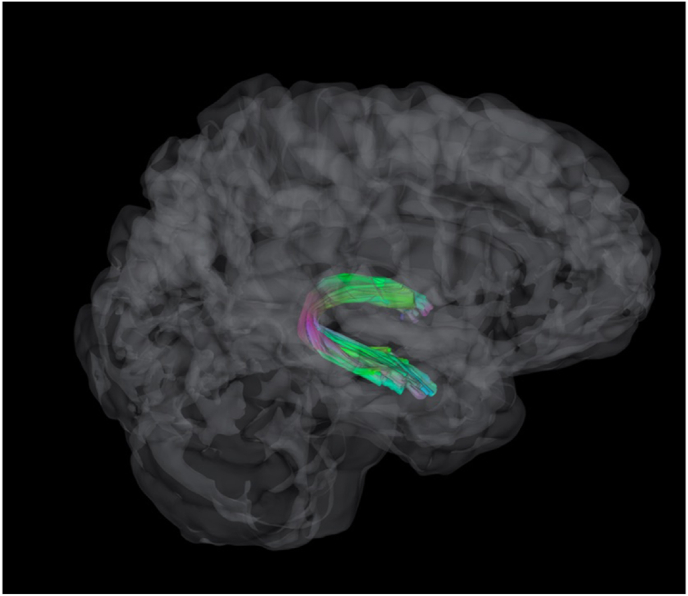
Plasma glial fibrillary acidic protein (GFAP), an astrocytic biomarker, has previously been linked with Alzheimer's disease (AD) status, amyloid levels, and memory performance in older adults. The neuroanatomical pathways by which astrogliosis/astrocyte reactivity might impact cognitive outcomes remains unclear. We evaluated whether plasma GFAP and amyloid levels had a synergistic effect on fornix structure, which is critically involved in AD-associated cholinergic pathways. We also examined whether fornix structure mediates associations between GFAP and verbal memory.
In a cohort of both asymptomatic and symptomatic older adults (total n = 99), we assessed plasma GFAP, amyloid-β42 (Aβ42), other AD-related proteins, and vascular markers, and we conducted comprehensive memory testing. Tractography-based methods were used to assess fornix structure with whole brain diffusion metrics to control for diffuse alterations in brain white matter.
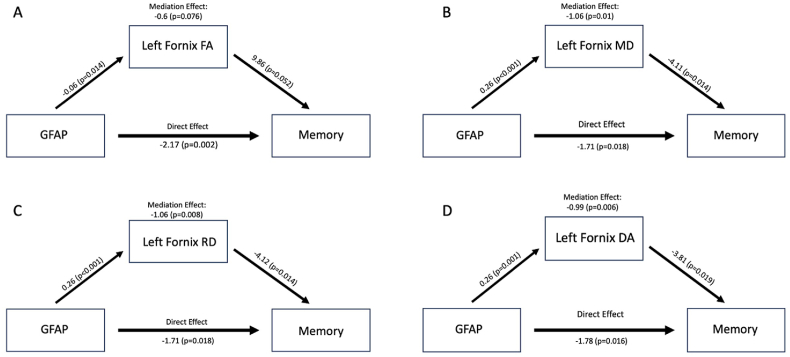
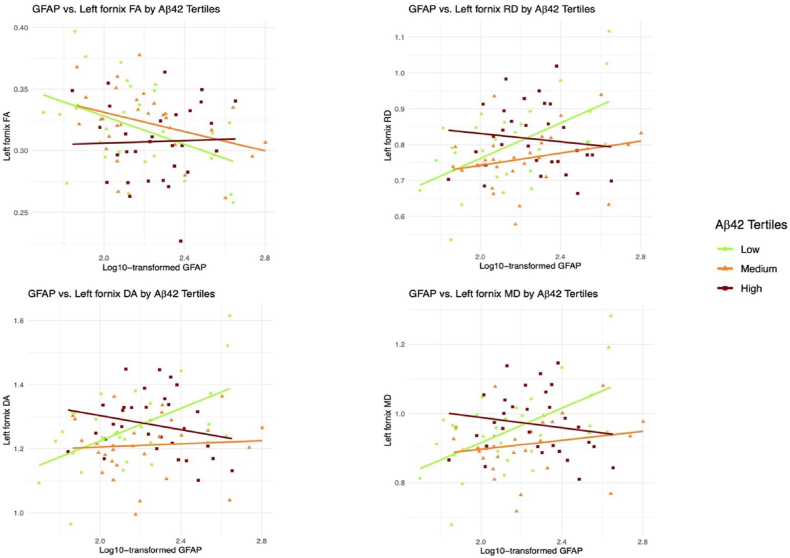
In individuals in the low plasma amyloid-β42 (Aβ42) group, higher plasma GFAP was associated with lower fractional anisotropy (FA; = 0.007), higher mean diffusivity (MD; < 0.001), higher radial diffusivity (RD; < 0.001), and higher axial diffusivity (DA; = 0.001) in the left fornix. These associations were independent of gene status, plasma levels of total tau and neurofilament light, plasma vascular biomarkers, and whole brain diffusion metrics. In a sub-analysis of participants in the low plasma Aβ42 group (n = 33), fornix structure mediated the association between higher plasma GFAP levels and lower verbal memory performance.
Higher plasma GFAP was associated with altered fornix microstructure in the setting of greater amyloid deposition. We also expanded on our prior GFAP-verbal memory findings by demonstrating that in the low plasma Aβ42 group, left fornix integrity may be a primary white matter conduit for the negative associations between GFAP and verbal memory performance. Overall, these findings suggest that astrogliosis/astrocyte reactivity may play an early, pivotal role in AD pathogenesis, and further demonstrate that high GFAP and low Aβ42 in plasma may reflect a particularly detrimental synergistic role in forniceal-memory pathways.
血浆胶质纤维酸性蛋白(GFAP)是一种星形胶质细胞生物标志物,此前已与老年人的阿尔茨海默病(AD)状态、淀粉样蛋白水平和记忆表现相关联。星形胶质细胞增生/星形胶质细胞反应性可能影响认知结果的神经解剖学途径仍不清楚。我们评估了血浆GFAP和淀粉样蛋白水平是否对穹窿结构有协同作用,而穹窿结构在AD相关胆碱能途径中起关键作用。我们还研究了穹窿结构是否介导了GFAP与言语记忆之间的关联。
在一组无症状和有症状的老年人(共99名)中,我们评估了血浆GFAP、淀粉样β蛋白42(Aβ42)、其他AD相关蛋白和血管标志物,并进行了全面的记忆测试。基于纤维束成像的方法用于通过全脑扩散指标评估穹窿结构,以控制脑白质的弥漫性改变。
在血浆淀粉样β蛋白42(Aβ42)水平较低的个体中,较高的血浆GFAP与左侧穹窿较低的分数各向异性(FA; = 0.007)、较高的平均扩散率(MD; < 0.001)、较高的径向扩散率(RD; < 0.001)和较高的轴向扩散率(DA; = 0.001)相关。这些关联独立于基因状态、总tau和神经丝轻链的血浆水平、血浆血管生物标志物以及全脑扩散指标。在血浆Aβ42水平较低的参与者(n = 33)的亚分析中,穹窿结构介导了较高的血浆GFAP水平与较低的言语记忆表现之间的关联。
在淀粉样蛋白沉积较多的情况下,较高的血浆GFAP与穹窿微结构改变相关。我们还扩展了之前关于GFAP与言语记忆的研究结果,表明在血浆Aβ42水平较低的组中,左侧穹窿完整性可能是GFAP与言语记忆表现之间负相关的主要白质通道。总体而言,这些发现表明星形胶质细胞增生/星形胶质细胞反应性可能在AD发病机制中起早期关键作用,并进一步证明血浆中高GFAP和低Aβ42可能在穹窿-记忆途径中反映出特别有害的协同作用。