Department of Paediatrics and Adolescent Medicine, The University of Hong Kong, Hong Kong, People's Republic of China.
Department of Pathology, Hong Kong Children's Hospital, Hong Kong, People's Republic of China.
BMJ Paediatr Open. 2024 Aug 28;8(1):e002736. doi: 10.1136/bmjpo-2024-002736.
Reticulocyte haemoglobin equivalent (RET-He) is a useful tool for evaluating recent iron usage irrespective of inflammatory status. This study aims to establish a reference for RET-He among Hong Kong healthy children under the age of 5 years and to investigate the association between RET-He and various blood parameters.
A total of 946 children aged 2-48 months from July 2019 to December 2022 were recruited in this cross-sectional study. The RET-He and other haematological parameters were measured by the haematology analyser from Sysmex XN-9100/XN-1500. The ferritin test was performed with the electrochemiluminescence immunoassay. Interval 2.5th percentile to 97.5th percentile represented the normal RET-He ranges. Linear multiple regression analysis was performed to examine the relation between RET-He and various blood parameters. Receiver-operating characteristic curve analysis revealed the sensitivity and specificity of RET-He in identifying iron deficiency.
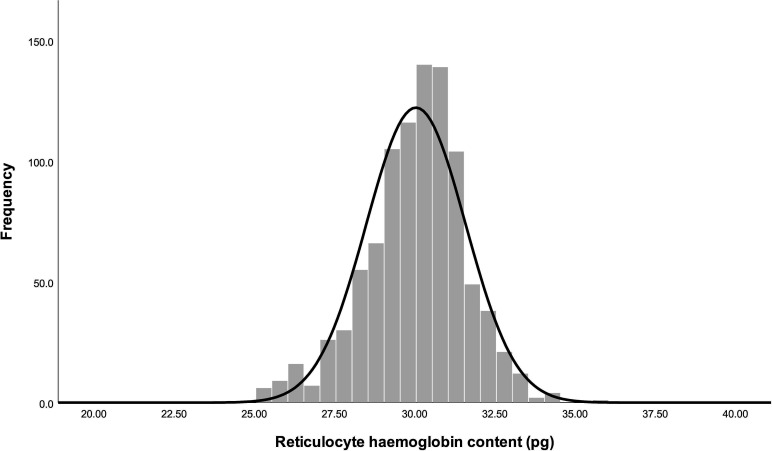
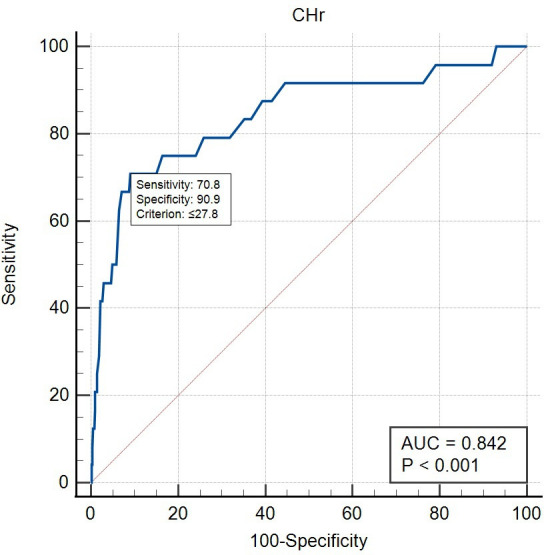
The RET-He in the study population was approximately normally distributed. The age-specific lower limit of RET-He ranges from 25.81 pg (25-36 months) to 27.15 pg (13-24 months). RET-He was found to be lower in the age group 2-6 months (mean=29.47 pg) and 7-12 months (mean=29.41 pg). Changes in RET-He and haemoglobin in relation to age were observed in both sexes (both p<0.001). RET-He was influenced by age, some red blood cell parameters and reticulocyte concentrations (all p<0.05). A cut-off value of RET-He ≤27.8 pg was determined for identifying iron deficiency.
RET-He levels varied with age, with a relatively lower level in infants than in other age groups. The value below the age-specific lower limit of the reference range of RET-He can be used as a limit for preliminary iron-deficiency screening.
网织红细胞血红蛋白含量(RET-He)是一种评估近期铁利用情况的有用工具,无论炎症状态如何。本研究旨在建立香港 5 岁以下健康儿童的 RET-He 参考范围,并探讨 RET-He 与各种血液参数之间的关系。
本横断面研究共纳入 2019 年 7 月至 2022 年 12 月期间 946 名 2-48 月龄的儿童。采用 Sysmex XN-9100/XN-1500 血液分析仪检测 RET-He 和其他血液参数。采用电化学发光免疫分析法检测铁蛋白。2.5%到 97.5%的区间代表正常的 RET-He 范围。采用线性多元回归分析来检验 RET-He 与各种血液参数之间的关系。采用受试者工作特征曲线分析来确定 RET-He 识别缺铁的灵敏度和特异性。
研究人群的 RET-He 呈近似正态分布。特定年龄的 RET-He 下限范围为 25.81pg(25-36 个月)至 27.15pg(13-24 个月)。2-6 个月(均值=29.47pg)和 7-12 个月(均值=29.41pg)龄组的 RET-He 较低。男女两性的 RET-He 和血红蛋白都随年龄而变化(均 p<0.001)。RET-He 受年龄、一些红细胞参数和网织红细胞浓度的影响(均 p<0.05)。确定 RET-He≤27.8pg 作为识别缺铁的截断值。
RET-He 水平随年龄而变化,婴儿期水平相对较低。参考范围的特定年龄下限以下的值可作为初步缺铁筛查的界限。