Department of Orthopaedic Surgery, Kawaguchi Kogyo General Hospital, Saitama, 332-0031, Japan.
Department of Joint Surgery and Sports Medicine, Graduate School of Medical and Dental Sciences, Tokyo Medical and Dental University, 1-5-45 Yushima, Bunkyo-ku, Tokyo, 113-8519, Japan.
BMC Musculoskelet Disord. 2024 Aug 29;25(1):674. doi: 10.1186/s12891-024-07737-y.
Fibrosis of the infrapatellar fat pad (IFP) is a feature of osteoarthritis and contributes substantially to the pain and dysfunction in patients' joints. However, the underlying mechanisms remain unclear. C-C motif chemokine ligand-2 (CCL2) plays a central role in tissue fibrosis. Thus, we aimed to investigate the role of CCL2 in the development of IFP fibrosis in a rat model of arthritis, hypothesizing that a CCL2 antagonist could mitigate fibrotic progression.
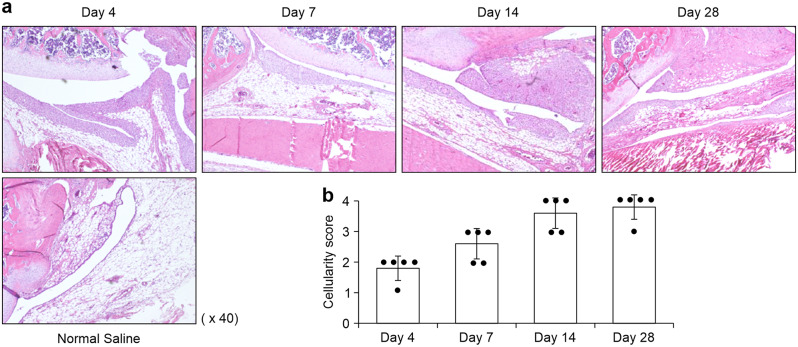
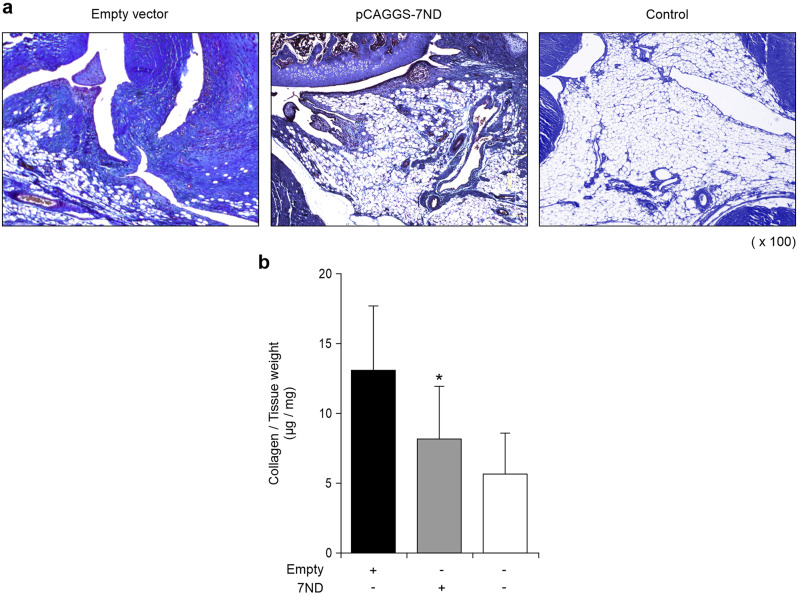
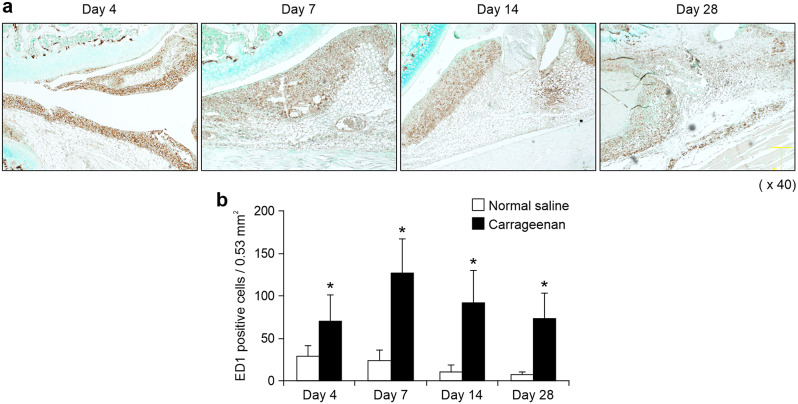
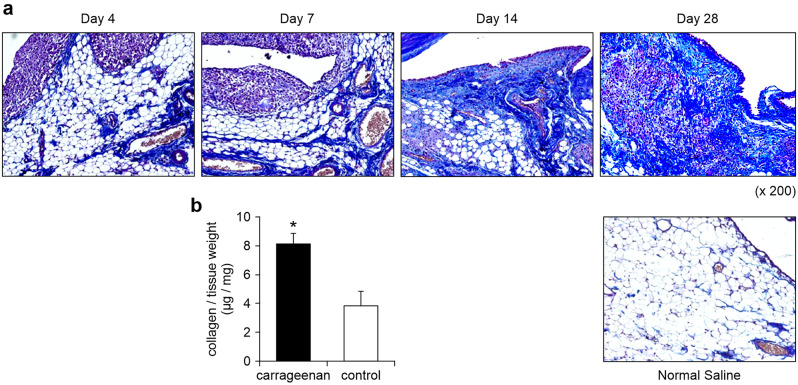
We induced arthritis in male Wistar rats using intra-articular injections of carrageenan. Furthermore, to evaluate the effects of a CCL2 antagonist on protein expression and collagen deposition in the IFP of the rats, we transferred an N-terminal-truncated CCL2 gene into a rat model via electroporation-mediated intramuscular injection. Macrophage infiltration and collagen deposition in the IFP were analyzed in vivo. Groups were compared using the Mann-Whitney U test and Student's t-test.
We identified infiltrating macrophages as well as increases in CCL2 and TGF-β levels as collagen deposition progressed. Gene transfer of the CCL2-antagonist before arthritis induction attenuated collagen deposition remarkably.
We provide initial evidence that anti-CCL2 gene therapy can effectively suppress the development of IFP fibrosis in a rat model. Thus, targeting CCL2 holds promise as a therapeutic strategy for managing tissue fibrosis in osteoarthritis patients.
髌下脂肪垫(IFP)纤维化是骨关节炎的一个特征,它会导致患者关节疼痛和功能障碍。然而,其潜在机制尚不清楚。C-C 基序趋化因子配体 2(CCL2)在组织纤维化中起着核心作用。因此,我们旨在研究 CCL2 在关节炎大鼠模型中 IFP 纤维化发展中的作用,假设 CCL2 拮抗剂可能会减轻纤维化的进展。
我们通过关节内注射角叉菜胶诱导雄性 Wistar 大鼠关节炎。此外,为了评估 CCL2 拮抗剂对大鼠 IFP 中蛋白表达和胶原沉积的影响,我们通过电穿孔介导的肌肉内注射将 N 端截断的 CCL2 基因转染到大鼠模型中。体内分析 IFP 中的巨噬细胞浸润和胶原沉积。使用曼-惠特尼 U 检验和学生 t 检验比较组间差异。
我们发现随着胶原沉积的进展,有浸润的巨噬细胞和 CCL2、TGF-β水平的增加。关节炎诱导前 CCL2-拮抗剂的基因转移显著减轻了胶原沉积。
我们提供了初步证据,表明抗 CCL2 基因治疗可以有效抑制大鼠模型中 IFP 纤维化的发展。因此,靶向 CCL2 作为骨关节炎患者组织纤维化的治疗策略具有很大的潜力。