Koch-Nolte Friedrich
Institute of Immunology, University Medical Center Hamburg-Eppendorf, Hamburg, Germany.
Immunol Rev. 2024 Nov;328(1):466-472. doi: 10.1111/imr.13385. Epub 2024 Aug 30.
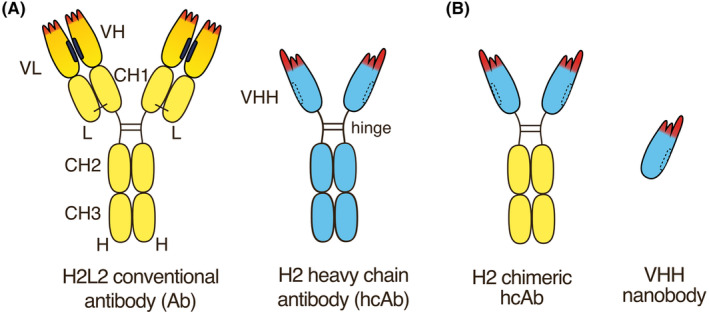
Nanobodies are the products of an intriguing invention in the evolution of immunoglobulins. This invention can be traced back approximately 45 million years to the common ancestor of extant dromedaries, camels, llamas, and alpacas. Next to conventional heterotetrameric H2L2 antibodies, these camelids produce homodimeric nanobody-based heavy chain antibodies, composed of shortened heavy chains that a lack the CH1 domain. Nanobodies against human target antigens are derived from immunized animals and/or synthetic nanobody libraries. As a robust, highly soluble, single immunoglobulin domain, a nanobody can easily be fused to another protein, for example to another nanobody and/or the hinge and constant domains of other immunoglobulins. Nanobody-derived heavy chain antibodies hold promise as a new form of immunotherapeutics.
纳米抗体是免疫球蛋白进化过程中一项有趣发明的产物。这项发明可追溯到大约4500万年前现存单峰骆驼、骆驼、美洲驼和羊驼的共同祖先。除了传统的异源四聚体H2L2抗体外,这些骆驼科动物还产生基于纳米抗体的同型二聚体重链抗体,由缺少CH1结构域的缩短重链组成。针对人类靶抗原的纳米抗体源自免疫动物和/或合成纳米抗体文库。作为一种强大、高度可溶的单一免疫球蛋白结构域,纳米抗体可以很容易地与另一种蛋白质融合,例如与另一种纳米抗体和/或其他免疫球蛋白的铰链区和恒定区融合。源自纳米抗体的重链抗体有望成为一种新型免疫疗法。