Deptartment of Radiology, University Medical Center Hamburg-Eppendorf, Hamburg, Germany.
Institute of Immunology University, Medical Center Hamburg-Eppendorf, Hamburg, Germany.
Front Immunol. 2018 Nov 6;9:2559. doi: 10.3389/fimmu.2018.02559. eCollection 2018.
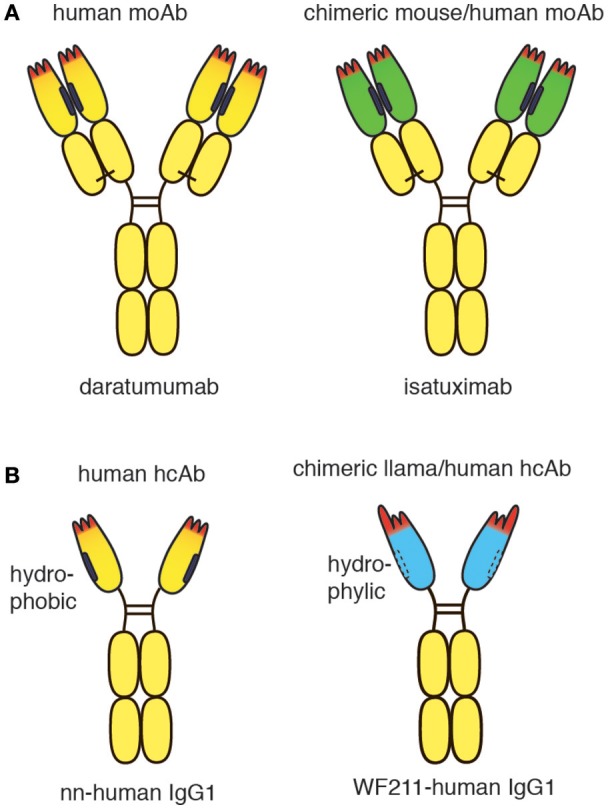
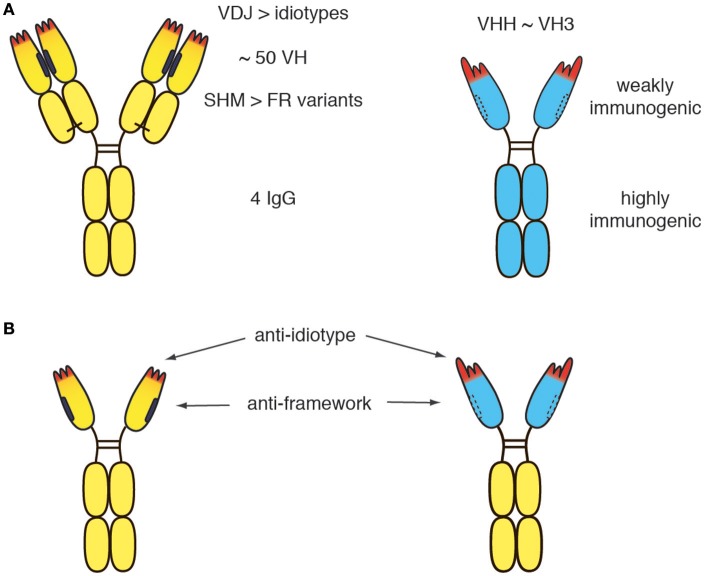
The NAD-metabolizing ectoenzyme CD38 is an established therapeutic target in multiple myeloma. The CD38-specific monoclonal antibodies daratumumab and isatuximab show promising results in the clinic. Nanobodies correspond to the single variable domains (VHH) derived from heavy chain antibodies that naturally occur in camelids. VHHs display high solubility and excellent tissue penetration . We recently generated a panel of CD38-specific nanobodies, some of which block or enhance the enzymatic activity of CD38. Fusion of such a nanobody to the hinge, CH2, and CH3 domains of human IgG1 generates a chimeric llama/human hcAb of about half the size of a conventional moAb (75 vs. 150 kDa). Similarly, a fully human CD38-specific hcAb can be generated using a CD38-specific human VH3 instead of a CD38-specific camelid nanobody. Here we discuss the advantages and disadvantages of CD38-specific hcAbs vs. conventional moAbs and provide an outlook for the potential use of CD38-specific hcAbs as novel therapeutics for multiple myeloma.
NAD 代谢型细胞外酶 CD38 是多发性骨髓瘤的既定治疗靶点。CD38 特异性单克隆抗体达雷妥尤单抗和伊沙妥昔单抗在临床上显示出良好的效果。纳米抗体对应于重链抗体中天然存在的单可变结构域 (VHH)。VHH 具有高溶解性和出色的组织穿透性。我们最近生成了一组 CD38 特异性纳米抗体,其中一些可阻断或增强 CD38 的酶活性。将这种纳米抗体与人类 IgG1 的铰链、CH2 和 CH3 结构域融合,可产生一种大小约为传统单克隆抗体一半的嵌合骆驼/人 hcAb(75 kDa 对 150 kDa)。同样,使用 CD38 特异性人 VH3 而不是 CD38 特异性骆驼纳米抗体,也可以生成完全人源 CD38 特异性 hcAb。本文讨论了 CD38 特异性 hcAb 与传统单克隆抗体相比的优缺点,并对 CD38 特异性 hcAb 作为多发性骨髓瘤新型治疗药物的潜在用途进行了展望。