Lundquist Institute for Biomedical Innovation, Harbor-University of California at Los Angeles (UCLA) Medical Center, Torrance, CA 90502, USA; Department of Obstetrics and Gynecology, David Geffen School of Medicine at UCLA and Harbor-UCLA Medical Center, Torrance, CA 90502, USA.
J Integr Med. 2024 Sep;22(5):515-522. doi: 10.1016/j.joim.2024.07.001. Epub 2024 Jul 5.
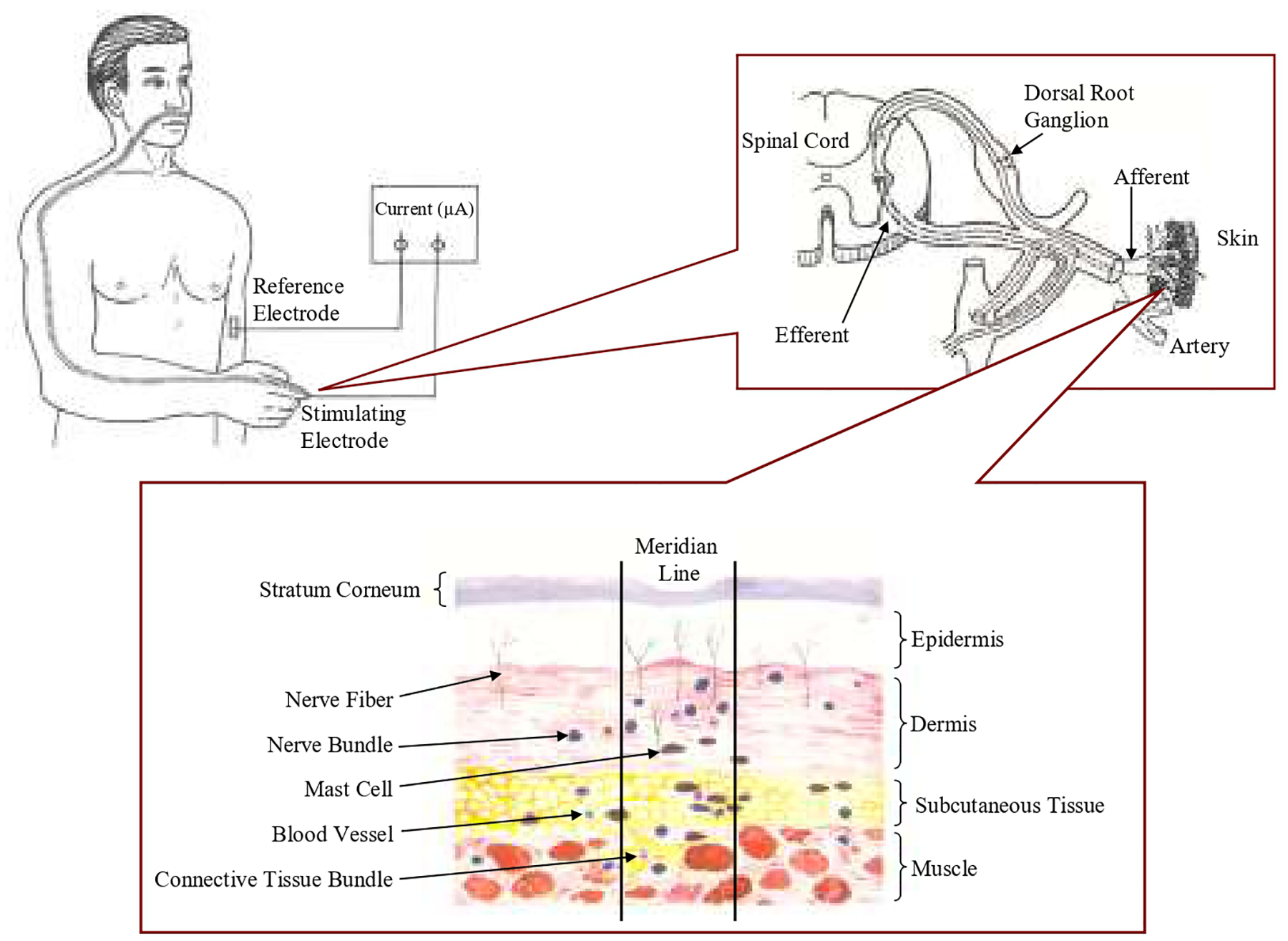
Numerous studies from different international groups have demonstrated that sensations can be propagated along acupuncture channel pathways. The propagated sensation along the channel pathway (PSCP) can be elicited by electroacupuncture (EA), transcutaneous electrical nerve stimulation (TENS), manual acupuncture (MA), and heat applied to distal acupuncture points (acupoints). Nitric oxide (NO) levels were reported to be elevated in the gracile nucleus and skin regions near to the EA sites, with higher levels at acupoints associated with an enhanced expression of NO synthase and transient receptor potential vanilloid type 1. The stimuli, EA, MA, TENS, and heat, have been used to elicit axonal reflexes, which increase local release of NO and neuropeptides such as calcitonin gene related peptide. Furthermore, the sensation of PSCP along the body surface occurs only ipsilaterally to the stimulated acupoints in various human studies, which does not support the involvement of the spinal-thalamic pathway, which would involve cross over transmission of the signals. The gracile nucleus receives ascending input from the sciatic nerve and responds to somatosensory stimulation mainly on the ipsilateral side via the dorsal column pathway. EA at Zusanli (ST36) increases NO release and expression of NO synthase mainly in the ipsilateral side of the gracile nucleus, while the cardiovascular effects and analgesic responses to EA at ST36 are changed by influences of l-arginine-derived NO synthesis in the ipsilateral gracile nucleus in rats. The stimuli-induced release of NOergic molecules and neuropeptides exist high levels in the acupoints, which contain rich neuronal components and blood vessels. Enhanced NOergic molecules at acupoints cause axon reflexes during the stimuli, which elevate cutaneous blood flow. Elevated NOergic molecules and local blood flow may spread over acupoints one after another along the meridian lines differing from nerve pathways following the stimuli to induce PSCP. The same types of stimulation also elicit NO release in the gracile nucleus, which contributes to the somatosensory signal transduction of PSCP through the dorsal medulla-thalamic pathways. Other substances such as serotonin and catecholamines are proposed to mediate responses and certain effects of acupuncture-like stimulation but their mechanisms are poorly-understood. In this review we summarize the current understanding of the neurobiological processes of PSCP research with an emphasis on recent developments of NO mediating stimulation-evoked axon reflexes and somatosensory signal transduction for PSCP perceptions through the dorsal medulla-thalamic pathways. Please cite this article as: Ma SX. Stimuli-evoked NOergic molecules and neuropeptides at acupuncture points and gracile nucleus contribute to signal transduction of propagated sensation along the meridian through the dorsal medulla-thalamic pathways. J Integr Med. 2024; 22(5): 515-522.
许多来自不同国际团队的研究表明,感觉可以沿着针灸通道路径传播。沿着通道路径传播的感觉(PSCP)可以通过电针(EA)、经皮神经电刺激(TENS)、手动针灸(MA)和施加在远端针灸点(针灸点)的热量来引出。据报道,在 EA 部位附近的薄束核和皮肤区域,一氧化氮(NO)水平升高,与增强的 NO 合酶和瞬时受体电位香草醛 1 表达相关的穴位处水平更高。刺激物,EA、MA、TENS 和热量,已被用于引出轴突反射,这会增加局部 NO 和降钙素基因相关肽等神经肽的释放。此外,在各种人体研究中,PSCP 仅在受刺激穴位的同侧体表出现,这并不支持涉及信号交叉传输的脊髓-丘脑通路的参与。薄束核通过背柱通路从坐骨神经接收上行输入,并主要通过对侧侧响应躯体感觉刺激。EA 在足三里(ST36)主要增加同侧薄束核中 NO 的释放和 NO 合酶的表达,而在大鼠中,ST36 的 EA 对心血管效应和镇痛反应的影响受同侧薄束核中 l-精氨酸衍生的 NO 合成的影响。刺激诱导的 NO 能分子和神经肽的释放在穴位中存在高水平,穴位中含有丰富的神经元成分和血管。刺激期间穴位中增强的 NO 能分子引起轴突反射,增加皮肤血流量。升高的 NO 能分子和局部血流可能沿着与刺激后沿神经通路不同的经络线一个接一个地在穴位之间扩散,以诱导 PSCP。相同类型的刺激也会在薄束核中引起 NO 的释放,这有助于通过背髓-丘脑通路进行 PSCP 的体感信号转导。其他物质,如血清素和儿茶酚胺,被提议介导针刺样刺激的反应和某些作用,但它们的机制了解甚少。在这篇综述中,我们总结了 PSCP 研究的神经生物学过程的当前理解,重点是最近关于通过背髓-丘脑通路进行 PSCP 感知的 NO 介导刺激诱发的轴突反射和体感信号转导的发展。请引用本文:马 SX。穴位和薄束核中的刺激诱导的 NO 能分子和神经肽有助于通过背髓-丘脑通路沿经络传递传播感觉的信号转导。J 整合医学。2024;22(5):515-522.