Centro Nacional de Investigaciones Cardiovasculares, Madrid, Spain.
CIBER de Enfermedades Cardiovasculares, Madrid, Spain.
Nat Med. 2024 Oct;30(10):2857-2866. doi: 10.1038/s41591-024-03213-1. Epub 2024 Aug 30.
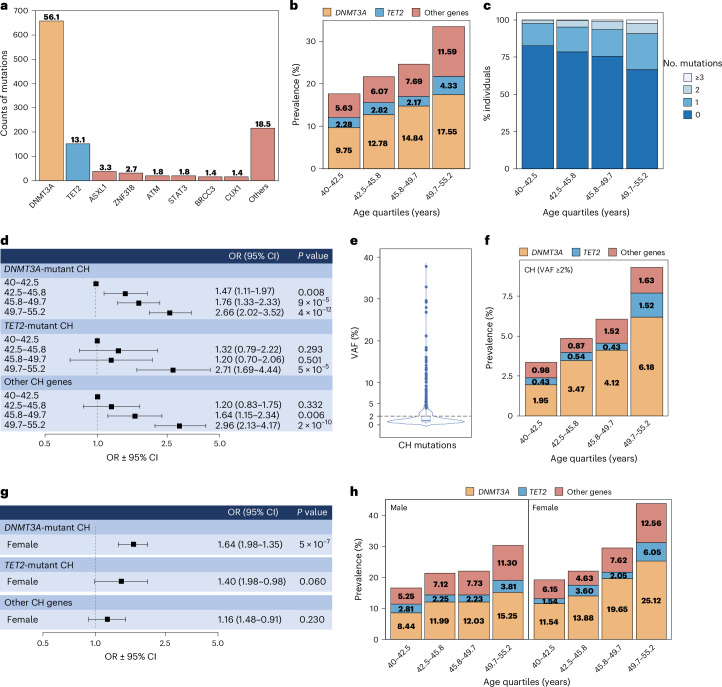
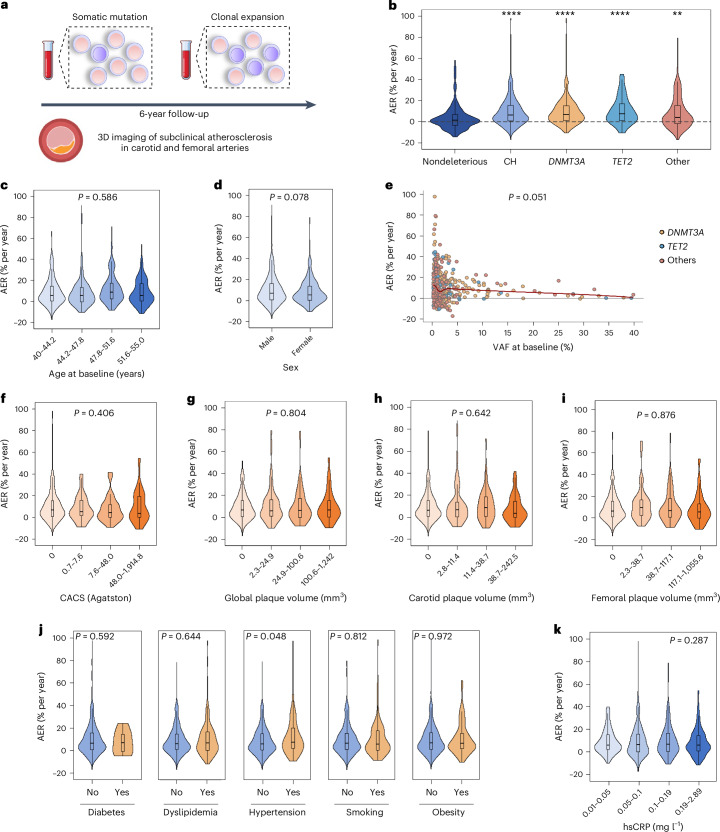
Clonal hematopoiesis, a condition in which acquired somatic mutations in hematopoietic stem cells lead to the outgrowth of a mutant hematopoietic clone, is associated with a higher risk of hematological cancer and a growing list of nonhematological disorders, most notably atherosclerosis and associated cardiovascular disease. However, whether accelerated atherosclerosis is a cause or a consequence of clonal hematopoiesis remains a matter of debate. Some studies support a direct contribution of certain clonal hematopoiesis-related mutations to atherosclerosis via exacerbation of inflammatory responses, whereas others suggest that clonal hematopoiesis is a symptom rather than a cause of atherosclerosis, as atherosclerosis or related traits may accelerate the expansion of mutant hematopoietic clones. Here we combine high-sensitivity DNA sequencing in blood and noninvasive vascular imaging to investigate the interplay between clonal hematopoiesis and atherosclerosis in a longitudinal cohort of healthy middle-aged individuals. We found that the presence of a clonal hematopoiesis-related mutation confers an increased risk of developing de novo femoral atherosclerosis over a 6-year period, whereas neither the presence nor the extent of atherosclerosis affects mutant cell expansion during this timeframe. These findings indicate that clonal hematopoiesis unidirectionally promotes atherosclerosis, which should help translate the growing understanding of this condition into strategies for the prevention of atherosclerotic cardiovascular disease in individuals exhibiting clonal hematopoiesis.
克隆性造血是一种获得性造血干细胞体细胞突变导致突变造血克隆生长的情况,与更高的血液系统癌症风险和越来越多的非血液系统疾病相关,尤其是动脉粥样硬化和相关心血管疾病。然而,动脉粥样硬化是否是克隆性造血的原因还是结果仍存在争议。一些研究支持某些与克隆性造血相关的突变通过加剧炎症反应直接导致动脉粥样硬化,而另一些研究则表明,克隆性造血是动脉粥样硬化的症状而不是原因,因为动脉粥样硬化或相关特征可能加速突变造血克隆的扩张。在这里,我们结合血液高灵敏度 DNA 测序和非侵入性血管成像,在一个健康中年个体的纵向队列中研究克隆性造血与动脉粥样硬化之间的相互作用。我们发现,在 6 年的时间内,携带克隆性造血相关突变会增加新发股动脉粥样硬化的风险,而在这段时间内,动脉粥样硬化的存在与否及其严重程度都不会影响突变细胞的扩张。这些发现表明,克隆性造血单向促进动脉粥样硬化,这应该有助于将对这种情况的日益深入的理解转化为在表现出克隆性造血的个体中预防动脉粥样硬化性心血管疾病的策略。