Department of Marmoset Biology and Medicine, Central Institute for Experimental Medicine and Life Science, Kawasaki, Japan.
Laboratory for Proteolytic Neuroscience, RIKEN Center for Brain Science, Wako, Japan.
Lab Anim (NY). 2024 Sep;53(9):244-251. doi: 10.1038/s41684-024-01424-0. Epub 2024 Aug 30.
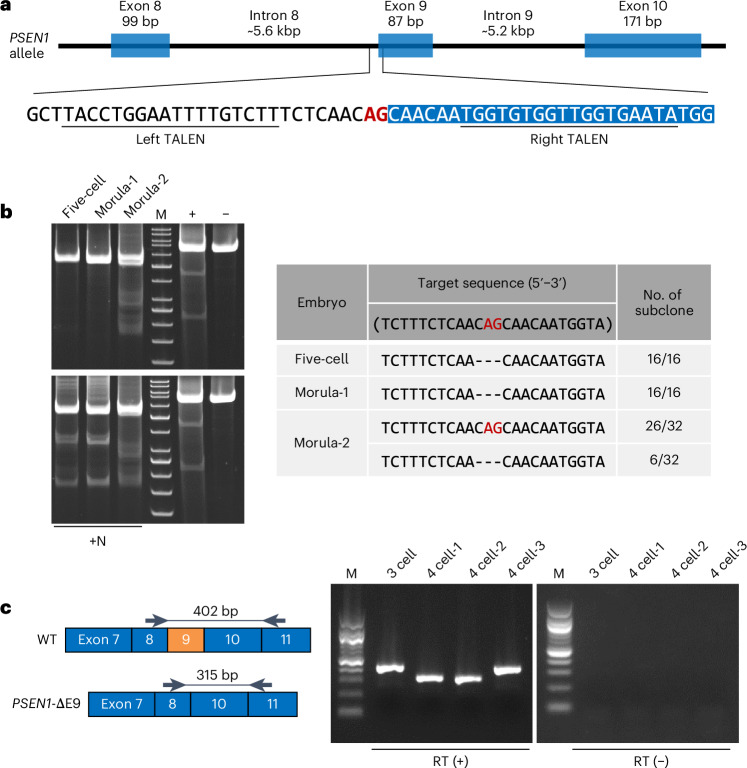
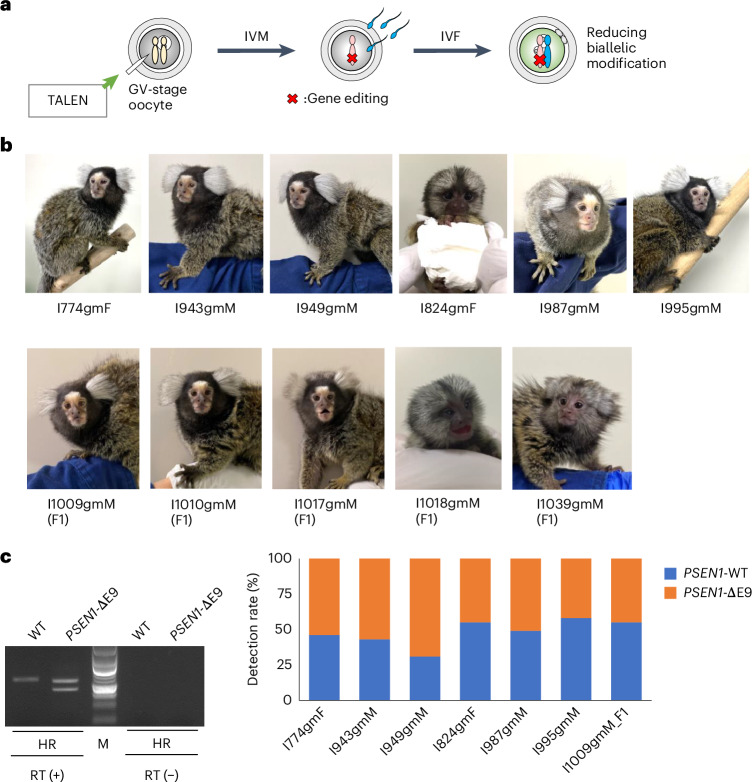
Nonhuman primates (NHPs), which are closely related to humans, are useful in biomedical research, and an increasing number of NHP disease models have been reported using gene editing. However, many disease-related genes cause perinatal death when manipulated homozygously by gene editing. In addition, NHP resources, which are limited, should be efficiently used. Here, to address these issues, we developed a method of introducing heterozygous genetic modifications into common marmosets by combining Platinum transcription activator-like effector nuclease (TALEN) and a gene-editing strategy in oocytes. We succeeded in introducing the heterozygous exon 9 deletion mutation in the presenilin 1 gene, which causes familial Alzheimer's disease in humans, using this technology. As a result, we obtained animals with the expected genotypes and confirmed several Alzheimer's disease-related biochemical changes. This study suggests that highly efficient heterozygosity-oriented gene editing is possible using TALEN and oocytes and is an effective method for producing genetically modified animals.
非人类灵长类动物(NHPs)与人类关系密切,在生物医学研究中很有用,并且越来越多的使用基因编辑的 NHP 疾病模型被报道。然而,许多与疾病相关的基因在通过基因编辑纯合操作时会导致围产期死亡。此外,NHP 资源有限,应该得到有效利用。在这里,为了解决这些问题,我们开发了一种在卵母细胞中结合 Platinum 转录激活因子样效应物核酸酶(TALEN)和基因编辑策略将杂合基因修饰引入普通狨猴的方法。我们成功地使用该技术引入了人类家族性阿尔茨海默病相关的早老素 1 基因的杂合外显子 9 缺失突变。结果,我们获得了具有预期基因型的动物,并证实了几种与阿尔茨海默病相关的生化变化。这项研究表明,使用 TALEN 和卵母细胞可以实现高效的杂合性导向基因编辑,这是一种产生基因修饰动物的有效方法。