Vetagro S.p.A., 42124 Reggio Emilia, Italy.
Department of Animal and Food Sciences, University of Delaware, 19716 Newark, DE, USA.
Poult Sci. 2024 Nov;103(11):104237. doi: 10.1016/j.psj.2024.104237. Epub 2024 Aug 22.
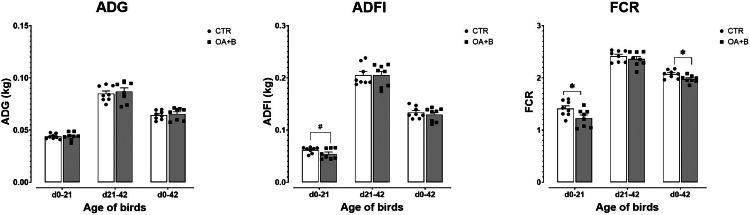
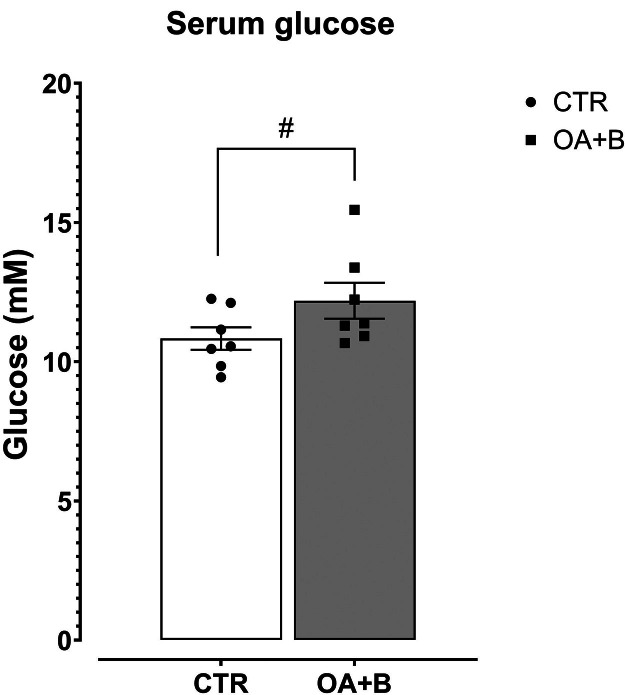
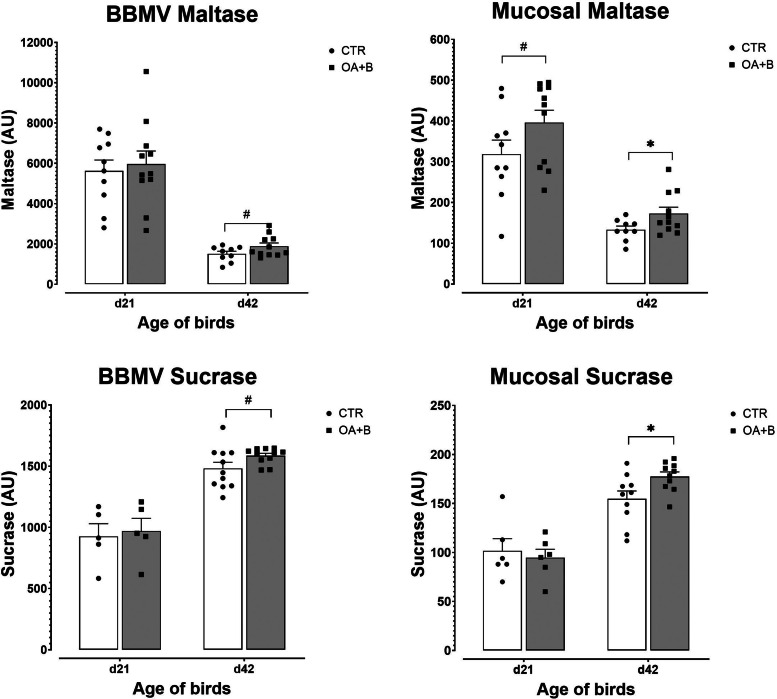
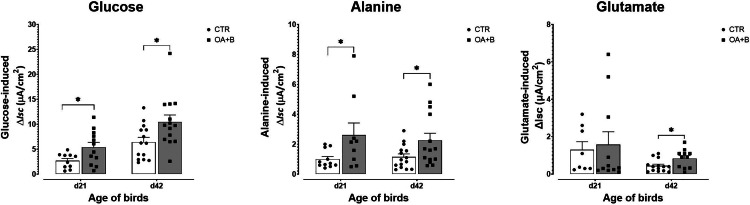
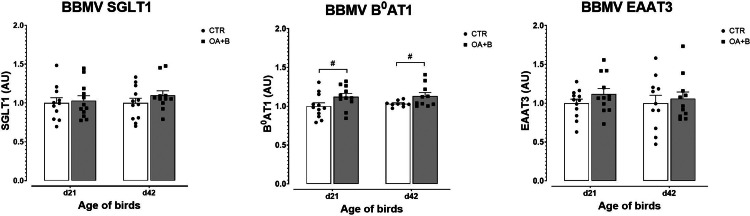
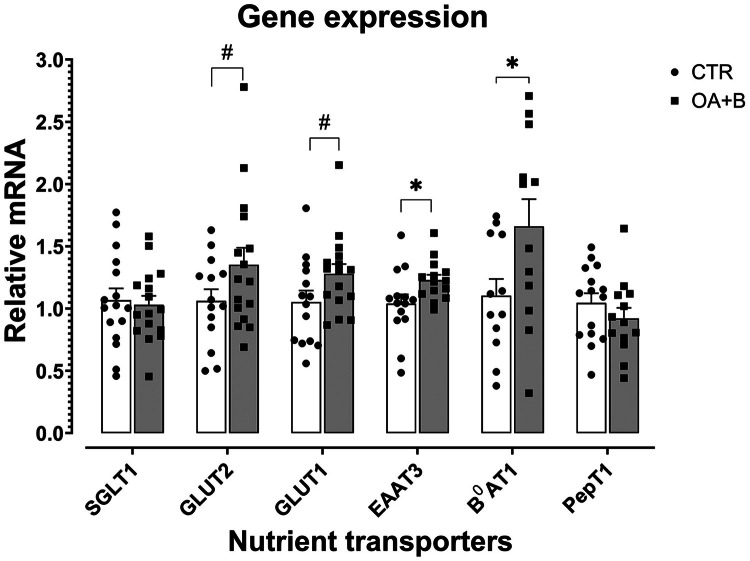
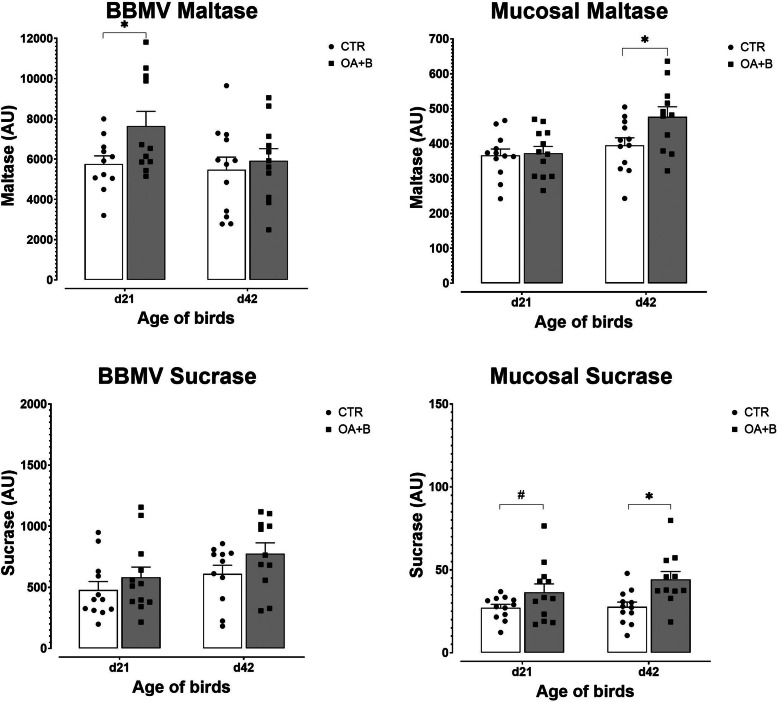
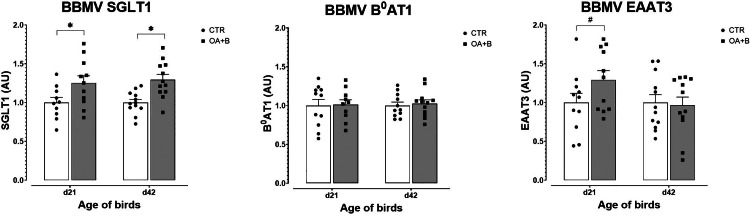
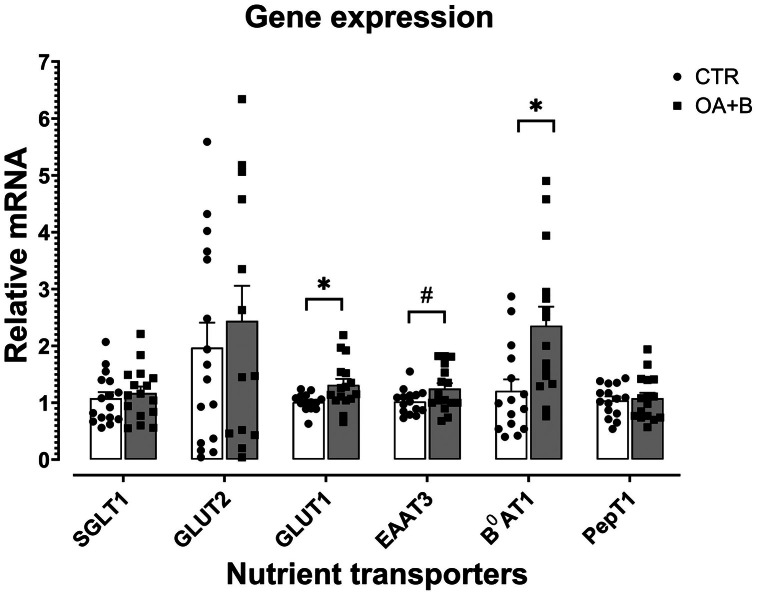
Organic acids and botanicals have shown protective effects on gut barrier and against inflammation in broilers. However, their effects on intestinal digestive enzymes and nutrients transporters expression and functions have not been fully studied. The objective of this study was to understand how a microencapsulated blend of botanicals and organic acids affected intestinal enzyme activities and nutrient transporters expression and functions in broilers. A total of 288 birds were assigned to a commercial control diet or diet supplemented with 500 g/MT (metric ton) of the microencapsulated additive. Growth performance was recorded weekly. At d 21 and d 42, jejunum and ileum were isolated for enzyme (maltase, sucrase, and aminopeptidase) and transporter (SGLT1, GLUT2, GLUT1, EAAT3, BAT1, and PepT1) analyses. Jejunum specific nutrients (glucose, alanine, and glutamate) transport activities were evaluated by Ussing chamber. Protein expression of nutrient transporters in small intestine were measured in mucosa and brush-border membrane (BBM) samples by western blot. Intestinal gene expression of the transporters was determined by RT-PCR. Statistical analysis was performed using Student's t-test comparing the supplemented diet to the control. The feed efficiency was significantly improved through the study period in the supplemented group (P ≤ 0.05). Significant changes of intestinal histology were shown in both jejunum (P ≤ 0.10) and ileum (P ≤ 0.05) after 21 d of treatment. At d21, jejunal maltase activity was upregulated (P ≤ 0.10). The Ussing chamber transport of glucose and alanine was increased, which was in line with increased gene expression (GLUT2, GLUT1, EAAT3, and BAT1) (P ≤ 0.10 and P ≤ 0.05, respectively) and BBMV protein levels (BAT1, P < 0.10). At d21, ileal sucrase and maltase activities were upregulated (P ≤ 0.05). Increased expressions of GLUT1, EAAT3, and BAT1 were observed in both mRNA and protein levels (P ≤ 0.05). Similar pattern of changes was also shown at d42 of age. Our results suggest that feeding microencapsulated additives improves intestinal nutrient digestion and transporter expression and function in broilers, thereby enhancing feed efficiency.
有机酸和植物提取物对肉鸡的肠道屏障和炎症具有保护作用。然而,它们对肠道消化酶和营养转运蛋白表达和功能的影响尚未得到充分研究。本研究旨在了解微胶囊化的植物提取物和有机酸混合物如何影响肉鸡的肠道酶活性以及营养转运蛋白的表达和功能。将 288 只鸡分为商业对照日粮组或日粮添加 500g/MT(公吨)微胶囊添加剂组。每周记录生长性能。在第 21 天和第 42 天,分离空肠和回肠,用于酶(麦芽糖酶、蔗糖酶和氨肽酶)和转运蛋白(SGLT1、GLUT2、GLUT1、EAAT3、BAT1 和 PepT1)分析。通过 Ussing 室评估空肠特定营养素(葡萄糖、丙氨酸和谷氨酸)的转运活性。通过 Western blot 测量小肠黏膜和刷状缘膜(BBM)样本中营养转运蛋白的蛋白质表达。通过 RT-PCR 确定转运蛋白的肠道基因表达。通过学生 t 检验比较补充日粮和对照日粮进行统计分析。在研究期间,补充组的饲料效率显著提高(P≤0.05)。处理 21 天后,空肠(P≤0.10)和回肠(P≤0.05)的肠道组织学发生显著变化。第 21 天,空肠麦芽糖酶活性上调(P≤0.10)。葡萄糖和丙氨酸的 Ussing 室转运增加,这与基因表达(GLUT2、GLUT1、EAAT3 和 BAT1)增加一致(P≤0.10 和 P≤0.05)和 BBMV 蛋白水平(BAT1,P<0.10)。第 21 天,回肠蔗糖酶和麦芽糖酶活性上调(P≤0.05)。GLUT1、EAAT3 和 BAT1 的表达在 mRNA 和蛋白质水平上均增加(P≤0.05)。在 42 日龄时也观察到类似的变化模式。我们的结果表明,饲喂微胶囊化添加剂可提高肉鸡肠道营养消化和转运蛋白的表达和功能,从而提高饲料效率。