Smits Karin C, Speekenbrink Ron G H, Hekman Edsko E G, Koenrades Maaike A, Heeringa Tijn J P, Arens Jutta, Halfwerk Frank R
Department of Cardiothoracic Surgery, Thorax Centrum Twente, Medisch Spectrum Twente, Enschede, The Netherlands.
Department of Biomechanical Engineering, Faculty of Engineering Technology, TechMed Centre, University of Twente, Enschede, The Netherlands.
Innovations (Phila). 2024 Sep-Oct;19(5):532-540. doi: 10.1177/15569845241273538. Epub 2024 Sep 2.
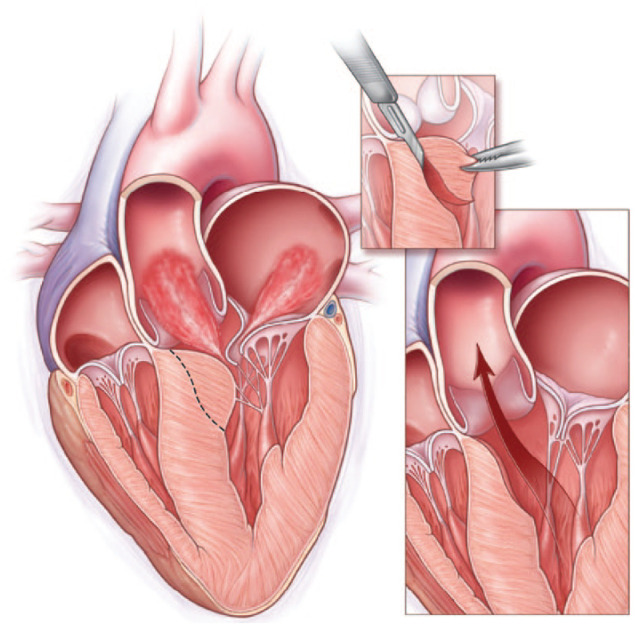
Hypertrophic obstructive cardiomyopathy (HOCM) develops in at least 1 out of 715 young adults. Patients who are refractory to medical therapy qualify for septal myectomy. Due to anatomy, serious complications such as ventricular septal defect and heart block may occur. Establishing cardiovascular magnetic resonance (CMR)-based 3-dimensional (3D) models as part of preoperative planning and training has the potential to decrease procedure-related complications and improve results.
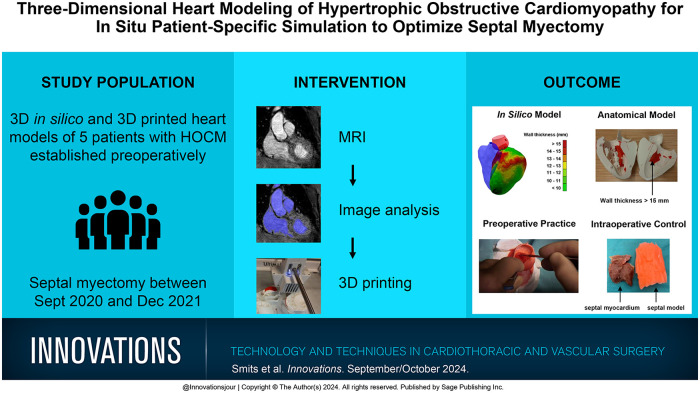
CMR images were used to segment cardiac structures. Left ventricular wall thickness was calculated and projected on top of the in silico model. A 3D model was printed with a red layer indicating a wall thickness exceeding 15 mm and used for preoperative resection planning and patient counseling. To provide preoperative patient-specific in situ simulation, the planned resection volume was replaced with silicone in a second model. For perioperative quality control, resected silicone was compared with resected myocardial tissue. The impact of the models was evaluated descriptively through consultation of both the cardiothoracic surgeon and patients and through patient outcomes.
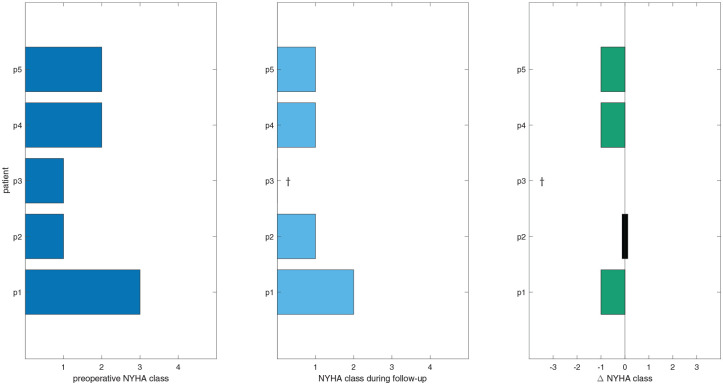
Three-dimensional in silico and 3D-printed heart models of 5 patients were established preoperatively. Since the introduction of the models in October 2020, the surgeon feels better prepared, more confident, and less difficulty with making decisions. In addition, patients feel better informed preoperatively.
Using 3D heart models optimized preoperative planning and training, intraoperative quality control, and patient consultation. Reduction of procedure-related complications and clinical outcome should be studied in larger cohorts.
肥厚型梗阻性心肌病(HOCM)在每715名年轻人中至少有1人发病。药物治疗无效的患者符合行室间隔心肌切除术的条件。由于解剖结构的原因,可能会发生室间隔缺损和心脏传导阻滞等严重并发症。建立基于心血管磁共振(CMR)的三维(3D)模型作为术前规划和训练的一部分,有可能减少手术相关并发症并改善手术效果。
利用CMR图像对心脏结构进行分割。计算左心室壁厚度并投影到虚拟模型上。打印一个3D模型,其中红色层表示壁厚超过15毫米,该模型用于术前切除规划和患者咨询。为了提供术前患者特异性原位模拟,在第二个模型中用硅胶替换计划切除的体积。对于围手术期质量控制,将切除的硅胶与切除的心肌组织进行比较。通过心胸外科医生和患者的咨询以及患者的治疗结果,对模型的影响进行描述性评估。
术前建立了5例患者的三维虚拟心脏模型和3D打印心脏模型。自2020年10月引入这些模型以来,外科医生感觉准备更充分、更自信,决策难度更小。此外,患者术前了解的信息更多。
使用3D心脏模型优化了术前规划和训练、术中质量控制以及患者咨询。应在更大的队列中研究减少手术相关并发症和临床结果。