Inagaki-Asano Asa, Honda Chikako, Matsumoto Hiroshige, Yoshioka-Maeda Kyoko
Department of Community Health Nursing/Public Health Nursing, Division of Health Science & Nursing, Graduate School of Medicine, The University of Tokyo, Tokyo, Japan.
SAGE Open Nurs. 2024 Aug 31;10:23779608241272462. doi: 10.1177/23779608241272462. eCollection 2024 Jan-Dec.
Early identification of developmental dysplasia of the hip (DDH) is necessary to minimize its negative effects. Ultrasound screening is useful for detecting DDH in hospitals. Awareness about community-based screening systems is low in Japan. Despite established nationwide home visiting services and child health checkups in the country, more than 10% of DDH patients are diagnosed at the age of ≥1 year. This review aimed to clarify the status of universal ultrasound screening for DDH among infants in community settings in Japan.
The electronic databases of Igaku Chuo Zasshi, MEDLINE, CHINAL, ERIC, and APA PsycInfo were searched for articles published between 2002 and 2022. Articles were evaluated with the reach, effectiveness, adoption, implementation, and maintenance framework.
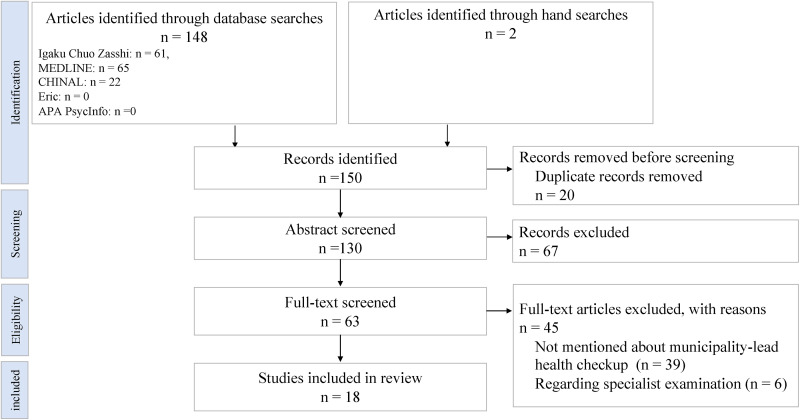
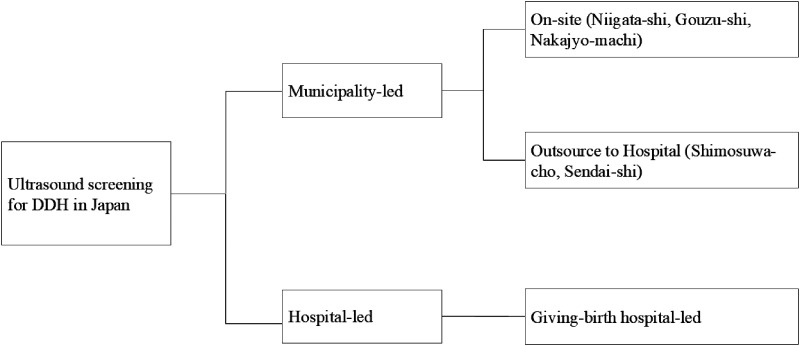
In total, 148 articles were identified. Two articles were manually added, and 67 articles were excluded through abstract reviews, of which 20 were duplicates. Finally, 18 articles were included in the analysis. There are two types of universal ultrasound screening in community settings: municipality-led and hospital-led. Since 1992, municipality-led screening has been conducted during public infant health checkups in five municipalities. Six hospitals implemented ultrasound screening. The participation rate was around 90%. The Graf method is typically used for this purpose. The prevalence of abnormal hips was 3.6%-16.6%. Owing to limited human resources and skills in ultrasound, all studies mentioned the necessity of a universal screening system for the early detection of DDH.
Embedding universal ultrasound screening in community health checkup systems enables collaboration between healthcare professionals and caregivers to improve health inequities and ensure early detection of DDH cases.
早期识别发育性髋关节发育不良(DDH)对于将其负面影响降至最低至关重要。超声筛查在医院中对检测DDH很有用。在日本,人们对基于社区的筛查系统的认知度较低。尽管该国已建立了全国性的家访服务和儿童健康检查,但超过10%的DDH患者在1岁及以上时才被诊断出来。本综述旨在阐明日本社区环境中针对婴儿的DDH普遍超声筛查的现状。
检索了《医学中央杂志》、MEDLINE、CHINAL、ERIC和APA PsycInfo的电子数据库,以查找2002年至2022年期间发表的文章。使用覆盖范围、有效性、采用情况、实施情况和维持框架对文章进行评估。
总共识别出148篇文章。手动添加了2篇文章,通过摘要评审排除了67篇文章,其中20篇为重复文章。最后,18篇文章纳入分析。社区环境中有两种类型的普遍超声筛查:市政府主导型和医院主导型。自1992年以来,五个市政府在公共婴儿健康检查期间开展了市政府主导型筛查。六家医院实施了超声筛查。参与率约为90%。通常使用格拉夫方法进行此项筛查。髋关节异常的患病率为3.6% - 16.6%。由于超声方面的人力资源和技能有限,所有研究都提到了建立普遍筛查系统以早期检测DDH的必要性。
将普遍超声筛查纳入社区健康检查系统可促进医疗保健专业人员与护理人员之间的合作,以改善健康不平等状况并确保早期发现DDH病例。