Lee Sangmin, Kim Jae-Hun, Song Wan, Sung Hyun Hwan, Jeon Hwang Gyun, Jeong Byong Chang, Seo Seong Il, Jeon Seong Soo, Park Se Hoon, Lee Ji Hyun, Yu Jiwoong, Kang Minyong
Department of Urology, Samsung Medical Center, Sungkyunkwan University School of Medicine, Seoul, Korea.
Department of Radiology, Samsung Medical Center, Sungkyunkwan University School of Medicine, Seoul, Korea.
Cancer Manag Res. 2024 Aug 28;16:1091-1101. doi: 10.2147/CMAR.S476150. eCollection 2024.
We investigated the relationship between body mass index (BMI), radiological body composition, and survival outcomes in patients with metastatic renal cell carcinoma (mRCC) underwent first-line immune checkpoint inhibitor (ICI)-based therapy.
Analyzing data from 102 patients treated between November 2019 and March 2023, pre-treatment computed tomography (CT) scans assessed fat and muscle areas. BMI and body composition indices were examined, including skeletal muscle index, subcutaneous fat index (SFI), visceral fat index, and total fat index. Kaplan-Meier curves and Log rank tests compared progression-free survival (PFS) and overall survival (OS), while multivariable Cox proportional regression analysis was performed to identify the variables significantly associated with survival outcomes.
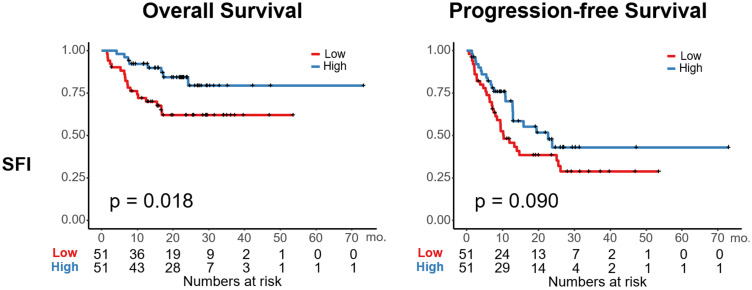
54 patients (52.9%) experienced disease progression, and 26 (25.5%) died during a median follow-up of 17.4 months. High SFI was significantly associated with improved OS (p = 0.018) but not PFS (p = 0.090). Multivariable analysis confirmed the positive impact of high SFI on OS (adjusted HR: 0.37, = 0.029) and suggested a trend towards improved PFS (adjusted HR: 0.61, = 0.088). Notably, in the ipilimumab + nivolumab subgroup, high SFI significantly correlated with both PFS and OS ( = 0.047 and = 0.012, respectively).
High SFI predicts favorable OS in patients with mRCC receiving first-line ICI-based therapy, especially patients treated with ipilimumab + nivolumab displayed a significant association between high SFI and favorable PFS and OS.
我们研究了接受一线免疫检查点抑制剂(ICI)治疗的转移性肾细胞癌(mRCC)患者的体重指数(BMI)、放射学身体成分与生存结局之间的关系。
分析2019年11月至2023年3月期间接受治疗的102例患者的数据,治疗前的计算机断层扫描(CT)评估脂肪和肌肉面积。检查BMI和身体成分指数,包括骨骼肌指数、皮下脂肪指数(SFI)、内脏脂肪指数和总脂肪指数。采用Kaplan-Meier曲线和对数秩检验比较无进展生存期(PFS)和总生存期(OS),同时进行多变量Cox比例回归分析以确定与生存结局显著相关的变量。
在中位随访17.4个月期间,54例患者(52.9%)疾病进展,26例患者(25.5%)死亡。高SFI与OS改善显著相关(p = 0.018),但与PFS无关(p = 0.090)。多变量分析证实高SFI对OS有积极影响(调整后HR:0.37,p = 0.029),并显示出PFS改善的趋势(调整后HR:0.61,p = 0.088)。值得注意的是,在伊匹木单抗+纳武单抗亚组中,高SFI与PFS和OS均显著相关(分别为p = 0.047和p = 0.012)。
高SFI预测接受一线ICI治疗的mRCC患者有良好的OS,尤其是接受伊匹木单抗+纳武单抗治疗的患者,高SFI与良好的PFS和OS之间存在显著关联。