Pollack Ethan, Norwood Dalton, Caceres Hector, Rapaka Babusai, Perry Isaac E, Barlass Usman, Mitchell Rachel, McCreight Jessica, Peter Shajan, Mulki Ramzi, Ahmed Ali, Kyanam Kondal, Sánchez-Luna Sergio A
Department of Internal Medicine The University of Alabama at Birmingham Heersink School of Medicine Birmingham Alabama USA.
Department of Internal Medicine UAB Minority Health and Health Equity Research Center The University of Alabama at Birmingham Heersink School of Medicine Birmingham Alabama USA.
DEN Open. 2024 Sep 1;5(1):e70005. doi: 10.1002/deo2.70005. eCollection 2025 Apr.
This study aimed to characterize the clinical outcomes, safety, and efficacy of lumen-apposing metal stents (LAMS) in treating benign gastrointestinal strictures.
A single-center retrospective review of all patients who underwent LAMS placement for benign strictures from June 2017 to July 2023. Primary outcomes were technical success, early clinical success, late clinical success (LCS), and sustained post-LAMS clinical success (SPLCS). Secondary outcomes included stent dwell time, stenosis changes, adverse events, reintervention rates, and symptomatology evaluation.
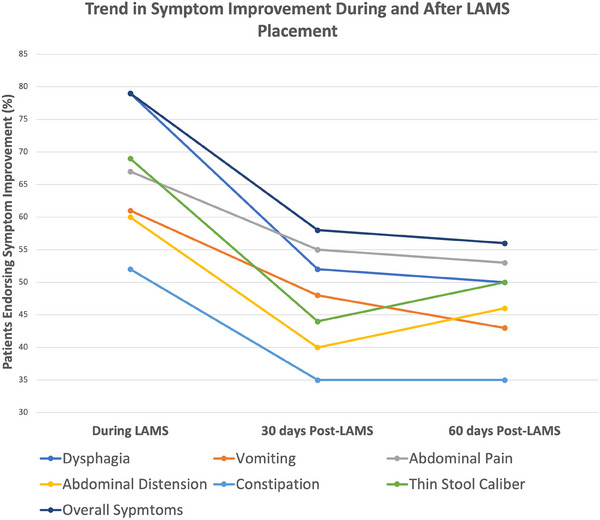
Thirty-five patients underwent placement of 42 LAMS (74% female, mean age: 54.2 ± 11.7 years). Anastomotic strictures accounted for 64% of cases ( = 27, 45% at the gastrojejunal anastomosis). The median STD was 91.0 days (interquartile range [IQR]: 55.0-132.0). Technical success was obtained in all cases. Early clinical successand LCS were achieved in 80% of cases overall. SPLCS was achieved in 45% ( = 15) of cases. The overall reintervention rate was 63%, with a median time to reintervention being 50.5 days (IQR: 24-105). adverse events occurred in 28% ( = 12) overall, with a 24% migration rate ( = 10). Follow-up was completed in 83% of cases with a median duration of 629 days (range: 192.0-1297.0). Overall symptom improvement occurred in 79% ( = 27) during indwelling LAMS versus 58% and 56% at 30- and 60-days post-removal, respectively.
LAMS for benign gastrointestinal strictures are associated with high technical and early clinical success/LCS rates, positive quality-of-life metrics, and a tolerable adverse event rate. Overall, recurrence of symptoms and high reintervention rates post-LAMS removal reinforce the difficulty in managing benign gastrointestinal strictures but also argue for LAMS as a definitive therapy in select cases.
本研究旨在描述管腔贴附金属支架(LAMS)治疗良性胃肠道狭窄的临床结局、安全性和有效性。
对2017年6月至2023年7月期间所有因良性狭窄接受LAMS置入术的患者进行单中心回顾性研究。主要结局指标为技术成功率、早期临床成功率、晚期临床成功率(LCS)和LAMS置入术后持续临床成功率(SPLCS)。次要结局指标包括支架留置时间、狭窄变化、不良事件、再次干预率和症状学评估。
35例患者置入了42枚LAMS(女性占74%,平均年龄:54.2±11.7岁)。吻合口狭窄占病例的64%(n=27,45%发生在胃空肠吻合口)。中位支架留置时间为91.0天(四分位间距[IQR]:55.0-132.0)。所有病例均取得技术成功。总体而言,80%的病例实现了早期临床成功和LCS。45%(n=15)的病例实现了SPLCS。总体再次干预率为63%,再次干预的中位时间为50.5天(IQR:24-105)。总体28%(n=12)发生不良事件,移位率为24%(n=10)。83%的病例完成随访,中位随访时间为629天(范围:192.0-1297.0)。LAMS留置期间总体症状改善率为79%(n=27),取出后30天和60天分别为58%和56%。
用于治疗良性胃肠道狭窄的LAMS具有较高的技术成功率和早期临床成功率/LCS率、良好的生活质量指标以及可耐受的不良事件发生率。总体而言,LAMS取出后症状复发和再次干预率高,这凸显了良性胃肠道狭窄管理的困难,但也支持在某些病例中将LAMS作为确定性治疗方法。