Wang Kai, Zan Shujie, Xu Jiachun, Sun Weiming, Li Caixia, Zhang Wei, Ni Daoyan, Cheng Ruzhen, Li Lin, Yu Zhen, Zhang Linlin, Liu Shuang, Cui Yuanwu, Zhang Yulian
The Second Affiliated Hospital of Tianjin University of Traditional Chinese Medicine, Tianjin, 300250, China.
Tianjin University of Traditional Chinese Medicine, Tianjin, 301617, China.
Heliyon. 2024 Aug 6;10(16):e35800. doi: 10.1016/j.heliyon.2024.e35800. eCollection 2024 Aug 30.
Aging is the primary risk factor for the onset of Alzheimer's disease (AD). Inflamma-aging is a major feature in the process of aging, and the chronic neuroinflammation caused by inflamma-aging is closely related to AD. As the main participant of neuroinflammation, the polarization of microglia (MG) could influence the development of neuroinflammation.
This study aims to observe the impact of YHD on microglia (MG) polarization and neuroinflammation to delay the onset and progression of AD.
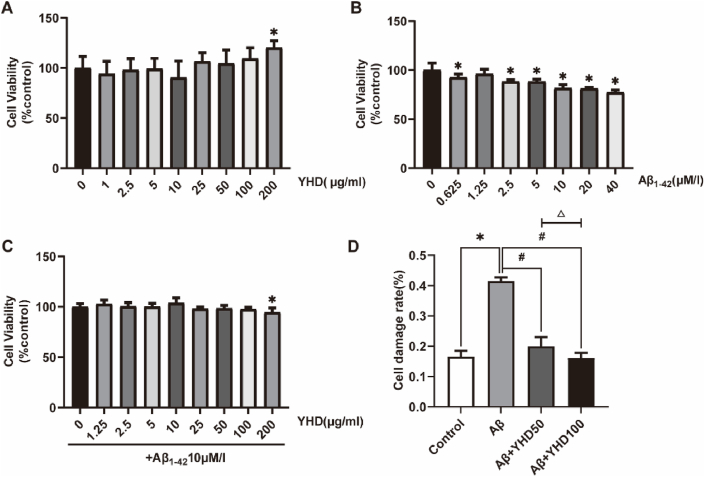
In vivo experiment, four-month senescence accelerated mouse prone 8 (SAMP8) were used as the model group, the SAMR1 mice of the same age were used as the control group. In YHD group, 6.24 g/kg YHD was intragastrically administrated continuously for 12 weeks, and Ibuprofen 0.026 g/kg in positive control group. Morris Water Maze test was used to evaluate the learning and memory ability, Nissl's staining and immunofluorescence double staining for neuron damage and MG M1/M2 polarization, Enzyme-Linked Immunosorbent Assay (ELISA) for neuroinflammation biomarkers in hippocampus, Western blot for key protein expression of TREM2/NF-κB signaling pathway. In vitro experiments, 10 μM/l Aβ induced BV-2 cell model was used to re-verify the effect of YHD regulating MG polarization to reduce neuroinflammation. Also, TREM2 small interfering RNA (siRNA) was used to clarify the key target of YHD.
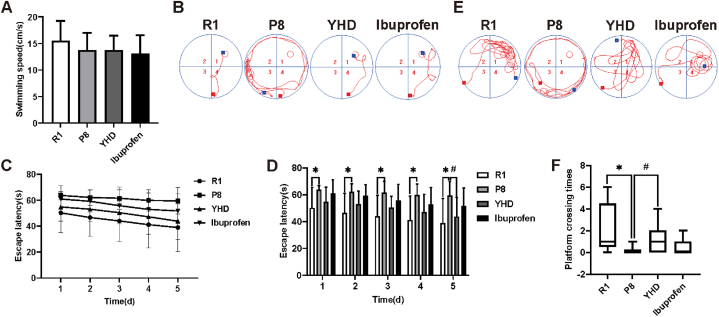
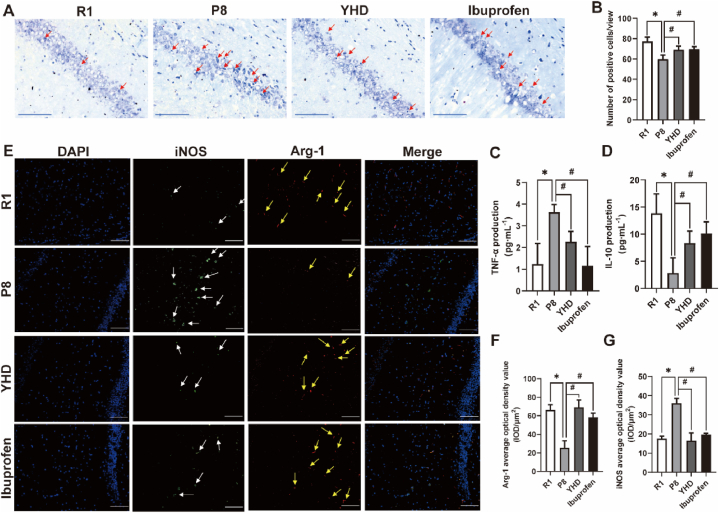
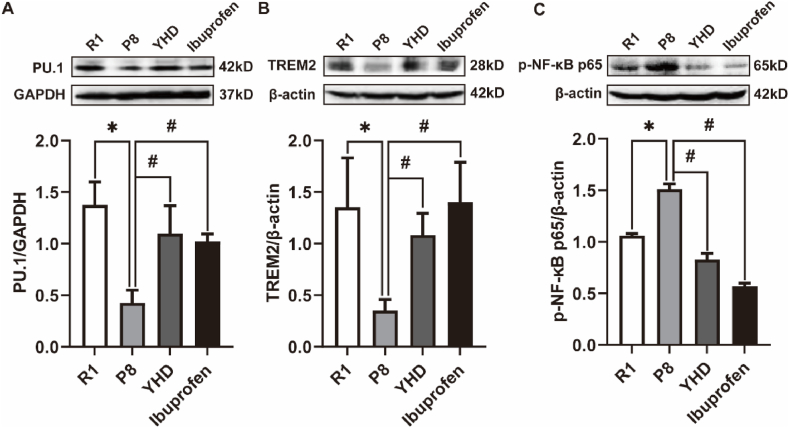
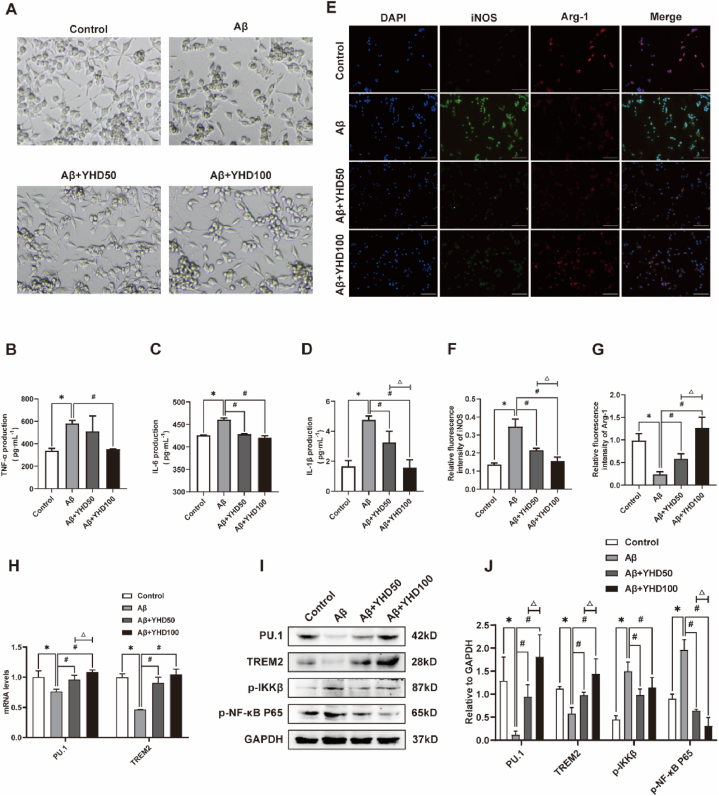
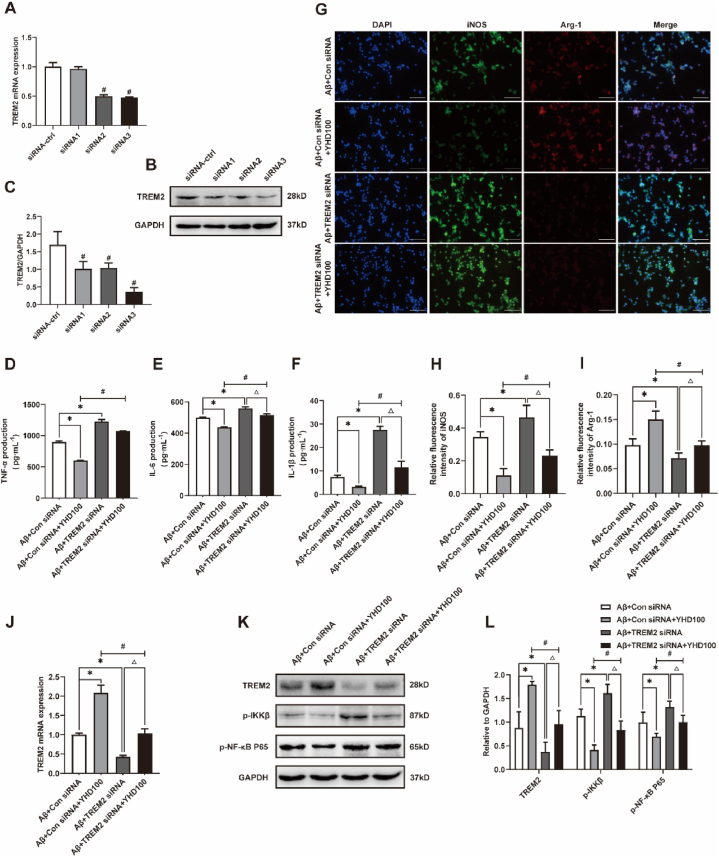
YHD could improve the learning and memory ability of SAMP8 mice evaluated by the Morris Water Maze test. Like Ibuprofen, YHD could regulate the M1/M2 polarization of MG and the levels of neuroinflammatory markers TNF-α and IL-10 in hippocampus, and relieve neuroinflammation and neuron loss. In addition, YHD could also regulate the expression of PU.1, TREM2, p-NF-κB P65 in the TREM2/NF-κB signaling pathway. Further in vitro experiments, we found that YHD had a significant regulatory effect on Aβ-induced BV-2 cell polarization, and it could significantly increase PU.1, TREM2, decrease p-NF-κB P65, -IKKβ, TNF-α, IL-6, IL-1β. At the same time, using siRNA to inhibit TREM2, it proved that TREM2 was a key target for YHD to promote Aβ-induced BV-2 cell M2 polarization to reduce neuroinflammation.
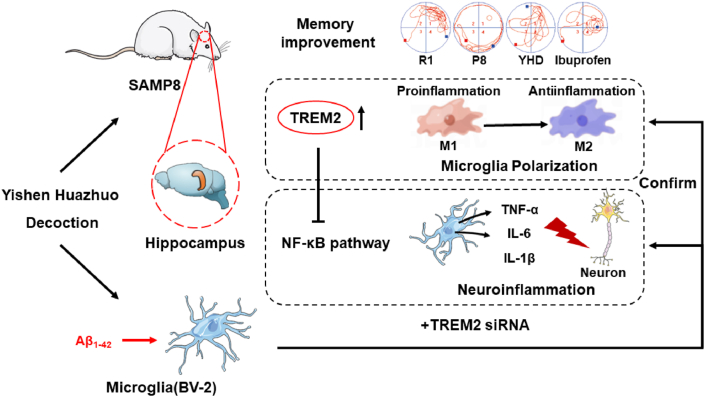
YHD could regulate the TREM2/NF-κB signaling pathway through TREM2, thereby to adjust MG polarization and reduce AD-related neuroinflammation.
衰老是阿尔茨海默病(AD)发病的主要危险因素。炎症衰老(inflamma-aging)是衰老过程中的一个主要特征,由炎症衰老引起的慢性神经炎症与AD密切相关。作为神经炎症的主要参与者,小胶质细胞(MG)的极化可影响神经炎症的发展。
本研究旨在观察益黄丹(YHD)对小胶质细胞(MG)极化和神经炎症的影响,以延缓AD的发生和发展。
在体内实验中,将4月龄快速老化小鼠易感8型(SAMP8)作为模型组,将同龄的SAMR1小鼠作为对照组。在YHD组中,连续12周以6.24 g/kg的剂量对小鼠进行YHD灌胃给药,在阳性对照组中以0.026 g/kg的剂量给予布洛芬。采用Morris水迷宫试验评估学习和记忆能力,采用尼氏染色和免疫荧光双染色检测神经元损伤及MG的M1/M2极化,采用酶联免疫吸附测定(ELISA)法检测海马中神经炎症生物标志物,采用蛋白质免疫印迹法检测TREM2/NF-κB信号通路关键蛋白的表达。在体外实验中,使用10 μM/l Aβ诱导的BV-2细胞模型来再次验证YHD调节MG极化以减轻神经炎症的作用。此外,使用TREM2小干扰RNA(siRNA)来明确YHD的关键靶点。
通过Morris水迷宫试验评估,YHD可改善SAMP8小鼠的学习和记忆能力。与布洛芬一样,YHD可调节MG的M1/M2极化以及海马中神经炎症标志物TNF-α和IL-10的水平,减轻神经炎症和神经元丢失。此外,YHD还可调节TREM2/NF-κB信号通路中PU.1、TREM2、p-NF-κB P65的表达。进一步的体外实验发现,YHD对Aβ诱导的BV-2细胞极化具有显著的调节作用,并且可显著增加PU.1、TREM2的表达,降低p-NF-κB P65、-IKKβ、TNF-α、IL-6、IL-1β的表达。同时,使用siRNA抑制TREM2,证明TREM2是YHD促进Aβ诱导的BV-2细胞M2极化以减轻神经炎症的关键靶点。
YHD可通过TREM2调节TREM2/NF-κB信号通路,从而调节MG极化并减轻AD相关的神经炎症。