Long Hui-Zhi, Zhou Zi-Wei, Cheng Yan, Luo Hong-Yu, Li Feng-Jiao, Xu Shuo-Guo, Gao Li-Chen
School of Pharmacy, The Affiliated Changsha Central Hospital, Hengyang Medical School, University of South China, Changsha, China.
Hunan Provincial Key Laboratory of Tumor Microenvironment Responsive Drug Research, Hengyang, China.
Front Aging Neurosci. 2022 Jun 30;14:888989. doi: 10.3389/fnagi.2022.888989. eCollection 2022.
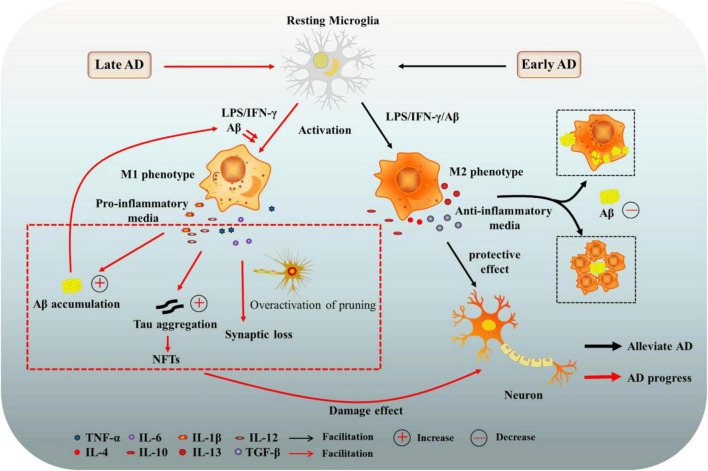
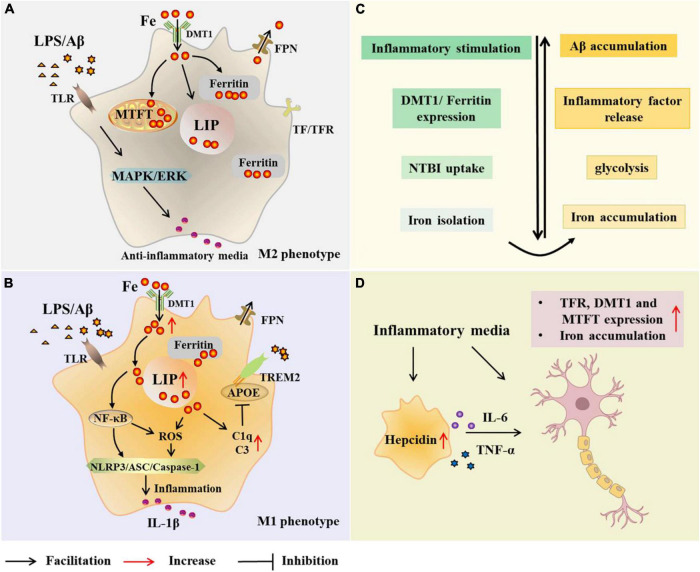
Alzheimer's disease (AD), the most common type of senile dementia, includes the complex pathogenesis of abnormal deposition of amyloid beta-protein (Aβ), phosphorylated tau (p-tau) and neuroimmune inflammatory. The neurodegenerative process of AD triggers microglial activation, and the overactivation of microglia produces a large number of neuroimmune inflammatory factors. Microglia dysfunction can lead to disturbances in iron metabolism and enhance iron-induced neuronal degeneration in AD, while elevated iron levels in brain areas affect microglia phenotype and function. In this manuscript, we firstly discuss the role of microglia in AD and then introduce the role of microglia in the immune-inflammatory pathology of AD. Their role in AD iron homeostasis is emphasized. Recent studies on microglia and ferroptosis in AD are also reviewed. It will help readers better understand the role of microglia in iron metabolism in AD, and provides a basis for better regulation of iron metabolism disorders in AD and the discovery of new potential therapeutic targets for AD.
阿尔茨海默病(AD)是最常见的老年痴呆类型,其发病机制复杂,包括β淀粉样蛋白(Aβ)异常沉积、磷酸化tau蛋白(p-tau)以及神经免疫炎症。AD的神经退行性过程会触发小胶质细胞激活,而小胶质细胞的过度激活会产生大量神经免疫炎症因子。小胶质细胞功能障碍可导致铁代谢紊乱,并加重AD中铁诱导的神经元变性,而脑区铁水平升高会影响小胶质细胞表型和功能。在本手稿中,我们首先讨论小胶质细胞在AD中的作用,然后介绍小胶质细胞在AD免疫炎症病理学中的作用。着重强调了它们在AD铁稳态中的作用。还综述了AD中关于小胶质细胞和铁死亡的最新研究。这将有助于读者更好地理解小胶质细胞在AD铁代谢中的作用,并为更好地调节AD中铁代谢紊乱以及发现AD新的潜在治疗靶点提供依据。