Prigmore Brian, Haneberg Erik, Elias Tristan, Wiedrick Jack, Ballin Jessica, Cole Brian J, Yanke Adam B, Crawford Dennis C
Oregon Health & Science University School of Medicine, Portland, Oregon, USA.
Midwest Orthopaedics at Rush, Chicago, Illinois, USA.
Orthop J Sports Med. 2024 Aug 28;12(8):23259671241264856. doi: 10.1177/23259671241264856. eCollection 2024 Aug.
There is no standardized rehabilitation protocol after osteochondral allograft (OCA) transplantation surgery to the distal femur. The spectrum of recommendations includes restrictions to toe-touch weightbearing (TTWB) for 6 weeks and immediate weightbearing as tolerated (WBAT).
PURPOSE/HYPOTHESIS: The purpose of this study was to compare outcomes for immediate unrestricted WBAT to restricted TTWB after OCA transplantation to the distal femur. It was hypothesized that the immediate WBAT protocol would be noninferior to delayed, restricted TTWB.
Retrospective cohort study.
A total of 74 patients who underwent press-fit, dowel technique OCA transplantation to the femoral condyle(s) for contained (International Cartilage Repair Society grade 3-4) lesions were identified in the Metrics of Osteochondral Allograft multicenter database: 36 patients (18 women/18 men) who were prescribed TTWB were allocated to the control cohort and 38 patients (21 women/17 men) who were prescribed WBAT were allocated to the test cohort. Baseline characteristics were similar except for larger grafts in test patients (3.4 vs 2.7 cm; = .004) and higher body mass index (BMI) in control patients (27.8 vs 24.9 kg/m; = .01). Failure rates, final patient-reported outcome (PRO) scores, and PRO score changes from baseline were compared between the cohorts. Multiple regression was used to control for potential confounders and investigate noninferiority using minimal clinically important differences (MCIDs).
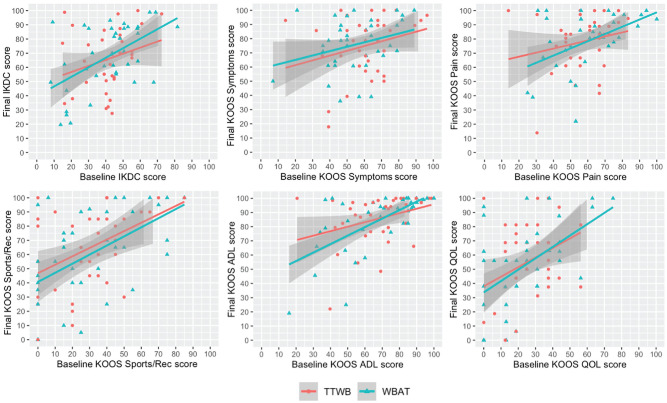
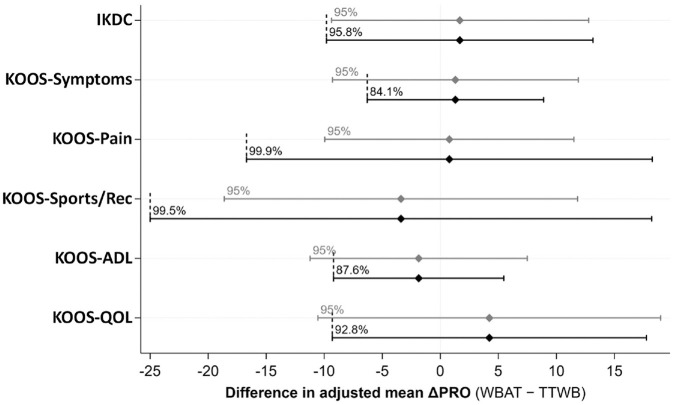
The mean follow-up was 2 years (range, 1-5 years) in both cohorts. Both cohorts showed significant improvement in all PRO scores, with no significant between-group differences in failure rates, final PRO scores, or PRO changes from baseline. There were 3 cases of failure in each cohort (control cohort: allograft revision [n = 2], debridement [n = 1]; test cohort: chondroplasty [n = 2], conversion to total knee arthroplasty [n = 1]). Regression analysis showed that adjusted differences in final PRO scores based on weightbearing protocol were minor and less than MCIDs when controlling for age, sex, graft size, BMI, and allograft location. Analysis of the MCIDs with respect to the lower bounds of the confidence intervals indicated that WBAT was noninferior to TTWB with a reasonable degree of confidence (range, 84.1%-99.9% confidence).
Results indicated that immediate unrestricted WBAT after OCA transplantation to the distal femur was equally safe and effective compared to restricted TTWB.
对于股骨远端同种异体骨软骨移植(OCA)手术后,尚无标准化的康复方案。推荐范围包括6周的足尖触地负重(TTWB)限制以及根据耐受情况即时负重(WBAT)。
目的/假设:本研究的目的是比较股骨远端OCA移植后即时无限制WBAT与受限TTWB的效果。假设即时WBAT方案不劣于延迟的受限TTWB。
回顾性队列研究。
在同种异体骨软骨移植多中心数据库中,共识别出74例接受压配式榫钉技术OCA移植至股骨髁以治疗局限性(国际软骨修复协会3 - 4级)损伤的患者:36例(18名女性/18名男性)被规定采用TTWB的患者被分配至对照组,38例(21名女性/17名男性)被规定采用WBAT的患者被分配至试验组。除试验组患者的移植物更大(3.4对2.7 cm;P = 0.004)以及对照组患者的体重指数(BMI)更高(27.8对24.9 kg/m²;P = 0.01)外,两组基线特征相似。比较两组之间的失败率、最终患者报告结局(PRO)评分以及PRO评分相对于基线的变化。采用多元回归控制潜在混杂因素,并使用最小临床重要差异(MCID)研究非劣效性。
两组的平均随访时间均为2年(范围1 - 5年)。两组所有PRO评分均有显著改善,在失败率、最终PRO评分或相对于基线的PRO变化方面,两组之间无显著差异。每组各有3例失败病例(对照组:异体骨翻修[n = 2],清创术[n = 1];试验组:软骨成形术[n = 2],转换为全膝关节置换术[n = 1])。回归分析表明,在控制年龄、性别、移植物大小(BMI)和异体骨位置时,基于负重方案的最终PRO评分调整差异较小且小于MCID。对置信区间下限的MCID分析表明,WBAT在合理的置信度下(范围84.1% - 99.9%置信度)不劣于TTWB。
结果表明,股骨远端OCA移植后即时无限制WBAT与受限TTWB同样安全有效。