Galgut Oliver, Ashford Fiona, Deeks Alexandra, Ghataure Andeep, Islam Mimia, Sambhi Tanvir, Ker Yiu Wayn, Duncan Christopher J A, de Silva Thushan I, Hopkins Susan, Hall Victoria, Klenerman Paul, Dunachie Susanna, Richter Alex
Institute of Immunology and Immunotherapy, College of Medical and Dental Science, University of Birmingham, Birmingham, UK.
University Hospitals Birmingham NHS Foundation Trust, Birmingham, UK.
Vaccine X. 2024 Aug 5;20:100546. doi: 10.1016/j.jvacx.2024.100546. eCollection 2024 Oct.
Health care workers (HCWs) have been at increased risk of infection during the SARS-CoV-2 pandemic and as essential workers have been prioritised for vaccination. Due to increased exposure HCW are considered a predictor of what might happen in the general population, particularly working age adults. This study aims to summarise effect of vaccination in this 'at risk' cohort.
Ovid MEDLINE and Embase were searched, and 358 individual articles were identified. Of these 49 met the inclusion criteria for review and 14 were included in a meta-analysis.
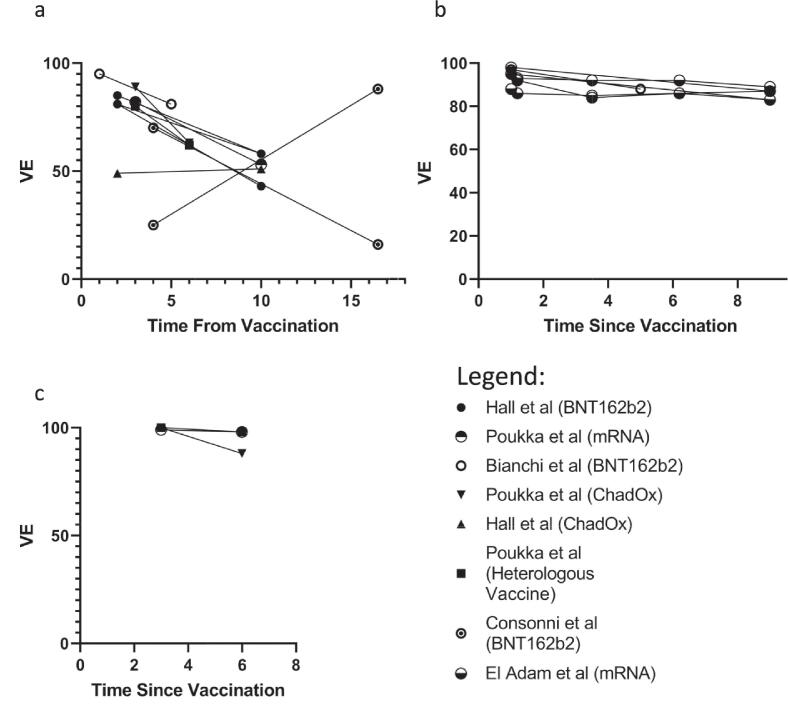
Participants included were predominantly female and working age. Median time to infection was 51 days. Reported vaccine effectiveness against infection, symptomatic infection, and infection requiring hospitalisation were between 5 and 100 %, 34 and 100 %, and 65 and 100 % (respectively). No vaccinated HCW deaths were recorded in any study. Pooled estimates of protection against infection, symptomatic infection, and hospitalisation were, respectively, 84.7 % (95 % CI 72.6-91.5 %, < 0.0001), 86.0 % (95 % CI 67.2 %-94.0 %; p < 0.0001), and 96.1 % (95 % CI 90.4 %-98.4 %). Waning protection against infection was reported by four studies, although protection against hospitalisation for severe infection persists for at least 6 months post vaccination.
Vaccination against SARS-CoV2 in HCWs is protective against infection, symptomatic infection, and hospitalisation. Waning protection is reported but this awaits more mature studies to understand durability more clearly. This study is limited by varying non-pharmacological responses to COVID-19 between included studies, a predominantly female and working age population, and limited information on asymptomatic transmission or long COVID protection.
在严重急性呼吸综合征冠状病毒2(SARS-CoV-2)大流行期间,医护人员(HCWs)面临的感染风险增加,并且作为关键岗位工作人员被优先安排接种疫苗。由于接触机会增加,医护人员被视为普通人群(尤其是工作年龄成年人)可能发生情况的一个预测指标。本研究旨在总结疫苗接种对这个“高危”队列的影响。
检索了Ovid MEDLINE和Embase数据库,共识别出358篇独立文章。其中49篇符合纳入综述的标准,14篇纳入了荟萃分析。
纳入的参与者主要为女性且处于工作年龄。感染的中位时间为51天。报告的疫苗对感染、有症状感染以及需要住院治疗的感染的有效性分别在5%至100%、34%至100%以及65%至100%之间。在任何研究中均未记录到接种疫苗的医护人员死亡情况。针对感染、有症状感染和住院治疗的合并保护估计值分别为84.7%(95%置信区间72.6%-91.5%,p<0.0001)、86.0%(95%置信区间67.2%-94.0%;p<0.0001)和96.1%(95%置信区间90.4%-98.4%)。四项研究报告了疫苗对感染的保护作用减弱,不过针对严重感染住院治疗的保护作用在接种疫苗后至少持续6个月。
医护人员接种SARS-CoV-2疫苗可预防感染、有症状感染和住院治疗。报告了保护作用减弱的情况,但这有待更成熟的研究来更清楚地了解其持久性。本研究的局限性在于纳入研究之间对2019冠状病毒病(COVID-19)的非药物反应各不相同、主要为女性和工作年龄人群,以及关于无症状传播或长期新冠保护的信息有限。