School of Psychological Science, University of Western Australia, Crawley, Western Australia, Australia.
School of Psychological Sciences, Macquarie University, Macquarie Park, New South Wales, Australia.
PeerJ. 2024 Aug 29;12:e17911. doi: 10.7717/peerj.17911. eCollection 2024.
Resilience refers to the process of demonstrating better outcomes than would be expected based on the adversity one experienced. Resilience is increasingly measured using a residual approach, which typically assesses adversity and mental health outcomes over a longitudinal timeframe. It remains unknown to what extent such a residual-based measurement of resilience is sensitive to variation in acute stress resilience, a candidate resilience factor.
Fifty-seven emerging adults enrolled in tertiary education completed measures of adversity and emotional experiences. To assess stress recovery, participants were exposed to a lab-based adverse event from which a Laboratory Stress Resilience Index was derived.
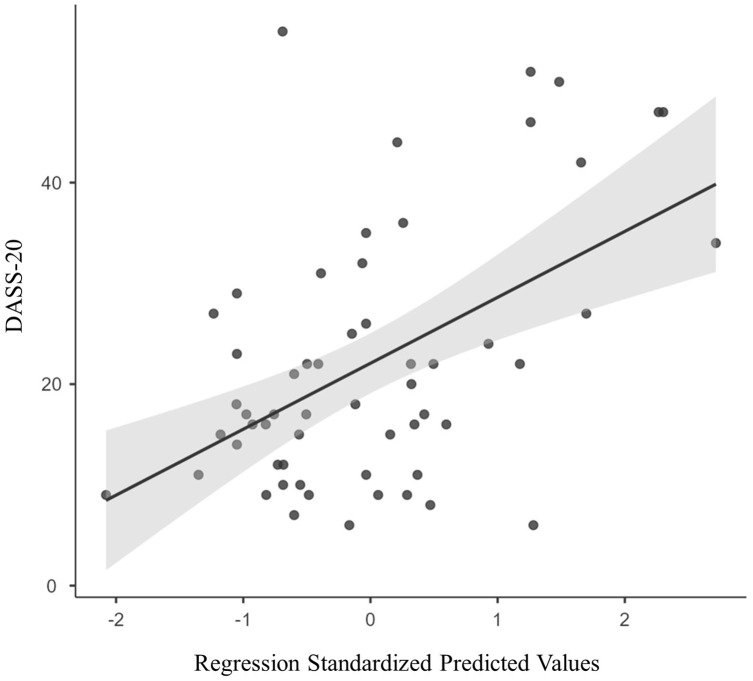
We derived a residual-based measure of emotional resilience from regressing emotional experience scores onto adversity scores. This residual-based measure of emotional resilience predicted variance in the Laboratory Stress Resilience Index over and above that predicted by both a traditional resilience measure and the emotional experiences measure. These findings suggest that acute stress resilience may be a factor underpinning variation in emotional resilience, and that the residual-based approach to measuring resilience is sensitive to such variation in stress resilience.
韧性是指表现出比基于所经历逆境预期更好的结果的过程。韧性越来越多地使用剩余方法来衡量,该方法通常在纵向时间框架内评估逆境和心理健康结果。目前尚不清楚这种基于剩余的韧性衡量方法在多大程度上敏感于急性应激韧性的变化,这是一个候选的韧性因素。
57 名参加高等教育的新兴成年人完成了逆境和情绪体验的测量。为了评估应激恢复,参与者接受了一项基于实验室的不良事件,从中得出了实验室应激恢复指数。
我们从逆境得分回归情绪体验得分中得出了情绪恢复的剩余衡量标准。这种基于剩余的情绪恢复衡量标准可以预测实验室应激恢复指数的变化,而不仅仅是传统的恢复衡量标准和情绪体验衡量标准所能预测的。这些发现表明,急性应激恢复力可能是情绪恢复力变化的一个因素,并且衡量恢复力的剩余方法对这种应激恢复力的变化很敏感。