Bertacchi Massimiliano, Wendel-Garcia Pedro D, Hana Anisa, Ince Can, Maggiorini Marco, Hilty Matthias P
Institute of Intensive Care Medicine, University Hospital of Zurich, Zurich, Switzerland.
Laboratory of Translational Intensive Care, Department of Intensive Care, Erasmus MC, University Medical Center, Rotterdam, The Netherlands.
Intensive Care Med Exp. 2024 Sep 2;12(1):76. doi: 10.1186/s40635-024-00662-3.
Circulatory shock and multi-organ failure remain major contributors to morbidity and mortality in critically ill patients and are associated with insufficient oxygen availability in the tissue. Intrinsic mechanisms to improve tissue perfusion, such as up-regulation of functional capillary density (FCD) and red blood cell velocity (RBCv), have been identified as maneuvers to improve oxygen extraction by the tissues; however, their role in circulatory shock and potential use as resuscitation targets remains unknown. To fill this gap, we examined the baseline and maximum recruitable FCD and RBCv in response to a topical nitroglycerin stimulus (FCD, RBCv) in patients with and without circulatory shock to test whether this may be a method to identify the presence and magnitude of a microcirculatory reserve capacity important for identifying a resuscitation target.
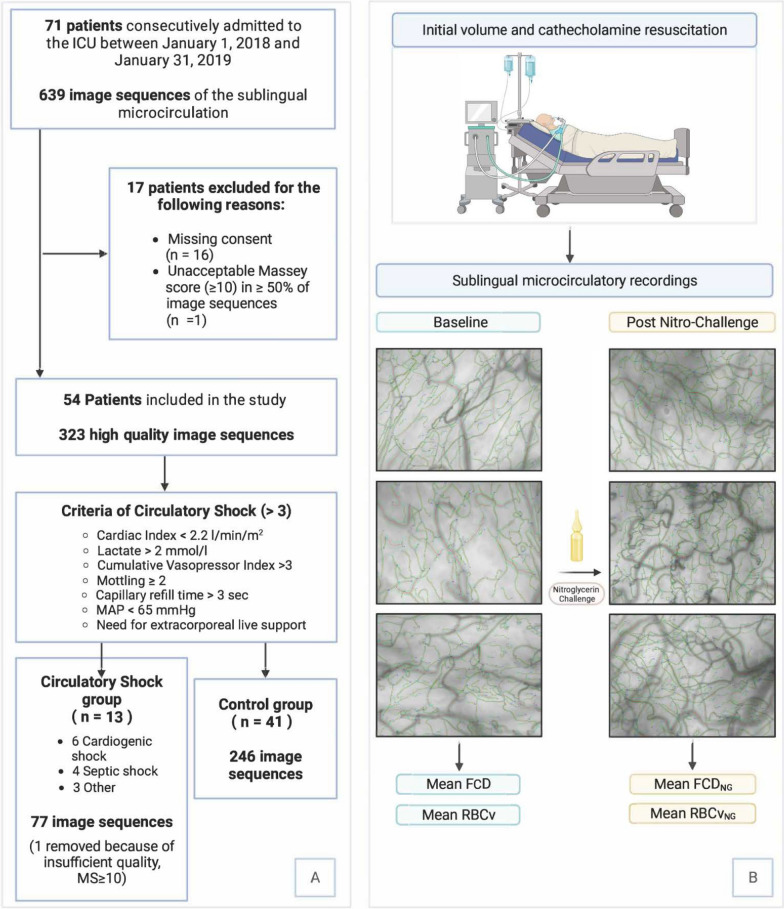
Sublingual handheld vital microscopy was performed after initial resuscitation in mechanically ventilated patients consecutively admitted to a tertiary medical ICU. FCD and RBCv were quantified using an automated computer vision algorithm (MicroTools). Patients with circulatory shock were retrospectively identified via standardized hemodynamic and clinical criteria and compared to patients without circulatory shock.
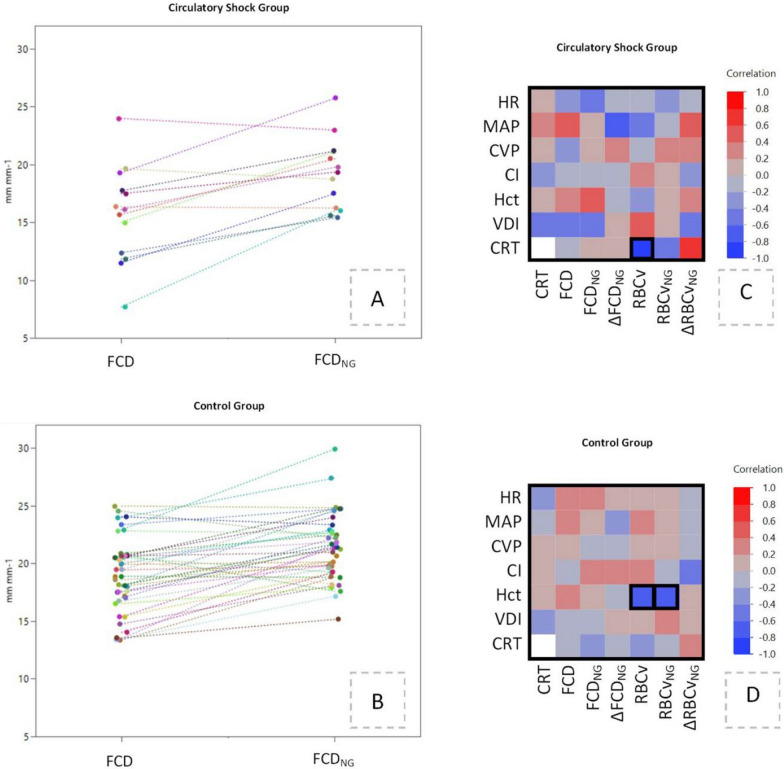
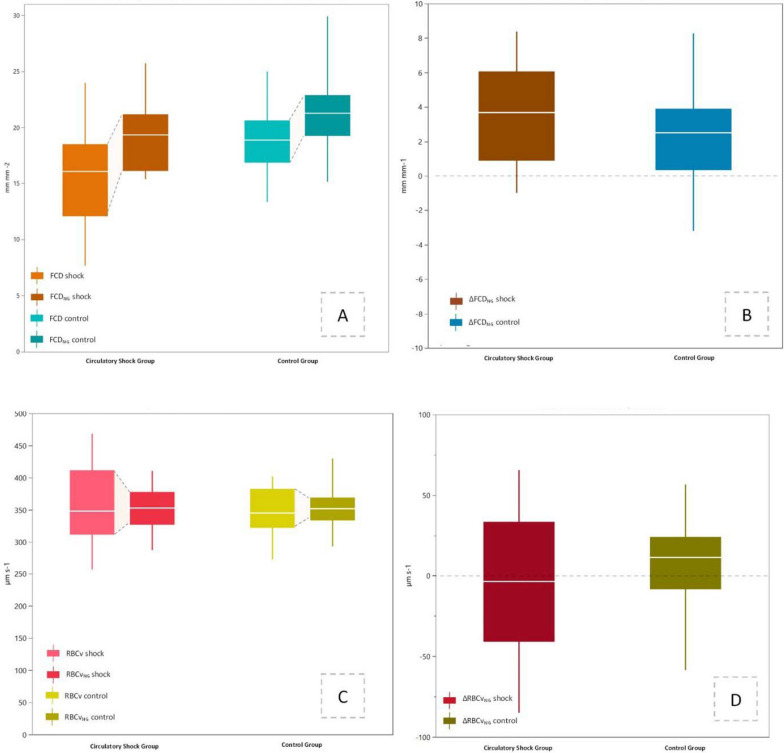
54 patients (57 ± 14y, BMI 26.3 ± 4.9 kg/m, SAPS 56 ± 19, 65% male) were included, 13 of whom presented with circulatory shock. Both groups had similar cardiac index, mean arterial pressure, RBCv, and RBCv. Heart rate (p < 0.001), central venous pressure (p = 0.02), lactate (p < 0.001), capillary refill time (p < 0.01), and Mottling score (p < 0.001) were higher in circulatory shock after initial resuscitation, while FCD and FCD were 10% lower (16.9 ± 4.2 and 18.9 ± 3.2, p < 0.01; 19.3 ± 3.1 and 21.3 ± 2.9, p = 0.03). Nitroglycerin response was similar in both groups, and circulatory shock patients reached FCD similar to baseline FCD found in patients without shock.
Critically ill patients suffering from circulatory shock were found to present with a lower sublingual FCD. The preserved nitroglycerin response suggests a dysfunction of intrinsic regulation mechanisms to increase the microcirculatory oxygen extraction capacity associated with circulatory shock and identifies a potential resuscitation target. These differences in microcirculatory hemodynamic function between patients with and without circulatory shock were not reflected in blood pressure or cardiac index.
循环性休克和多器官功能衰竭仍然是危重症患者发病和死亡的主要原因,并且与组织中氧供应不足有关。已确定改善组织灌注的内在机制,如上调功能性毛细血管密度(FCD)和红细胞流速(RBCv),是改善组织氧摄取的手段;然而,它们在循环性休克中的作用以及作为复苏靶点的潜在用途仍不清楚。为了填补这一空白,我们检测了有或无循环性休克患者对局部硝酸甘油刺激(FCD、RBCv)的基线和最大可募集FCD及RBCv,以测试这是否可能是一种识别对确定复苏靶点很重要的微循环储备能力的存在和大小的方法。
对连续入住三级医疗重症监护病房的机械通气患者进行初始复苏后,采用舌下手持式活体显微镜检查。使用自动计算机视觉算法(MicroTools)对FCD和RBCv进行量化。通过标准化的血流动力学和临床标准对循环性休克患者进行回顾性识别,并与无循环性休克的患者进行比较。
纳入54例患者(57±14岁,体重指数26.3±4.9kg/m²,简化急性生理学评分56±19,65%为男性),其中13例出现循环性休克。两组的心脏指数、平均动脉压、RBCv和RBCv相似。初始复苏后,循环性休克患者的心率(p<0.001)、中心静脉压(p=0.02)、乳酸(p<0.001)、毛细血管再充盈时间(p<0.01)和皮肤花斑评分(p<0.001)较高,而FCD和FCD低10%(16.9±4.2和18.9±3.2,p<0.