School of Physiotherapy, Department of Medicine, Surgery and Health Sciences, University of Trieste, via Pascoli 31, 34100, Trieste, Italy.
PhD program in Personalized Medicine and Innovative Therapies, Department of Medicine, Surgery and Health Sciences, University of Trieste, Strada di Fiume 447, 34149, Trieste, Italy.
Neurol Sci. 2024 Nov;45(11):5501-5509. doi: 10.1007/s10072-024-07742-y. Epub 2024 Sep 3.
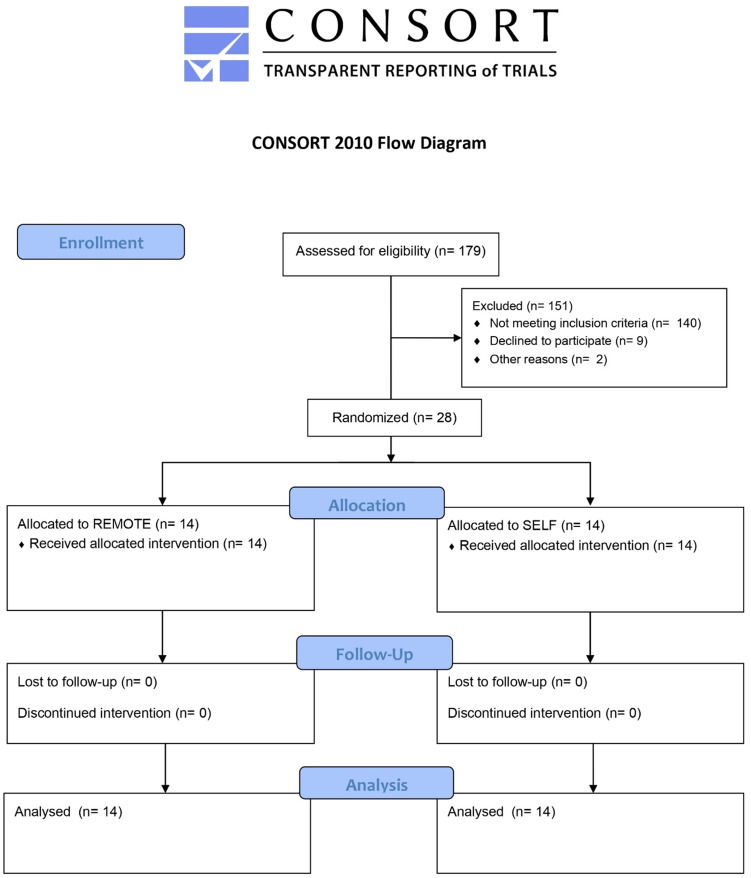
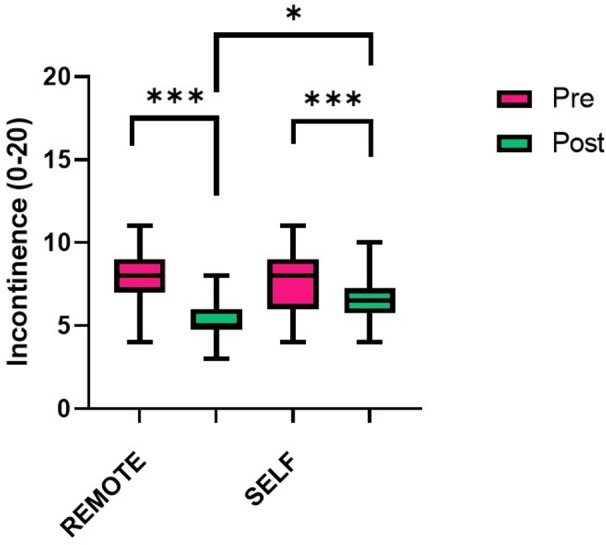
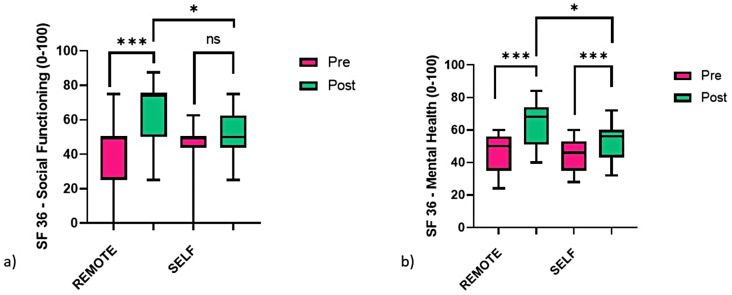
Telerehabilitation has been suggested to be equally effective than in-person rehabilitation, and could be helpful to increase participation and reduce barriers. People with multiple sclerosis (MS) often present urogenital dysfunctions, impairing independence and quality of life (QoL). Since the different available telerehabilitation protocols, the present study aimed to compare a live video urogenital rehabilitation intervention protocol (REMOTE) with a home-based pre-recorded video protocol (SELF). A randomized-controlled trial was performed, with 14 females with MS being allocated in the REMOTE group (36 ± 9 y) and 14 females in the SELF group (37 ± 7 y). Both telerehabilitation protocols were identical in terms of contents (including pelvic floor training and relaxation exercises), frequency and duration, consisting of 10 sessions of 45 min each, every 5 days. Questionnaires were administered at the beginning and the end of the study: Short Form Health Survey 36 (SF-36), Beck Depression Inventory (BDI), Female Sexual Function Index (FSFI), International Consultation on Incontinence Questionnaire (ICIQ) symptoms and related QoL, the main outcome being ICIQ incontinence score. Despite most of the outcomes improved in both groups, REMOTE was found to be more effective than SELF in most of the SF-36 domains (from p < 0.001 pη 0.555 to p = 0.044 pη 0.147), FSFI (p = 0.001 pη 0.373), ICIQ (p = 0.003 pη 0.291). Despite the home-based pre-recorded videos could be effective in improving urogenital symptoms, live video urogenital rehabilitation results in larger improvements. Telerehabilitation should be encouraged for urogenital dysfunctions in females with MS, and pre-recorded videos could represent an alternative when live sessions are not available. Clinical trial registration This randomized controlled trial was registered on ClinicalTrials.gov with the number NCT05984095.
远程康复被认为与面对面康复同样有效,并且可以帮助增加参与度并减少障碍。多发性硬化症(MS)患者常出现泌尿生殖功能障碍,从而影响独立性和生活质量(QoL)。由于不同的远程康复方案,本研究旨在比较现场视频泌尿生殖康复干预方案(REMOTE)与基于家庭的预录制视频方案(SELF)。进行了一项随机对照试验,将 14 名 MS 女性患者分配到 REMOTE 组(36±9 岁)和 SELF 组(37±7 岁)。这两种远程康复方案在内容、频率和时长方面完全相同,均包括 10 次 45 分钟的课程,每 5 天进行一次。在研究开始和结束时,通过问卷调查评估以下指标:简明健康调查量表 36 项(SF-36)、贝克抑郁量表(BDI)、女性性功能指数(FSFI)、国际尿失禁咨询问卷简表(ICIQ)症状和相关 QoL,主要结局是 ICIQ 失禁评分。尽管两组的大多数结果均有所改善,但 REMOTE 在大多数 SF-36 领域(p<0.001,pη0.555 至 p=0.044,pη0.147)、FSFI(p=0.001,pη0.373)和 ICIQ(p=0.003,pη0.291)方面的效果均优于 SELF。尽管基于家庭的预录制视频可能有效改善泌尿生殖系统症状,但现场视频泌尿生殖康复的效果更大。对于 MS 女性的泌尿生殖功能障碍,应鼓励进行远程康复,并且在无法进行现场课程时,预录制视频可以作为替代方案。临床试验注册 本随机对照试验已在 ClinicalTrials.gov 上注册,编号为 NCT05984095。