Department of Public Health, Institute of Health, Dambi Dollo University, Dambi Dollo, Ethiopia.
Department of Health Systems Management and Economics, School of Public Health, College of Medicine and Health Sciences, Bahir Dar University, Bahir Dar, Ethiopia.
BMC Public Health. 2024 Sep 2;24(1):2374. doi: 10.1186/s12889-024-19809-8.
The Internet is the preferred source of health information for retrieving relevant information. In Ethiopia, the Internet penetration rate is improving year to year, but it is still at a low level compared to the rest of the world and neighboring African countries. Due to a lack of adequate information, it is important to assess Internet use, spatial variation, and determinants of Internet use among reproductive-age group women in Ethiopia.
Secondary data from EDHS 2016 were used to analyze 15,683 women aged 15-49 years. Spatial analysis was performed using ArcGIS 10.7. The Bernoulli model was used by applying Kuldorff's methods using SaTScan 10.1.2 software to analyze the purely spatial clusters of Internet use. A multilevel mixed-effect logistic regression was applied to estimate community variance to identify individual- and community-level factors associated with Internet use. All models were fitted in STATA version 17.0, and finally, the adjusted odds ratio (AOR) with a corresponding 95% confidence interval (CI) was reported.
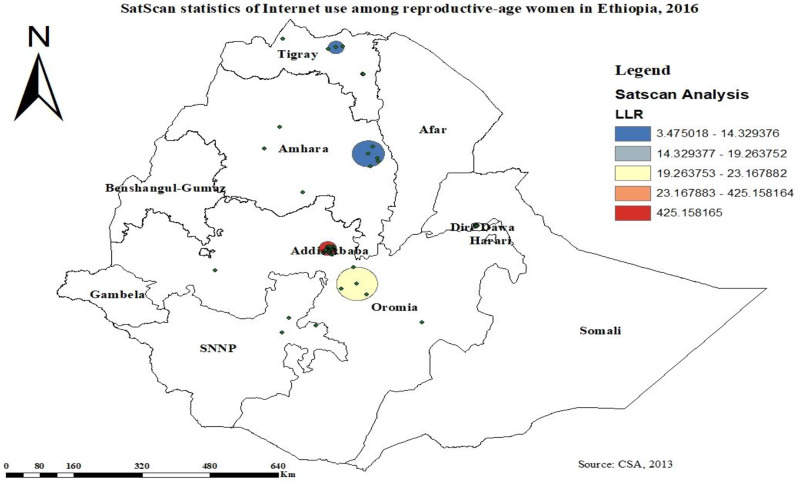
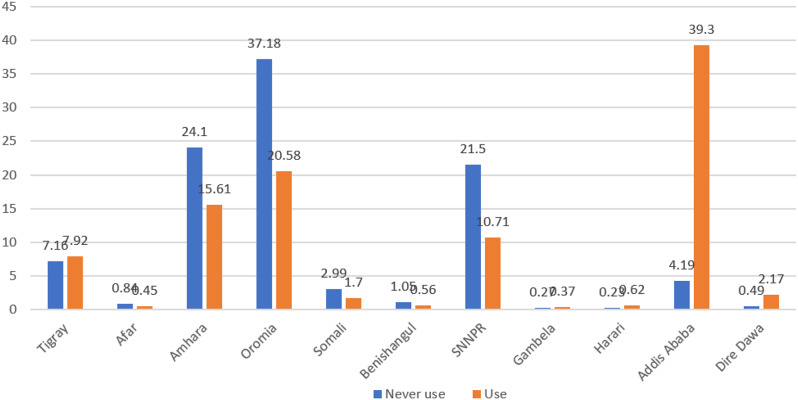
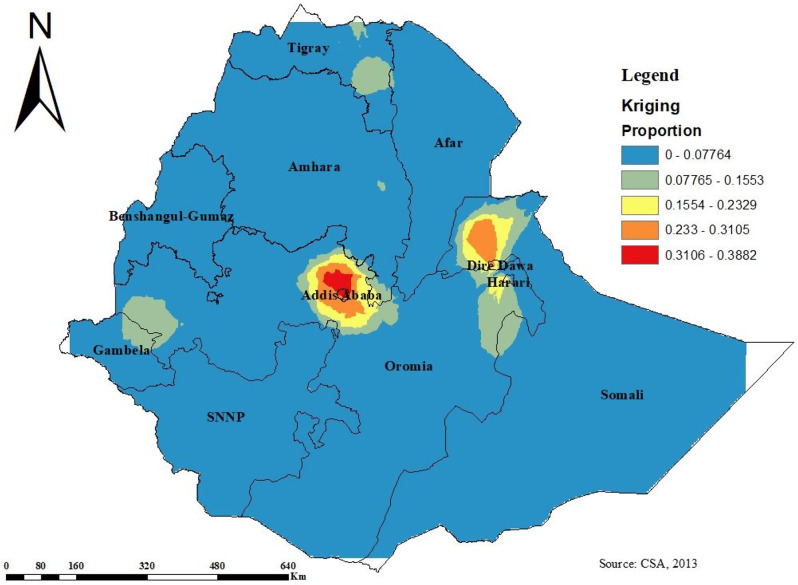
The magnitude of Internet use was 4.97% ± 95% CI (4.63-5.32). The overall average age of women was 24.21 ± 8.06 years, with the age range 15-24 years constituting the larger group (39.2%). Women with secondary and above education [AOR = 6.47; 95% CI (5.04, 8.31)], unmarried [AOR = 2.60; 95% CI (1.89, 3.56)], rich [AOR = 1.95; 95% CI (1.00, 3.80)], own a mobile phone [AOR = 3.74; 95% CI (2.75, 5.09)], media exposure [AOR = 2.63; 95% CI (2.03, 3.42)], and urban [AOR = 1.80; 95% CI (1.08, 3.01)] had higher odds of Internet use. The spatial variation in Internet use was found to be nonrandom (global Moran's I = 0.58, p value < 0.001). Fifty-seven primary clusters were identified that were located in Addis Ababa city with a relative likelihood of 10.24 and a log-likelihood ratio of 425.16.
Internet use among reproductive-age women in Ethiopia is 4.97 and has significant spatial variation across the country. Both community- and individual-level factors affect Internet use in Ethiopia. Therefore, educating women, improving access to media, encouraging women to use family planning, and supporting household wealth could improve women's Internet use.
互联网是检索相关信息的首选健康信息来源。在埃塞俄比亚,互联网普及率逐年提高,但与世界其他地区和非洲邻国相比仍处于较低水平。由于缺乏足够的信息,评估埃塞俄比亚育龄妇女的互联网使用情况、空间差异以及互联网使用的决定因素非常重要。
使用 EDHS 2016 的二次数据对 15683 名 15-49 岁的妇女进行分析。使用 ArcGIS 10.7 进行空间分析。使用 SaTScan 10.1.2 软件应用 Kuldorff 方法的 Bernoulli 模型分析互联网使用的纯空间聚类。应用多层混合效应逻辑回归估计社区方差,以确定与互联网使用相关的个体和社区层面的因素。所有模型均在 STATA 版本 17.0 中拟合,最后报告调整后的优势比(AOR)及其相应的 95%置信区间(CI)。
互联网使用的比例为 4.97%±95%CI(4.63-5.32)。女性的总体平均年龄为 24.21±8.06 岁,年龄在 15-24 岁的女性比例较大(39.2%)。接受过中等和高等教育的女性[AOR=6.47;95%CI(5.04,8.31)]、未婚[AOR=2.60;95%CI(1.89,3.56)]、富裕[AOR=1.95;95%CI(1.00,3.80)]、拥有手机[AOR=3.74;95%CI(2.75,5.09)]、媒体曝光[AOR=2.63;95%CI(2.03,3.42)]和城市[AOR=1.80;95%CI(1.08,3.01)]的女性更有可能使用互联网。发现互联网使用的空间变化是非随机的(全局 Moran's I=0.58,p 值<0.001)。确定了 57 个初级集群,它们位于亚的斯亚贝巴市,相对可能性为 10.24,对数似然比为 425.16。
埃塞俄比亚育龄妇女的互联网使用率为 4.97%,全国范围内存在显著的空间差异。社区和个体层面的因素都会影响埃塞俄比亚的互联网使用。因此,对妇女进行教育、改善获取媒体的途径、鼓励妇女使用计划生育以及支持家庭财富,都可以提高妇女的互联网使用水平。