Silver-Gorges Ian, Shamblin Brian M, Ashford Mason, Bower Paityn, Fuentes Mariana M P B
Department of Earth, Ocean, and Atmospheric Science Florida State University Tallahassee Florida USA.
Warnell School of Forestry and Natural Resources University of Georgia Athens Georgia USA.
Ecol Evol. 2024 Sep 2;14(9):e70166. doi: 10.1002/ece3.70166. eCollection 2024 Sep.
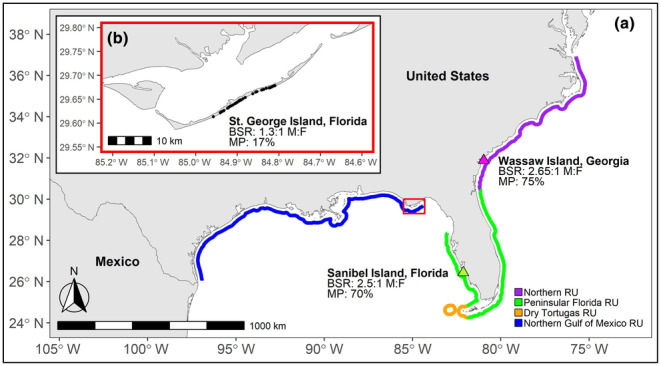
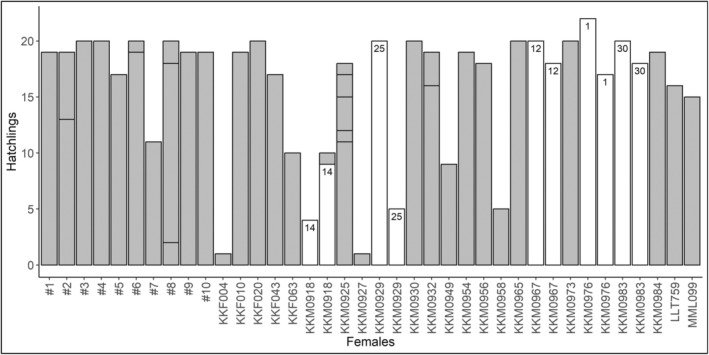
Small populations of imperiled species are susceptible to the negative consequences of skewed sex-ratios. In imperiled species with environmental sex determination such as sea turtles, examining sex ratios across a range of environments and population abundance levels can provide insight into factors that influence population resilience, which can then be the foci of management plans for these species. Breeding sex ratios (the ratio of actively breeding males to females during a reproductive season; BSRs) extrapolated from genetic parentage analyses are a common approach for enumerating sex ratios in sea turtles. Such analyses also allow for the characterization of multiple paternity within sea turtle clutches, which should reflect BSRs and breeding behaviors. We characterized the first BSR for a breeding assemblage of loggerhead sea turtles () belonging to the temperate, low-abundance Northern Gulf of Mexico Recovery Unit using genotypes of 16 microsatellite loci from nesting females and hatchlings. Unlike prior studies at both more-tropical and more-temperate, and higher-abundance, Recovery Units in this region, we found a balanced BSR of 1.3:1 males:female and a low incidence (~17%) of multiple paternity. This suggests that there are relatively few males breeding at this assemblage and within this Recovery Unit. Beaches in this region are expected to produce substantial numbers of male hatchlings based on sand temperature data. The relative dearth of mature males may then be due to hydrologic disturbances that disproportionately affect the fitness and survival of male hatchlings, or due to demographic stochasticity. More work is needed to study the factors that might influence male hatchling production and fitness in this region, particularly as climate change is predicted to lead to feminization in global sea turtle populations. Our work demonstrates the broad utility of characterizing BSRs and other sex ratios across a range of populations in imperiled, environmentally sensitive species.
濒危物种的小种群容易受到性别比例失衡的负面影响。在具有环境性别决定的濒危物种中,如海龟,研究一系列环境和种群丰度水平下的性别比例,可以深入了解影响种群恢复力的因素,进而成为这些物种管理计划的重点。通过遗传亲权分析推断出的繁殖性别比例(繁殖季节中积极繁殖的雄性与雌性的比例;BSRs)是计算海龟性别比例的常用方法。此类分析还可以对海龟巢穴内的多重父权进行特征描述,这应该能反映BSRs和繁殖行为。我们利用筑巢雌性海龟和幼龟的16个微卫星位点的基因型,对属于墨西哥湾北部温带、低丰度恢复单元的一组蠵龟的首次繁殖性别比例进行了特征描述。与该地区此前在热带性更强、温带性更强以及丰度更高的恢复单元所做的研究不同,我们发现雄性与雌性的平衡繁殖性别比例为1.3:1,且多重父权的发生率较低(约17%)。这表明在这个群体以及这个恢复单元内繁殖的雄性相对较少。根据沙温数据,预计该地区的海滩会产出大量雄性幼龟。成熟雄性相对较少可能是由于水文干扰对雄性幼龟的适应性和存活率产生了不成比例的影响,或者是由于种群统计学随机性。需要开展更多工作来研究可能影响该地区雄性幼龟产出和适应性的因素,尤其是在预计气候变化将导致全球海龟种群雌性化的情况下。我们的研究表明,在濒危的、对环境敏感的物种中,描述一系列种群的繁殖性别比例和其他性别比例具有广泛的实用性。