• 文献检索
  • 文档翻译
  • 深度研究
  • 学术资讯
  • Suppr Zotero 插件Zotero 插件
  • 邀请有礼
  • 套餐&价格
  • 历史记录
应用&插件
Suppr Zotero 插件Zotero 插件浏览器插件Mac 客户端Windows 客户端微信小程序
定价
高级版会员购买积分包购买API积分包
服务
文献检索文档翻译深度研究API 文档MCP 服务
关于我们
关于 Suppr公司介绍联系我们用户协议隐私条款
关注我们

Suppr 超能文献

核心技术专利:CN118964589B侵权必究
粤ICP备2023148730 号-1Suppr @ 2026

文献检索

告别复杂PubMed语法,用中文像聊天一样搜索,搜遍4000万医学文献。AI智能推荐,让科研检索更轻松。

立即免费搜索

文件翻译

保留排版,准确专业,支持PDF/Word/PPT等文件格式,支持 12+语言互译。

免费翻译文档

深度研究

AI帮你快速写综述,25分钟生成高质量综述,智能提取关键信息,辅助科研写作。

立即免费体验

阿魏酸甲酯通过调节PI3K/HIF-1α/VEGF信号通路减轻大鼠脑缺血再灌注损伤

Ferulic Acid Methyl Ester Attenuates Cerebral Ischemia-Reperfusion Injury in Rats by Modulating PI3K/HIF-1α/VEGF Signaling Pathway.

作者信息

Zhou Peijie, Yu Shangshang, Wang Xuan, Zhang Xiaofei, Guo Dongyan, Zhao Chongbo, Cheng Jiangxue, Wang Jing, Sun Jing

机构信息

Department of Pharmaceutics, College of Pharmacy, The Key Laboratory of Basic and New Drug Research of Traditional Chinese Medicine, Shaanxi Provincial Engineering Technology Research Center for Traditional Chinese Medicine Decoction Pieces, Shaanxi University of Chinese Medicine, Xianyang, Shaanxi, People's Republic of China.

出版信息

J Inflamm Res. 2024 Aug 29;17:5741-5762. doi: 10.2147/JIR.S473665. eCollection 2024.

DOI:10.2147/JIR.S473665
PMID:39224659
原文链接:https://pmc.ncbi.nlm.nih.gov/articles/PMC11368119/
Abstract

BACKGROUND

Cerebral ischaemia-reperfusion injury (CIRI) could worsen the inflammatory response and oxidative stress in brain tissue. According to previous studies, ferulic acid methyl ester (FAME), as the extract with the strongest comprehensive activity in the traditional Chinese medicine Huang Hua oil dot herb, has significant anti-oxidative stress and neuroprotective functions, and can effectively alleviate CIRI, but its mechanism of action is still unclear.

METHODS

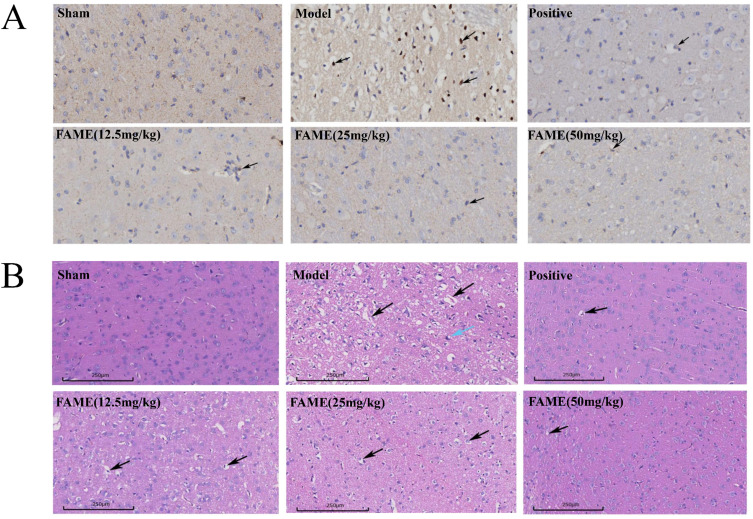
Firstly, the pharmacological effects of FAME were investigated by in vitro oxidative stress and inflammatory experiments. Secondly, evaluate the therapeutic effects of FAME in the treatment of CIRI by brain histopathological staining and cerebral infarct area by replicating the in vivo MACO model. Thirdly, RNA-Seq and network pharmacology were utilized to predict the possible targets and mechanisms of FAME for CIRI at the molecular level. Finally, the expression of key target proteins, as well as the key regulatory relationships were verified by molecular docking visualization, Western Blotting and immunohistochemistry.

RESULTS

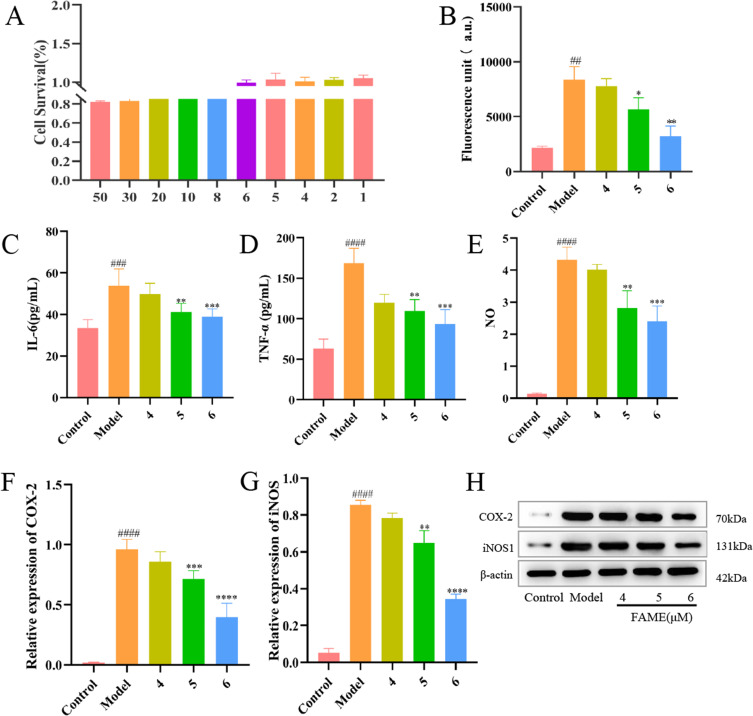
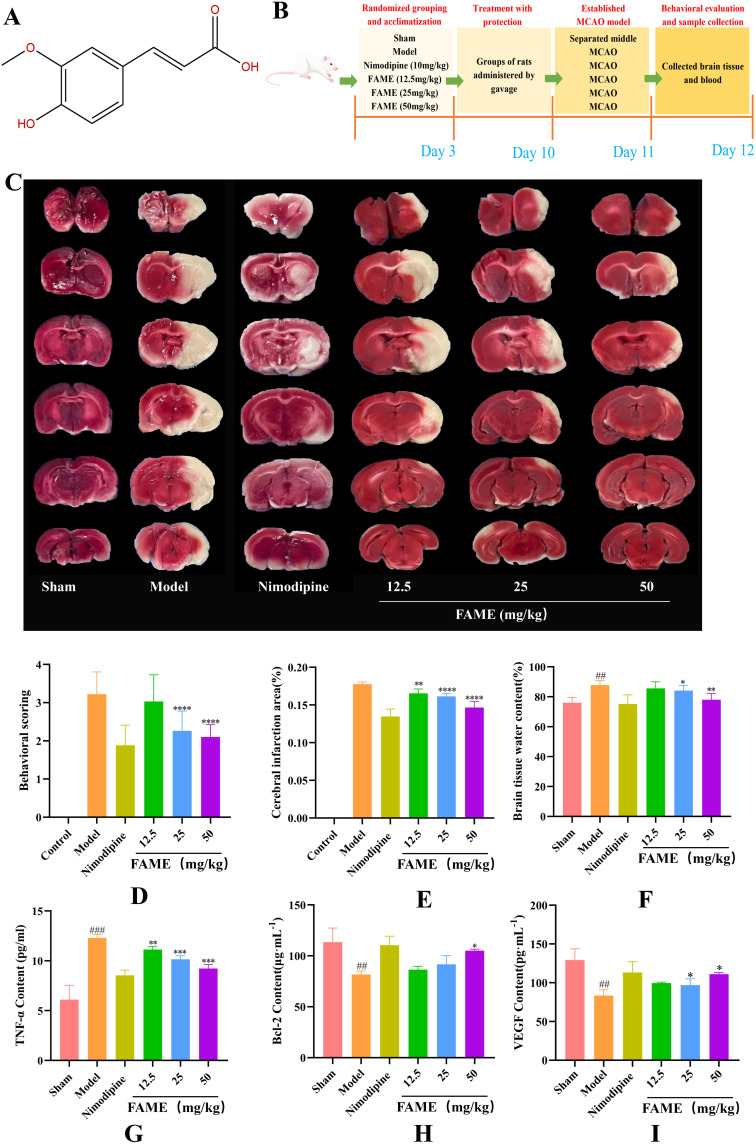
The results of in vitro experiments concluded that FAME could significantly reduce the content of TNF-α, IL-1β and ROS, inhibiting COX-2 and iNOS protein expression in cells(p<0.01). FAME was demonstrated to have anti-oxidative stress and anti-inflammatory effects. The results of in vivo experiments showed that after the administration of FAME, the area of cerebral infarction in rats with CIRI was reduced, the content of Bcl-2 and VEGF was increased(p<0.05). Network pharmacology and RNA-Seq showed that the alleviation of CIRI by FAME may be through PI3K-AKT and HIF-1 signaling pathway. Enhanced expression of HIF-1α, VEGF, p-PI3K, p-AKT proteins in the brain tissues of rats in the FAME group was verified by molecular docking and Western Blotting.

CONCLUSION

FAME possesses significant anti-inflammatory and anti-oxidative stress activities and alleviates CIRI through the PI3K/HIF-1α/VEGF signaling pathway.

摘要

背景

脑缺血再灌注损伤(CIRI)可加重脑组织的炎症反应和氧化应激。根据以往研究,阿魏酸甲酯(FAME)作为中药黄花油点草中综合活性最强的提取物,具有显著的抗氧化应激和神经保护作用,能有效减轻CIRI,但其作用机制尚不清楚。

方法

首先,通过体外氧化应激和炎症实验研究FAME的药理作用。其次,通过复制体内大脑中动脉闭塞(MACO)模型,采用脑组织病理染色和脑梗死面积评估FAME治疗CIRI的疗效。第三,利用RNA测序(RNA-Seq)和网络药理学在分子水平预测FAME治疗CIRI的潜在靶点和机制。最后,通过分子对接可视化、蛋白质免疫印迹法(Western Blotting)和免疫组化验证关键靶蛋白的表达以及关键调控关系。

结果

体外实验结果表明,FAME可显著降低肿瘤坏死因子-α(TNF-α)、白细胞介素-1β(IL-1β)和活性氧(ROS)含量,抑制细胞中环氧合酶-2(COX-2)和诱导型一氧化氮合酶(iNOS)蛋白表达(p<0.01)。证明FAME具有抗氧化应激和抗炎作用。体内实验结果显示,给予FAME后,CIRI大鼠的脑梗死面积减小,Bcl-2和血管内皮生长因子(VEGF)含量增加(p<0.05)。网络药理学和RNA-Seq显示,FAME减轻CIRI可能是通过磷脂酰肌醇-3激酶-蛋白激酶B(PI3K-AKT)和低氧诱导因子-1(HIF-1)信号通路。通过分子对接和Western Blotting验证了FAME组大鼠脑组织中HIF-1α、VEGF、磷酸化PI3K(p-PI3K)、磷酸化AKT(p-AKT)蛋白表达增强。

结论

FAME具有显著的抗炎和抗氧化应激活性,并通过PI3K/HIF-1α/VEGF信号通路减轻CIRI。

https://cdn.ncbi.nlm.nih.gov/pmc/blobs/6c34/11368119/00f78cd8433d/JIR-17-5741-g0012.jpg
https://cdn.ncbi.nlm.nih.gov/pmc/blobs/6c34/11368119/bc5029931622/JIR-17-5741-g0001.jpg
https://cdn.ncbi.nlm.nih.gov/pmc/blobs/6c34/11368119/09498f800d02/JIR-17-5741-g0002.jpg
https://cdn.ncbi.nlm.nih.gov/pmc/blobs/6c34/11368119/65db358b643f/JIR-17-5741-g0003.jpg
https://cdn.ncbi.nlm.nih.gov/pmc/blobs/6c34/11368119/593240ff0dd1/JIR-17-5741-g0004.jpg
https://cdn.ncbi.nlm.nih.gov/pmc/blobs/6c34/11368119/821977da4d9b/JIR-17-5741-g0005.jpg
https://cdn.ncbi.nlm.nih.gov/pmc/blobs/6c34/11368119/10a08b4f0459/JIR-17-5741-g0006.jpg
https://cdn.ncbi.nlm.nih.gov/pmc/blobs/6c34/11368119/ac7177c4b35e/JIR-17-5741-g0007.jpg
https://cdn.ncbi.nlm.nih.gov/pmc/blobs/6c34/11368119/6e85d10a93fd/JIR-17-5741-g0008.jpg
https://cdn.ncbi.nlm.nih.gov/pmc/blobs/6c34/11368119/f4791940f8b3/JIR-17-5741-g0009.jpg
https://cdn.ncbi.nlm.nih.gov/pmc/blobs/6c34/11368119/8e0bcfe018c5/JIR-17-5741-g0010.jpg
https://cdn.ncbi.nlm.nih.gov/pmc/blobs/6c34/11368119/202d85641533/JIR-17-5741-g0011.jpg
https://cdn.ncbi.nlm.nih.gov/pmc/blobs/6c34/11368119/00f78cd8433d/JIR-17-5741-g0012.jpg
https://cdn.ncbi.nlm.nih.gov/pmc/blobs/6c34/11368119/bc5029931622/JIR-17-5741-g0001.jpg
https://cdn.ncbi.nlm.nih.gov/pmc/blobs/6c34/11368119/09498f800d02/JIR-17-5741-g0002.jpg
https://cdn.ncbi.nlm.nih.gov/pmc/blobs/6c34/11368119/65db358b643f/JIR-17-5741-g0003.jpg
https://cdn.ncbi.nlm.nih.gov/pmc/blobs/6c34/11368119/593240ff0dd1/JIR-17-5741-g0004.jpg
https://cdn.ncbi.nlm.nih.gov/pmc/blobs/6c34/11368119/821977da4d9b/JIR-17-5741-g0005.jpg
https://cdn.ncbi.nlm.nih.gov/pmc/blobs/6c34/11368119/10a08b4f0459/JIR-17-5741-g0006.jpg
https://cdn.ncbi.nlm.nih.gov/pmc/blobs/6c34/11368119/ac7177c4b35e/JIR-17-5741-g0007.jpg
https://cdn.ncbi.nlm.nih.gov/pmc/blobs/6c34/11368119/6e85d10a93fd/JIR-17-5741-g0008.jpg
https://cdn.ncbi.nlm.nih.gov/pmc/blobs/6c34/11368119/f4791940f8b3/JIR-17-5741-g0009.jpg
https://cdn.ncbi.nlm.nih.gov/pmc/blobs/6c34/11368119/8e0bcfe018c5/JIR-17-5741-g0010.jpg
https://cdn.ncbi.nlm.nih.gov/pmc/blobs/6c34/11368119/202d85641533/JIR-17-5741-g0011.jpg
https://cdn.ncbi.nlm.nih.gov/pmc/blobs/6c34/11368119/00f78cd8433d/JIR-17-5741-g0012.jpg

相似文献

1
Ferulic Acid Methyl Ester Attenuates Cerebral Ischemia-Reperfusion Injury in Rats by Modulating PI3K/HIF-1α/VEGF Signaling Pathway.阿魏酸甲酯通过调节PI3K/HIF-1α/VEGF信号通路减轻大鼠脑缺血再灌注损伤
J Inflamm Res. 2024 Aug 29;17:5741-5762. doi: 10.2147/JIR.S473665. eCollection 2024.
2
Porcine cardiac blood - Salvia miltiorrhiza root alleviates cerebral ischemia reperfusion injury by inhibiting oxidative stress induced apoptosis through PI3K/AKT/Bcl-2/Bax signaling pathway.猪心血液-丹参根通过抑制氧化应激诱导的凋亡来减轻脑缺血再灌注损伤,通过 PI3K/AKT/Bcl-2/Bax 信号通路。
J Ethnopharmacol. 2023 Nov 15;316:116698. doi: 10.1016/j.jep.2023.116698. Epub 2023 Jun 5.
3
An Integrated Analysis of Network Pharmacology and Experimental Validation to Reveal the Mechanism of Chinese Medicine Formula Naotaifang in Treating Cerebral Ischemia-Reperfusion Injury.基于网络药理学与实验验证的整合分析揭示脑泰方治疗脑缺血再灌注损伤的作用机制。
Drug Des Devel Ther. 2021 Sep 7;15:3783-3808. doi: 10.2147/DDDT.S328837. eCollection 2021.
4
Mechanism of Astragalus mongholicus Bunge ameliorating cerebral ischemia-reperfusion injury: Based on network pharmacology analysis and experimental verification.黄芪改善脑缺血再灌注损伤的机制:基于网络药理学分析与实验验证
J Ethnopharmacol. 2024 Jul 15;329:118157. doi: 10.1016/j.jep.2024.118157. Epub 2024 Apr 6.
5
Sanpian decoction ameliorates cerebral ischemia-reperfusion injury by regulating SIRT1/ERK/HIF-1α pathway through in silico analysis and experimental validation.通过计算机模拟分析和实验验证,三皮汤通过调节SIRT1/ERK/HIF-1α信号通路减轻脑缺血再灌注损伤。
J Ethnopharmacol. 2024 Jan 10;318(Pt A):116898. doi: 10.1016/j.jep.2023.116898. Epub 2023 Jul 17.
6
Dan-Deng-Tong-Nao softgel capsule promotes angiogenesis of cerebral microvasculature to protect cerebral ischemia reperfusion injury via activating HIF-1α-VEGFA-Notch1 signaling pathway.丹灯通脑软胶囊通过激活 HIF-1α-VEGFA-Notch1 信号通路促进脑微血管血管生成,保护脑缺血再灌注损伤。
Phytomedicine. 2023 Sep;118:154966. doi: 10.1016/j.phymed.2023.154966. Epub 2023 Jul 13.
7
Roles of Nrf2/HO-1 and HIF-1α/VEGF in lung tissue injury and repair following cerebral ischemia/reperfusion injury.脑缺血再灌注损伤后 Nrf2/HO-1 和 HIF-1α/VEGF 在肺组织损伤与修复中的作用。
J Cell Physiol. 2019 Jun;234(6):7695-7707. doi: 10.1002/jcp.27767. Epub 2018 Nov 22.
8
Calycosin alleviates cerebral ischemia/reperfusion injury by repressing autophagy via STAT3/FOXO3a signaling pathway.毛蕊异黄酮通过 STAT3/FOXO3a 信号通路抑制自噬从而减轻脑缺血再灌注损伤。
Phytomedicine. 2023 Jul;115:154845. doi: 10.1016/j.phymed.2023.154845. Epub 2023 Apr 28.
9
Chrysin inhibits ferroptosis of cerebral ischemia/reperfusion injury via regulating HIF-1α/CP loop.白杨素通过调控 HIF-1α/CP 环抑制脑缺血再灌注损伤中的铁死亡。
Biomed Pharmacother. 2024 May;174:116500. doi: 10.1016/j.biopha.2024.116500. Epub 2024 Mar 30.
10
Moxibustion preconditioning reduces inflammatory response in rats with cerebral ischemia-reperfusion injury by regulating PI3K / AKT / mTOR signaling pathway.艾灸预处理通过调节 PI3K/AKT/mTOR 信号通路减少脑缺血再灌注损伤大鼠的炎症反应。
Zhen Ci Yan Jiu. 2024 Mar 25;49(3):238-246. doi: 10.13702/j.1000-0607.20230267.

引用本文的文献

1
Exosomal MicroRNA: an Effective Strategy for the Treatment of Intracerebral Hemorrhage.外泌体微小RNA:一种治疗脑出血的有效策略。
Mol Neurobiol. 2025 Apr 2. doi: 10.1007/s12035-025-04886-6.

本文引用的文献

1
Cocaine induces vascular smooth muscle cells proliferation via DRP1-mediated mitochondrial fission and PI3K/HIF-1α signaling.可卡因通过 DRP1 介导线粒体分裂和 PI3K/HIF-1α 信号通路诱导血管平滑肌细胞增殖。
Biochem Biophys Res Commun. 2023 Oct 8;676:30-35. doi: 10.1016/j.bbrc.2023.07.020. Epub 2023 Jul 14.
2
Protection of a novel velvet antler polypeptide PNP1 against cerebral ischemia-reperfusion injury.一种新型鹿茸多肽 PNP1 对脑缺血再灌注损伤的保护作用。
Int J Biol Macromol. 2023 Aug 30;247:125815. doi: 10.1016/j.ijbiomac.2023.125815. Epub 2023 Jul 13.
3
Protection against brain injury after ischemic stroke by intravenous human amnion epithelial cells in combination with tissue plasminogen activator.
静脉注射人羊膜上皮细胞联合组织型纤溶酶原激活剂对缺血性中风后脑损伤的保护作用。
Front Neurosci. 2023 Jun 16;17:1157236. doi: 10.3389/fnins.2023.1157236. eCollection 2023.
4
Geraniol protects hippocampal CA1 neurons and improves functional outcomes in global model of stroke in rats.香叶醇保护海马 CA1 神经元,并改善大鼠全脑中风模型的功能结果。
Chem Biol Drug Des. 2023 Sep;102(3):523-535. doi: 10.1111/cbdd.14260. Epub 2023 Apr 28.
5
Two Ferulic Acid Derivatives Inhibit Neuroinflammatory Response in Human HMC3 Microglial Cells via NF-B Signaling Pathway.两种阿魏酸衍生物通过 NF-B 信号通路抑制人源 HMC3 小胶质细胞的神经炎症反应。
Molecules. 2023 Feb 22;28(5):2080. doi: 10.3390/molecules28052080.
6
Re-Exploring the Inflammation-Related Core Genes and Modules in Cerebral Ischemia.再探脑缺血相关炎症核心基因和模块。
Mol Neurobiol. 2023 Jun;60(6):3439-3451. doi: 10.1007/s12035-023-03275-1. Epub 2023 Mar 3.
7
Mechanistic insights of Cucumis melo L. seeds for gastrointestinal muscle spasms through calcium signaling pathway-related gene regulation networks in WGCNA and in vitro, in vivo studies.蔓越莓种子通过 WGCNA 及在体、离体研究调控钙信号通路相关基因网络治疗胃肠道肌肉痉挛的作用机制研究。
Comput Biol Med. 2023 Mar;155:106596. doi: 10.1016/j.compbiomed.2023.106596. Epub 2023 Feb 2.
8
Gelsemine Exerts Neuroprotective Effects on Neonatal Mice with Hypoxic-Ischemic Brain Injury by Suppressing Inflammation and Oxidative Stress via Nrf2/HO-1 Pathway.钩吻素子通过Nrf2/HO-1通路抑制炎症和氧化应激,对缺氧缺血性脑损伤新生小鼠发挥神经保护作用。
Neurochem Res. 2023 May;48(5):1305-1319. doi: 10.1007/s11064-022-03815-6. Epub 2022 Nov 30.
9
Emerging Treatment Strategies for Cerebral Ischemia-Reperfusion Injury.脑缺血再灌注损伤的新兴治疗策略
Neuroscience. 2022 Dec 15;507:112-124. doi: 10.1016/j.neuroscience.2022.10.020. Epub 2022 Oct 28.
10
An immune-related gene signature for the prognosis of human bladder cancer based on WGCNA.基于 WGCNA 的人类膀胱癌预后免疫相关基因特征。
Comput Biol Med. 2022 Dec;151(Pt A):106186. doi: 10.1016/j.compbiomed.2022.106186. Epub 2022 Oct 12.