Roy Sunetra K, Majumdar Sukanta, Singh Rashmi, Paul Avijit
Department of Community Medicine, Calcutta National Medical College, Kolkata, West Bengal, India.
J Family Med Prim Care. 2024 Aug;13(8):2880-2885. doi: 10.4103/jfmpc.jfmpc_1050_23. Epub 2024 Jul 26.
Postpartum depression (PPD) is a form of depression that affects new mothers within the first year after childbirth. PPD can negatively impact both the mother's quality of life and the child's development. Untreated PPD can lead to adverse outcomes, such as infant growth retardation, poor child survival, impaired development, and undernutrition. The burden of PPD is a significant public health concern, with a global prevalence increase of 18.4% from 2005 to 2015. Early detection and intervention of PPD can mitigate the severity and chronicity of symptoms.
This study aimed to determine the prevalence of PPD among mothers in an urban area of Kolkata and identify any influencing factors.
The study utilized a cross-sectional design, surveying 189 mothers within the postpartum period of 6 weeks to 1 year. Edinburg Postnatal Depression Scale was used to identify possible PPD.
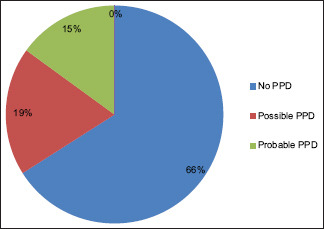
About 29% of the women had probable PPD, 19% had possible depression, and 15% had no depression. Factors associated with depression included low birth weight and primiparity, while financial independence served as a protective factor. Multinomial regression analysis revealed that low-birth-weight babies, marital conflict, lack of support at home, and primiparity had higher odds of depression, whereas financial independence was a protective factor. Age was not statistically significant.
A high prevalence of PPD and significant associations with factors emphasized the importance of screening all mothers for PPD, providing medical care and counselling, and ensuring acceptance and support from partners, family, and society.
产后抑郁症(PPD)是一种在产后一年内影响新妈妈的抑郁症形式。产后抑郁症会对母亲的生活质量和孩子的发育产生负面影响。未经治疗的产后抑郁症会导致不良后果,如婴儿生长发育迟缓、儿童存活率低、发育受损和营养不良。产后抑郁症的负担是一个重大的公共卫生问题,从2005年到2015年全球患病率上升了18.4%。早期发现和干预产后抑郁症可以减轻症状的严重程度和慢性化程度。
本研究旨在确定加尔各答市区母亲中产后抑郁症的患病率,并确定任何影响因素。
本研究采用横断面设计,对189名产后6周至1年的母亲进行调查。使用爱丁堡产后抑郁量表来识别可能患有产后抑郁症的情况。
约29%的女性可能患有产后抑郁症,19%可能患有抑郁症,15%没有抑郁症。与抑郁症相关的因素包括低出生体重和初产,而经济独立是一个保护因素。多项回归分析显示,低体重儿、婚姻冲突、家庭缺乏支持和初产患抑郁症的几率较高,而经济独立是一个保护因素。年龄在统计学上不显著。
产后抑郁症的高患病率以及与相关因素的显著关联强调了对所有母亲进行产后抑郁症筛查、提供医疗护理和咨询以及确保伴侣、家庭和社会给予接纳和支持的重要性。