Cockx Helena M, Oostenveld Robert, Flórez R Yuli A, Bloem Bastiaan R, Cameron Ian G M, van Wezel Richard J A
Department of Neurobiology, Faculty of Science, Donders Institute for Brain, Cognition and Behaviour, Radboud University, 6525AJ Nijmegen, The Netherlands.
Department of Neurology, Center of Expertise for Parkinson and Movement Disorders, Donders Institute for Brain, Cognition and Behaviour, Radboud University Medical Center, 6525GC Nijmegen, The Netherlands.
Brain Commun. 2024 Aug 2;6(5):fcae259. doi: 10.1093/braincomms/fcae259. eCollection 2024.
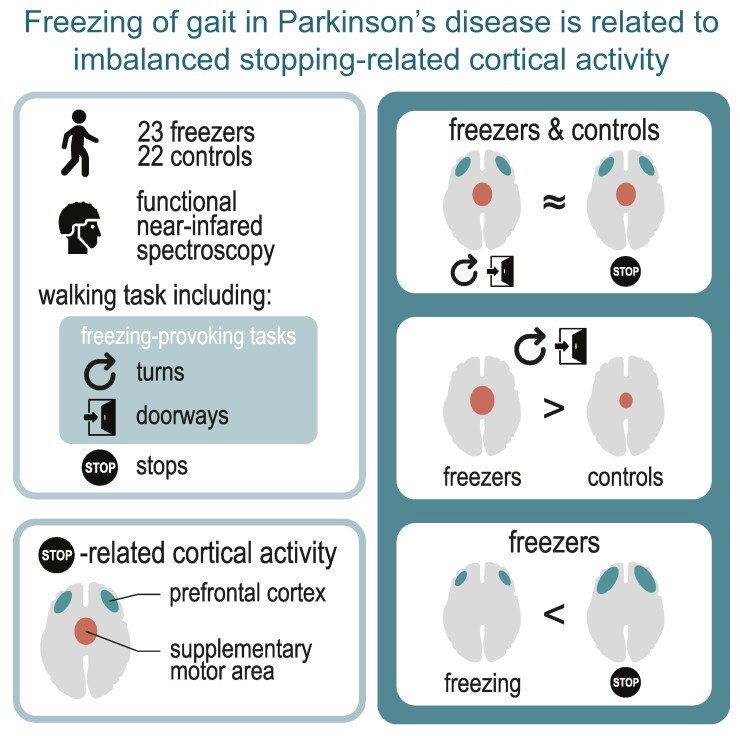
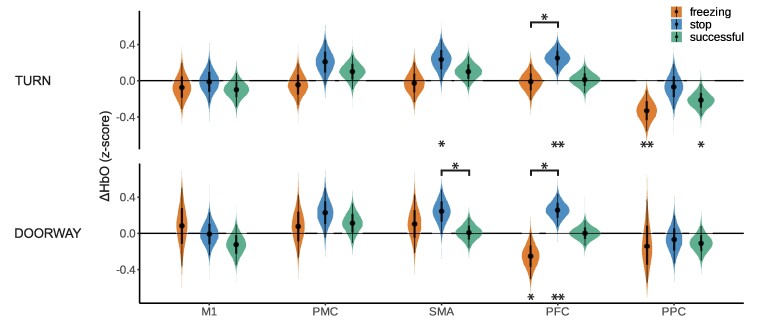
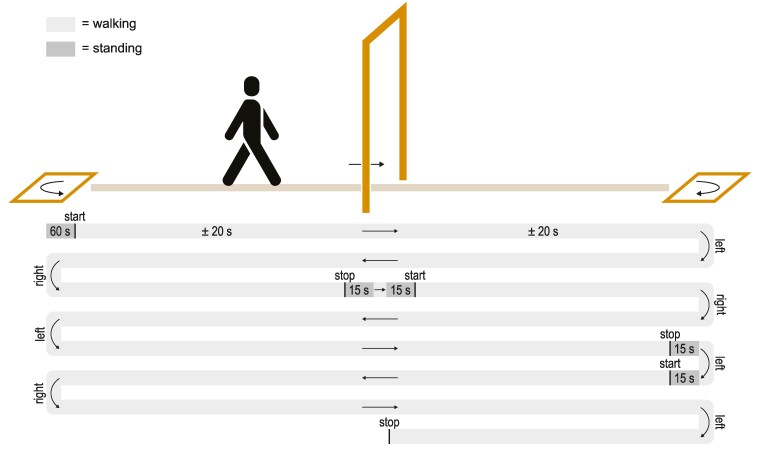
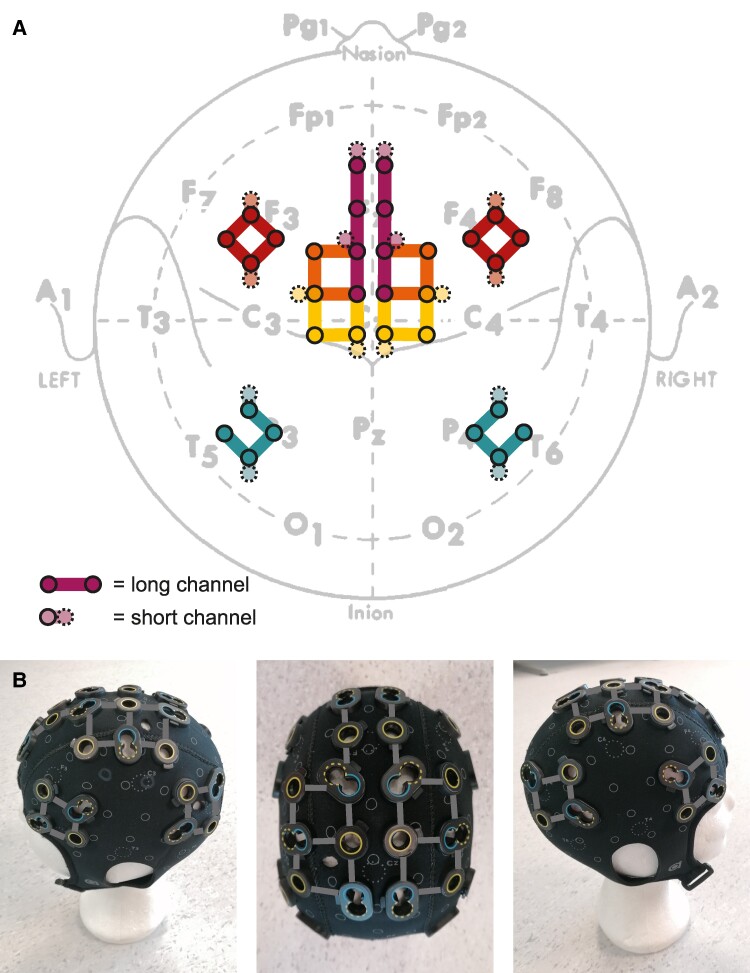
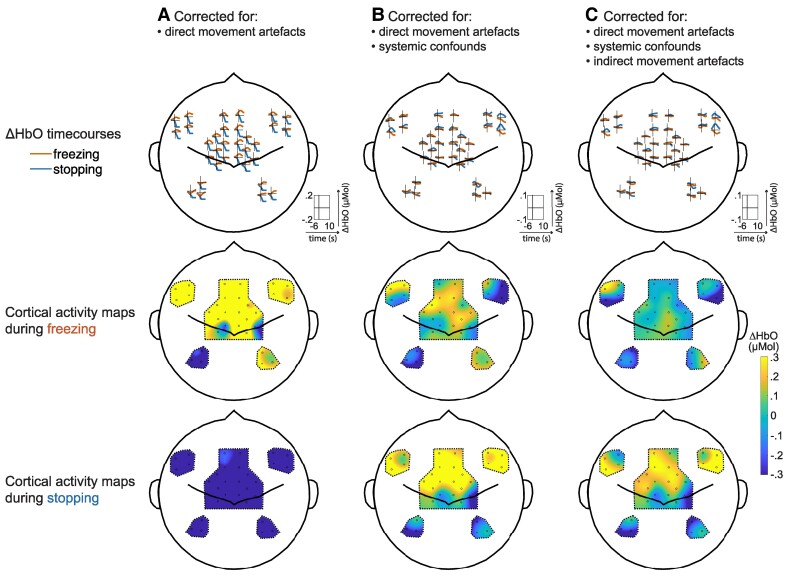
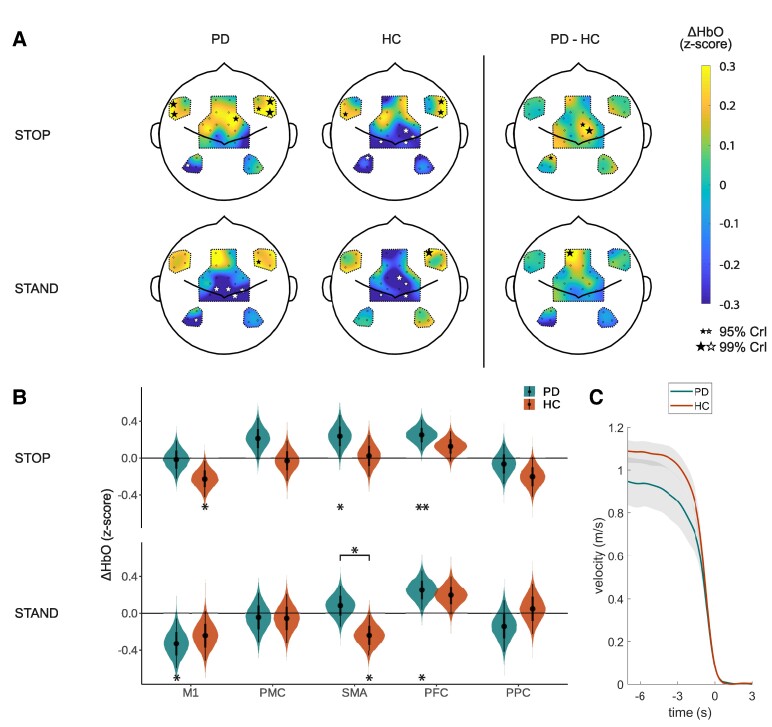
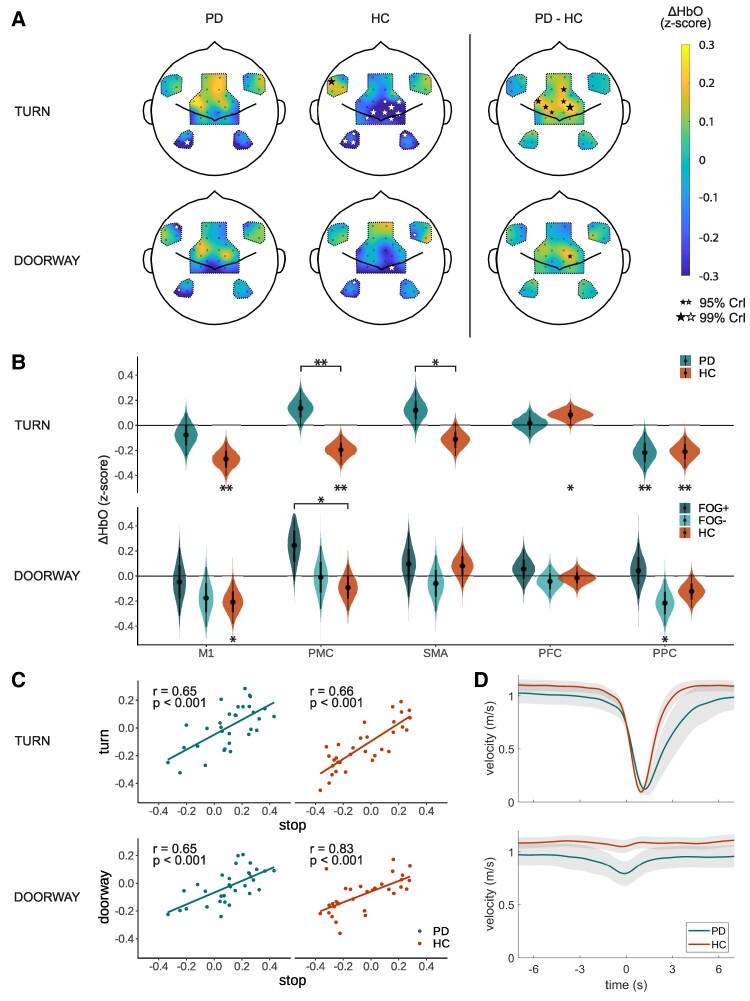
Freezing of gait, characterized by involuntary interruptions of walking, is a debilitating motor symptom of Parkinson's disease that restricts people's autonomy. Previous brain imaging studies investigating the mechanisms underlying freezing were restricted to scan people in supine positions and yielded conflicting theories regarding the role of the supplementary motor area and other cortical regions. We used functional near-infrared spectroscopy to investigate cortical haemodynamics related to freezing in freely moving people. We measured functional near-infrared spectroscopy activity over multiple motor-related cortical areas in 23 persons with Parkinson's disease who experienced daily freezing ('freezers') and 22 age-matched controls during freezing-provoking tasks including turning and doorway passing, voluntary stops and actual freezing. Crucially, we corrected the measured signals for confounds of walking. We first compared cortical activity between freezers and controls during freezing-provoking tasks without freezing (i.e. turning and doorway passing) and during stops. Secondly, within the freezers, we compared cortical activity between freezing, stopping and freezing-provoking tasks without freezing. First, we show that turning and doorway passing (without freezing) resemble cortical activity during stopping in both groups involving activation of the supplementary motor area and prefrontal cortex, areas known for their role in inhibiting actions. During these freezing-provoking tasks, the freezers displayed higher activity in the premotor areas than controls. Secondly, we show that, during actual freezing events, activity in the prefrontal cortex was lower than during voluntary stopping. The cortical relation between the freezing-provoking tasks (turning and doorway passing) and stopping may explain their susceptibility to trigger freezing by activating a stopping mechanism. Besides, the stopping-related activity of the supplementary motor area and prefrontal cortex seems to be out of balance in freezers. In this paper, we postulate that freezing results from a paroxysmal imbalance between the supplementary motor area and prefrontal cortex, thereby extending upon the current role of the supplementary motor area in freezing pathophysiology.
步态冻结的特征是行走时出现非自主性中断,是帕金森病中一种使人衰弱的运动症状,会限制患者的自主性。以往关于步态冻结潜在机制的脑成像研究仅限于对仰卧位的人进行扫描,并且在辅助运动区和其他皮质区域的作用方面产生了相互矛盾的理论。我们使用功能近红外光谱技术来研究自由活动人群中与步态冻结相关的皮质血流动力学。我们在23名每天经历步态冻结的帕金森病患者(“冻结者”)和22名年龄匹配的对照者进行诱发步态冻结的任务(包括转弯和通过门口)、自主停止和实际步态冻结期间,测量了多个与运动相关的皮质区域的功能近红外光谱活动。至关重要的是,我们对测量信号进行了行走干扰校正。我们首先比较了“冻结者”和对照者在无步态冻结的诱发步态冻结任务(即转弯和通过门口)期间以及停止期间的皮质活动。其次,在“冻结者”组内,我们比较了步态冻结、停止和无步态冻结的诱发步态冻结任务期间的皮质活动。首先,我们发现两组中转弯和通过门口(无步态冻结)时的皮质活动类似于停止时的皮质活动,包括辅助运动区和前额叶皮质的激活,这些区域以其在抑制动作中的作用而闻名。在这些诱发步态冻结的任务中,“冻结者”在前运动区的活动高于对照者。其次,我们发现,在实际步态冻结事件期间,前额叶皮质的活动低于自主停止期间。诱发步态冻结的任务(转弯和通过门口)与停止之间的皮质关系可能解释了它们通过激活停止机制而易于触发步态冻结的原因。此外,辅助运动区和前额叶皮质与停止相关的活动在“冻结者”中似乎失衡。在本文中,我们假设步态冻结是由辅助运动区和前额叶皮质之间的阵发性失衡引起的,从而扩展了目前辅助运动区在步态冻结病理生理学中的作用。