Department of Anthropology, University of California, Los Angeles, CA, USA.
Department of Human Behavior, Ecology and Culture, Max Planck Institute for Evolutionary Anthropology, Leipzig, Germany.
Philos Trans R Soc Lond B Biol Sci. 2024 Oct 21;379(1912):20220521. doi: 10.1098/rstb.2022.0521. Epub 2024 Sep 4.
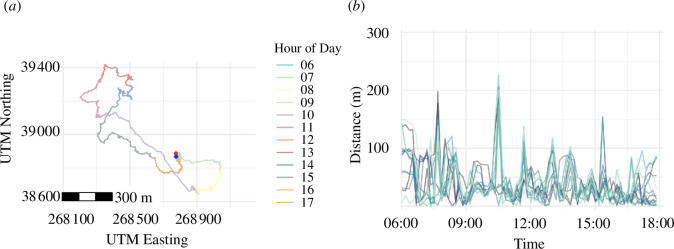
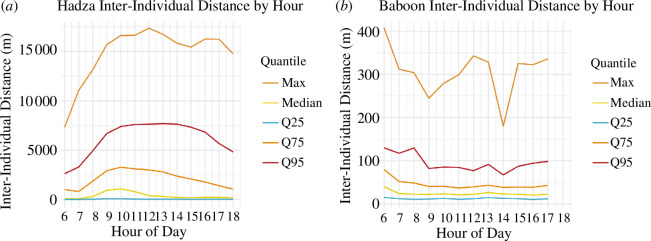
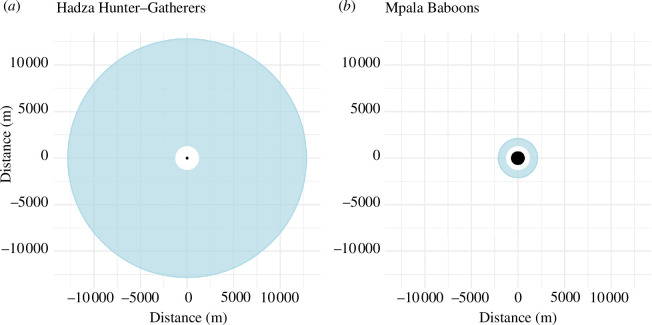
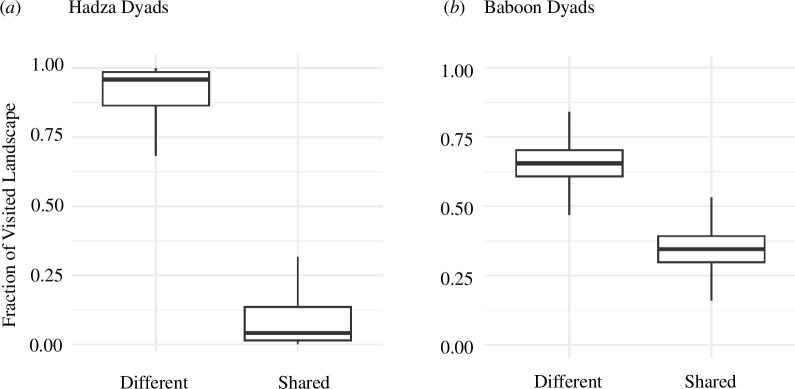
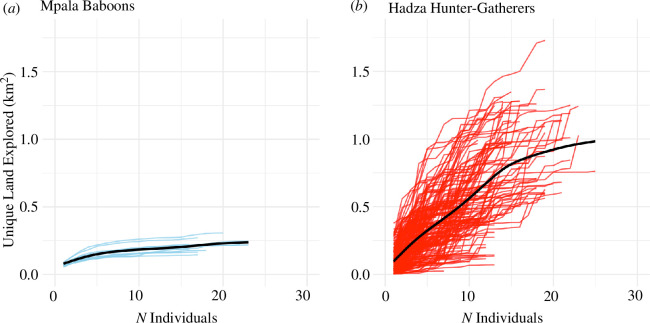
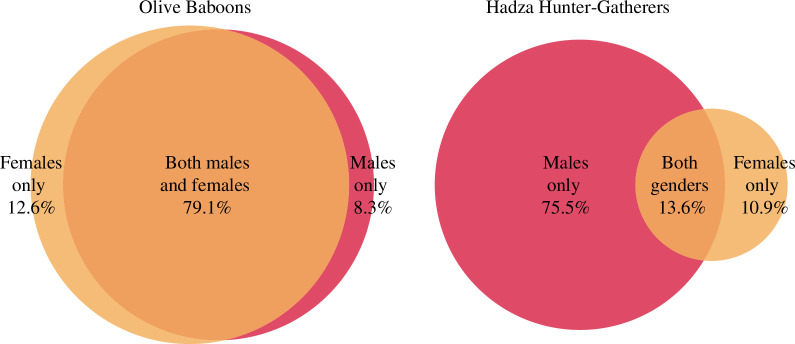
Human evolutionary ecology stands to benefit by integrating theory and methods developed in movement ecology, and in turn, to make contributions to the broader field of movement ecology by leveraging our species' distinct attributes. In this paper, we review data and evolutionary models suggesting that major changes in socio-spatial behaviour accompanied the evolution of language. To illustrate and explore these issues, we present a comparison of GPS measures of the socio-spatial behaviour of Hadza hunter-gatherers of northern Tanzania to those of olive baboons (), a comparatively small-brained primate that is also savanna-adapted. While standard spatial metrics show modest differences, measures of spatial diversity, landscape exploration and spatiotemporal displacement between individuals differ markedly. Groups of Hadza foragers rapidly accumulate a vast, diverse knowledge pool about places and things over the horizon, contrasting with the baboon's narrower and more homogeneous pool of ecological information. The larger and more complex socio-spatial world illustrated by the Hadza is one where heightened cognitive abilities for spatial and episodic memory, navigation, perspective taking and communication about things beyond the here and now all have clear value.This article is part of the theme issue 'The spatial-social interface: a theoretical and empirical integration'.
人类进化生态学通过整合运动生态学中发展的理论和方法将从中受益,反过来,通过利用我们物种独特的属性,为更广泛的运动生态学领域做出贡献。在本文中,我们回顾了数据和进化模型,这些数据和进化模型表明,伴随着语言的进化,社会空间行为发生了重大变化。为了说明和探讨这些问题,我们比较了坦桑尼亚北部哈扎狩猎采集者的 GPS 测量的社会空间行为与相对较小的灵长类动物——非洲草原狒狒的 GPS 测量的社会空间行为。虽然标准的空间指标显示出适度的差异,但空间多样性、景观探索和个体之间的时空位移的测量值差异显著。哈扎觅食者群体迅速积累了一个关于地平线外的地方和事物的广泛而多样的知识库,与狒狒更窄和更同质的生态信息库形成对比。哈扎人所展示的更大、更复杂的社会空间世界,需要具备更高的空间和情景记忆、导航、换位思考以及关于现在之外的事物的沟通等认知能力,这些能力显然具有价值。本文是主题为“空间-社会界面:理论和经验的综合”的一部分。