Singer Barry A, Morgan Dawn, Stamm Julie A, Williams Anita A
The MS Center for Innovations in Care, Missouri Baptist Medical Center, St. Louis, MO, 63131, USA.
Patient Author: MS patient advocate, author, speaker, founder of Unquiet Minds Move Nonprofit, Washington, DC, USA.
Neurol Ther. 2024 Dec;13(6):1507-1525. doi: 10.1007/s40120-024-00654-1. Epub 2024 Sep 4.
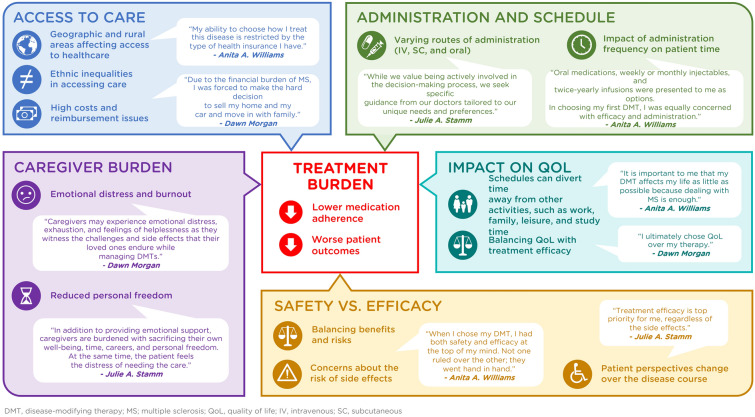
The number of disease-modifying therapies (DMTs) approved for the treatment of multiple sclerosis (MS) has greatly increased in recent decades, leading to higher treatment complexity. DMTs can differ in mode and frequency of administration, benefit-risk profile, and associated costs. Patients with MS contend not only with the burden of their chronic disease but also with the treatment burden of their MS therapy. Adhering to dosing schedules and infusion appointments can be difficult for busy, working-age patients or those with limited access to transportation. Patients and healthcare professionals (HCPs) may have differing priorities, concerns, and preferences when selecting treatment, potentially affecting treatment satisfaction and, importantly, adherence. Additionally, patients face direct and indirect costs related to treatment. These factors can all contribute to a high treatment burden on patients, impacting their quality of life and potentially leading to worse patient outcomes. HCPs, patients, and caregivers must work together to alleviate treatment burden through effective communication, shared decision-making, appreciating each other's perspectives, and additional HCP support. Consideration of treatment burden into clinical guidelines is also warranted. In this review, we examine key factors impacting treatment burden for patients with MS, with a focus on the patient perspective as provided by our patient authors, and provide strategies to minimize treatment burden.
近几十年来,获批用于治疗多发性硬化症(MS)的疾病修正疗法(DMTs)数量大幅增加,导致治疗复杂性提高。DMTs在给药方式和频率、获益风险概况以及相关成本方面可能存在差异。MS患者不仅要应对慢性病的负担,还要承受MS治疗的负担。对于忙碌的工作年龄患者或交通不便的患者来说,遵守给药时间表和输液预约可能很困难。在选择治疗方案时,患者和医疗保健专业人员(HCPs)可能有不同的优先事项、关注点和偏好,这可能会影响治疗满意度,重要的是,还会影响依从性。此外,患者面临与治疗相关的直接和间接成本。这些因素都会给患者带来很高的治疗负担,影响他们的生活质量,并可能导致更差的患者结局。HCPs、患者和护理人员必须共同努力,通过有效的沟通、共同决策、理解彼此的观点以及额外的HCP支持来减轻治疗负担。将治疗负担纳入临床指南也是有必要的。在这篇综述中,我们研究了影响MS患者治疗负担的关键因素,重点关注我们的患者作者所提供的患者视角,并提供了将治疗负担降至最低的策略。