Department of Cardiology, Herlev-Gentofte University Hospital, University of Copenhagen, Gentofte Hospitalsvej 6, 2900 Hellerup, Denmark.
The Danish Heart Foundation, Copenhagen, Denmark.
Europace. 2024 Aug 30;26(9). doi: 10.1093/europace/euae231.
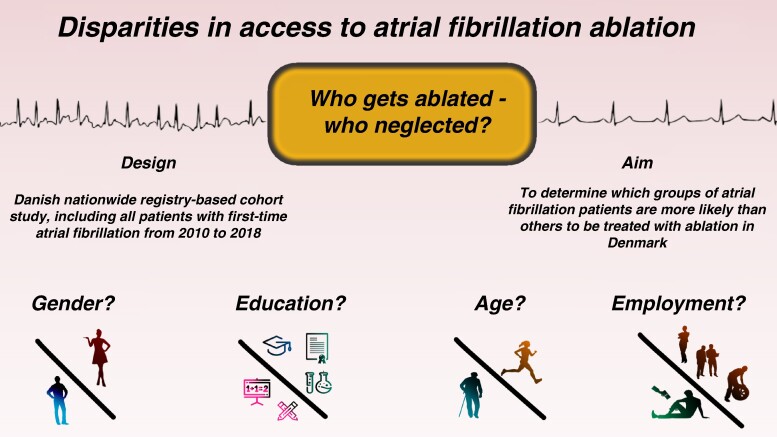
Atrial fibrillation (AF) is a common arrhythmia associated with reduced quality of life that can lead to serious complications such as stroke and heart failure. Ablation is a safe and effective treatment for AF but is not offered equally to all patients. The aim of this study is to identify demographic groups more or less likely to undergo AF ablation.
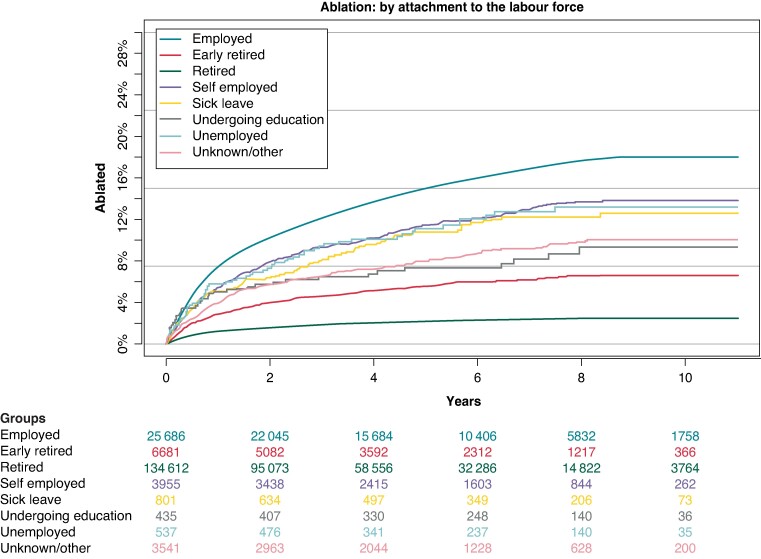
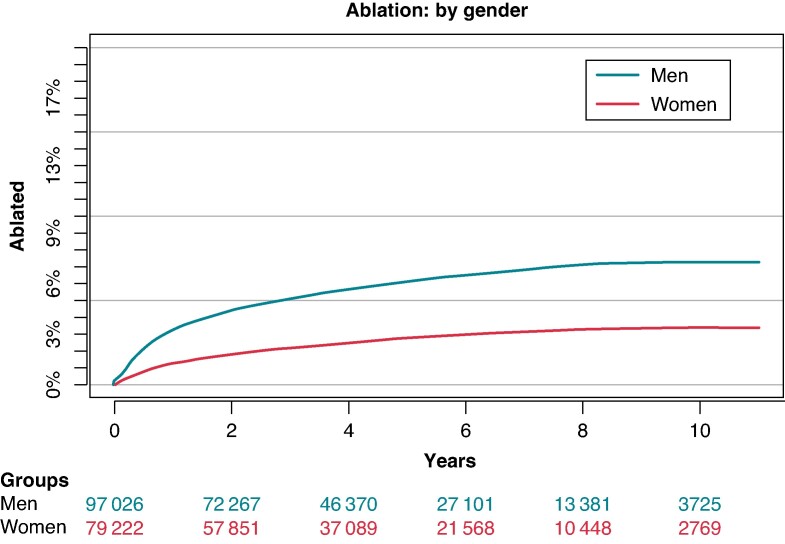
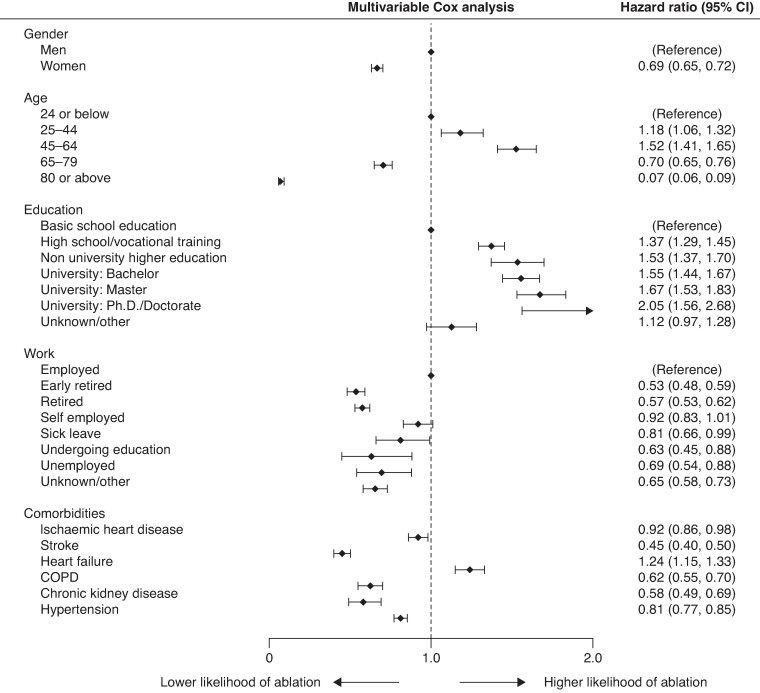
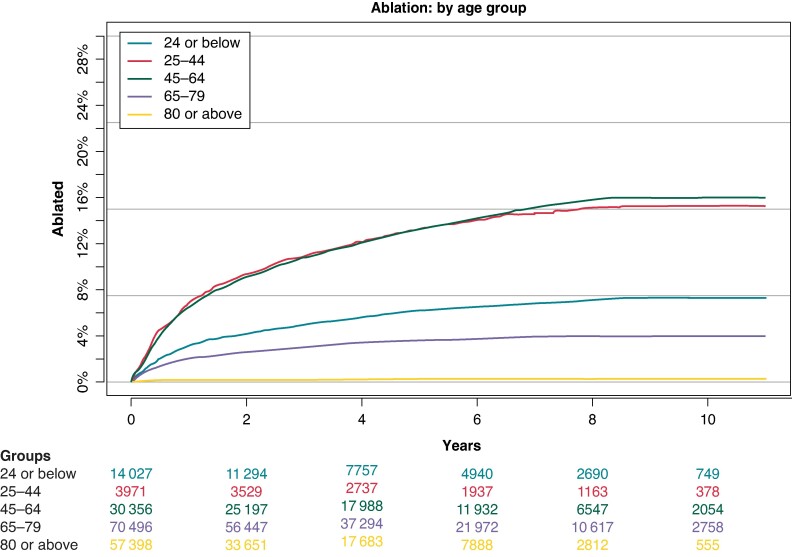
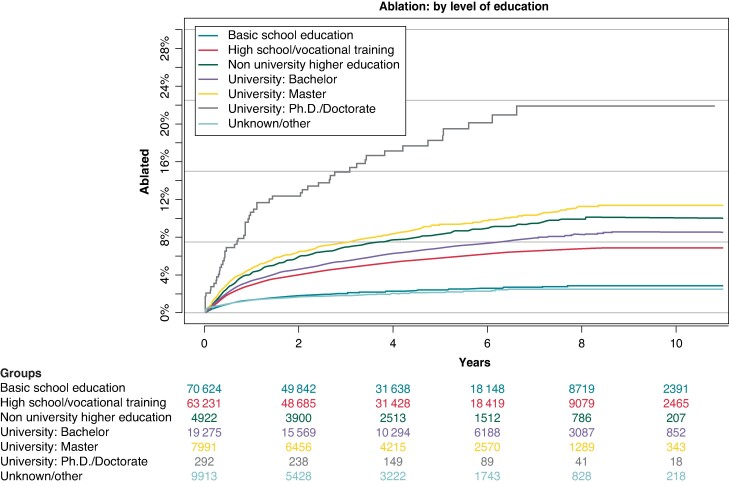
All patients with newly diagnosed AF between 2010 and 2018 were identified in the Danish nationwide registries. The association between gender, age, level of education and attachment to the job market, and the likelihood of receiving AF ablation was investigated using multivariable Cox proportional hazard analysis. Cumulative incidence was calculated using the Aalen-Johansen estimator. A total of 176 248 patients were included. Men were more likely to receive ablation than women (7% vs. 3%). Patients aged 25-44 and 45-64 were most likely to receive ablation, while only 0.7% of patients aged 80 or above received ablation. The rate of ablation significantly decreased with decreasing level of education. Full-time employed patients were most likely to receive ablation, followed by self-employed, unemployed, on sick leave, undergoing education, and early retired patients. Retired patients were the least likely to receive ablation (3%).
This study found that women, older patients, patients with lower levels of education, and patients on social benefits are less likely to receive AF ablation. These findings suggest that there are significant social and economic disparities in AF ablation treatment in Denmark.
心房颤动(AF)是一种常见的心律失常,会降低生活质量,可导致严重并发症,如中风和心力衰竭。消融术是一种安全有效的 AF 治疗方法,但并非所有患者都能平等获得。本研究旨在确定更有可能或不太可能接受 AF 消融的人群。
在丹麦全国登记处中确定了 2010 年至 2018 年间新诊断为 AF 的所有患者。使用多变量 Cox 比例风险分析调查了性别、年龄、教育程度和与就业市场的联系与接受 AF 消融的可能性之间的关系。使用 Aalen-Johansen 估计器计算累积发生率。共纳入 176248 例患者。男性接受消融的可能性高于女性(7%对 3%)。25-44 岁和 45-64 岁的患者最有可能接受消融,而 80 岁或以上的患者中只有 0.7%接受消融。随着教育程度的降低,消融的比例显著下降。全职工作的患者最有可能接受消融,其次是自雇、失业、休病假、接受教育和提前退休的患者。退休患者接受消融的可能性最低(3%)。
本研究发现,女性、老年患者、教育程度较低的患者和享受社会福利的患者接受 AF 消融的可能性较低。这些发现表明,丹麦在 AF 消融治疗方面存在显著的社会和经济差异。