Alfred-Wegener-Institut-Helmholtz-Zentrum für Polar- und Meeresforschung, Bremerhaven, Germany.
Center for Earth System Sustainability, Institute of Oceanography, University of Hamburg, Hamburg, Germany.
Nat Commun. 2024 Sep 4;15(1):7385. doi: 10.1038/s41467-024-51636-8.
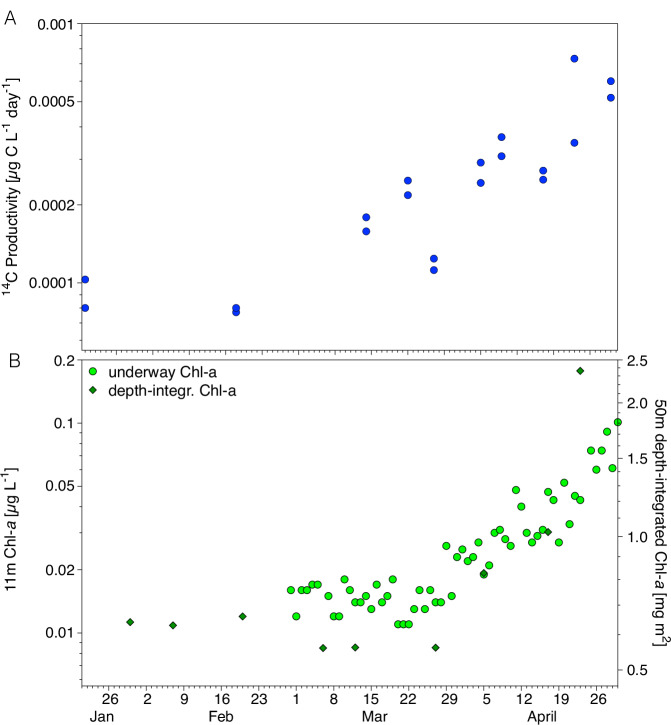
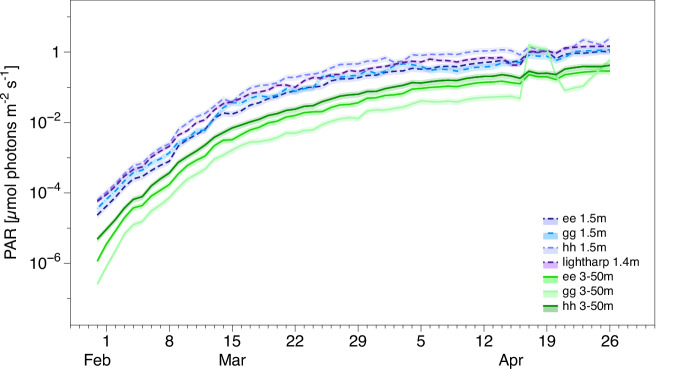
Photosynthesis is one of the most important biological processes on Earth, providing the main source of bioavailable energy, carbon, and oxygen via the use of sunlight. Despite this importance, the minimum light level sustaining photosynthesis and net growth of primary producers in the global ocean is still unknown. Here, we present measurements from the MOSAiC field campaign in the central Arctic Ocean that reveal the resumption of photosynthetic growth and algal biomass buildup under the ice pack at a daily average irradiance of not more than 0.04 ± 0.02 µmol photons m s in late March. This is at least one order of magnitude lower than previous estimates (0.3-5 µmol photons m s) and near the theoretical minimum light requirement of photosynthesis (0.01 µmol photons m s). Our findings are based on measurements of the temporal development of the under-ice light field and concurrent measurements of both chlorophyll a concentrations and potential net primary production underneath the sea ice at 86 °N. Such low light requirements suggest that euphotic zones where photosynthesis can occur in the world's oceans may extend further in depth and time, with major implications for global productivity estimates.
光合作用是地球上最重要的生物过程之一,通过利用太阳光为生物提供主要的可用能源、碳和氧。尽管如此重要,但全球海洋中维持光合作用和初级生产者净生长的最低光水平仍然未知。在这里,我们展示了 MOSAiC 野外考察在北极中部海洋的测量结果,揭示了在 3 月下旬,每日平均辐照度不超过 0.04±0.02 µmol 光子 m−2 s−1 时,冰下光合作用和藻类生物量的恢复。这至少低了一个数量级,接近光合作用的理论最低光需求(0.01 µmol 光子 m−2 s−1)。我们的发现基于对冰下光场的时间发展的测量,以及在 86°N 下对海冰下的叶绿素 a 浓度和潜在净初级生产力的并发测量。如此低的光需求表明,世界海洋中可以进行光合作用的透光带在深度和时间上可能会进一步延伸,这对全球生产力估计有重大影响。