Department of Neurobiology and Department of Psychiatry of the Second Affiliated Hospital, Zhejiang University School of Medicine, Hangzhou, China.
Nanhu Brain-computer Interface Institute, Hangzhou, China.
Nat Commun. 2024 Sep 4;15(1):7728. doi: 10.1038/s41467-024-51983-6.
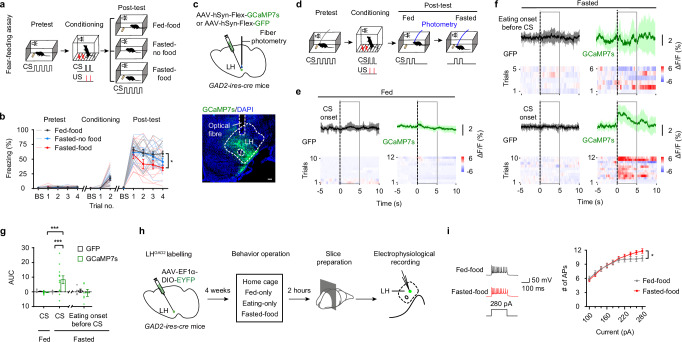
To ensure survival, animals must sometimes suppress fear responses triggered by potential threats during feeding. However, the mechanisms underlying this process remain poorly understood. In the current study, we demonstrated that when fear-conditioned stimuli (CS) were presented during food consumption, a neural projection from lateral hypothalamic (LH) GAD2 neurons to nucleus incertus (NI) relaxin-3 (RLN3)-expressing neurons was activated, leading to a reduction in CS-induced freezing behavior in male mice. LH neurons established excitatory connections with the NI. The activity of this neural circuit, including NI neurons, attenuated CS-induced freezing responses during food consumption. Additionally, the lateral mammillary nucleus (LM), which received NI projections, along with RLN3 signaling in the LM, mediated the decrease in freezing behavior. Collectively, this study identified an LH-NI-LM circuit involved in modulating fear responses during feeding, thereby enhancing our understanding of how animals coordinate nutrient intake with threat avoidance.
为了生存,动物有时必须抑制进食时潜在威胁引发的恐惧反应。然而,这一过程的机制仍知之甚少。在本研究中,我们证明了当条件性恐惧刺激(CS)在进食期间出现时,来自下丘脑外侧(LH)GAD2 神经元到不确定核(NI)松弛素-3(RLN3)表达神经元的神经投射被激活,导致雄性小鼠 CS 诱导的冻结行为减少。LH 神经元与 NI 建立兴奋性连接。该神经回路的活动,包括 NI 神经元,在进食期间减弱了 CS 诱导的冻结反应。此外,接收 NI 投射的外侧乳状核(LM)以及 LM 中的 RLN3 信号,介导了冻结行为的减少。总的来说,这项研究确定了一个 LH-NI-LM 回路,该回路参与调节进食时的恐惧反应,从而增进了我们对动物如何协调营养摄入与避免威胁的理解。