Department of Epidemiology and Quantitative Methods On Health, National School of Public Health, Oswaldo Cruz Foundation, Rio de Janeiro, Brazil.
National Institute of Infectious Disease Evandro Chagas, Oswaldo Cruz Foundation, Rio de Janeiro, Brazil.
Reprod Health. 2024 Sep 4;20(Suppl 2):194. doi: 10.1186/s12978-024-01851-9.
Brazil is one of the countries with the highest rates of caesarean sections (CS), reaching almost 90% of births in the private sector. A quality improvement project called "Adequate Childbirth Project (PPA)" was conceived to reduce CS in the private sector. This project consisted of four primary components: "Governance", "Participation of Women", "Reorganization of Care" and "Monitoring". This paper aims to evaluate: (1) which specific activities of the PPA had the largest effect on the probability of a woman having a vaginal delivery; (2) which primary component of the PPA had the largest effect on the probability of vaginal delivery and (3) which scenarios combining the implementation of different activities planned in the PPA had a higher effect on the probability of vaginal delivery.
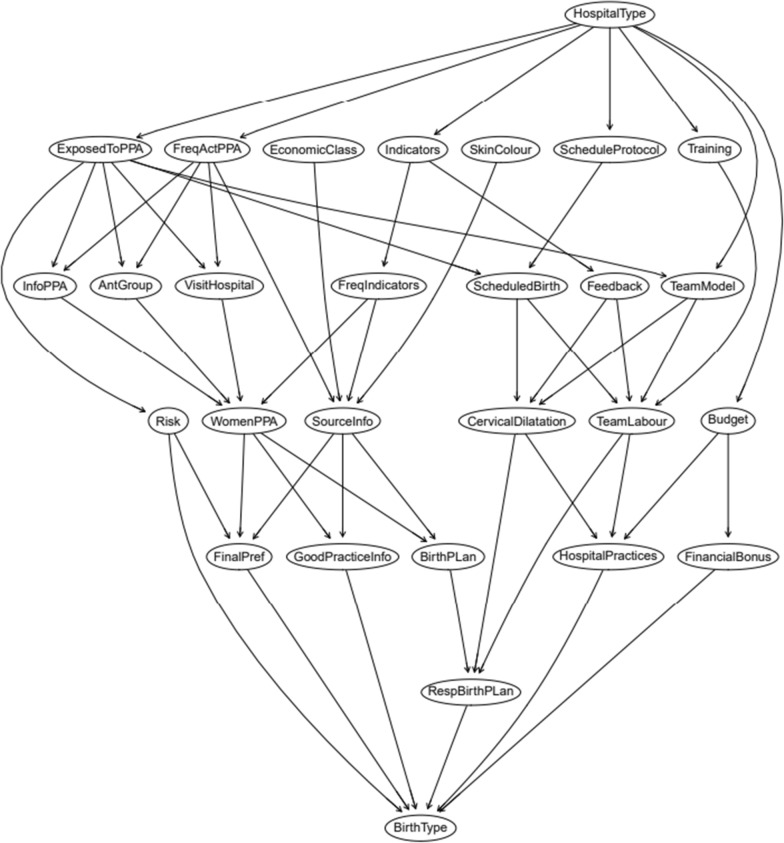
A sample of 12 private hospitals participating in the PPA was evaluated. We used a Bayesian Network (BN) to capture both non-linearities and complex cause-effect relations. The BN integrated knowledge from experts and data from women to estimate 26 model parameters. The PPA was evaluated in 2473 women belonging to groups 1-4 of the Robson classification, who were divided into two groups: those participating or not participating in the PPA.
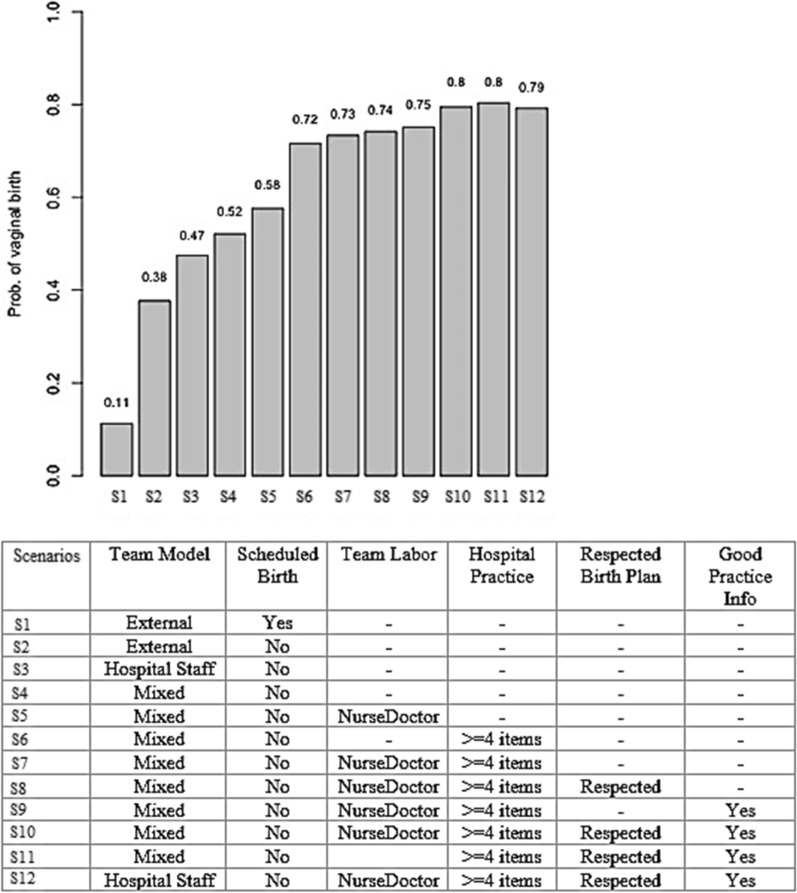
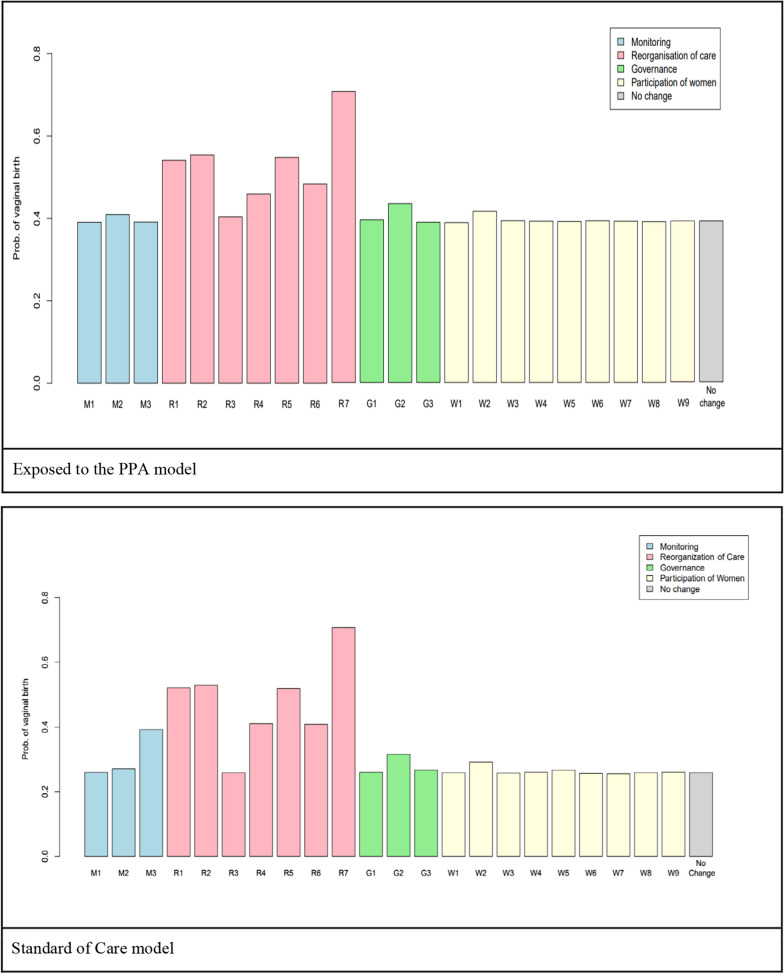
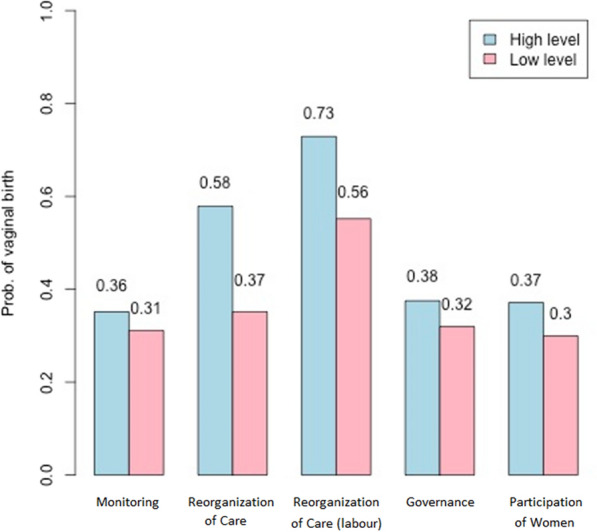
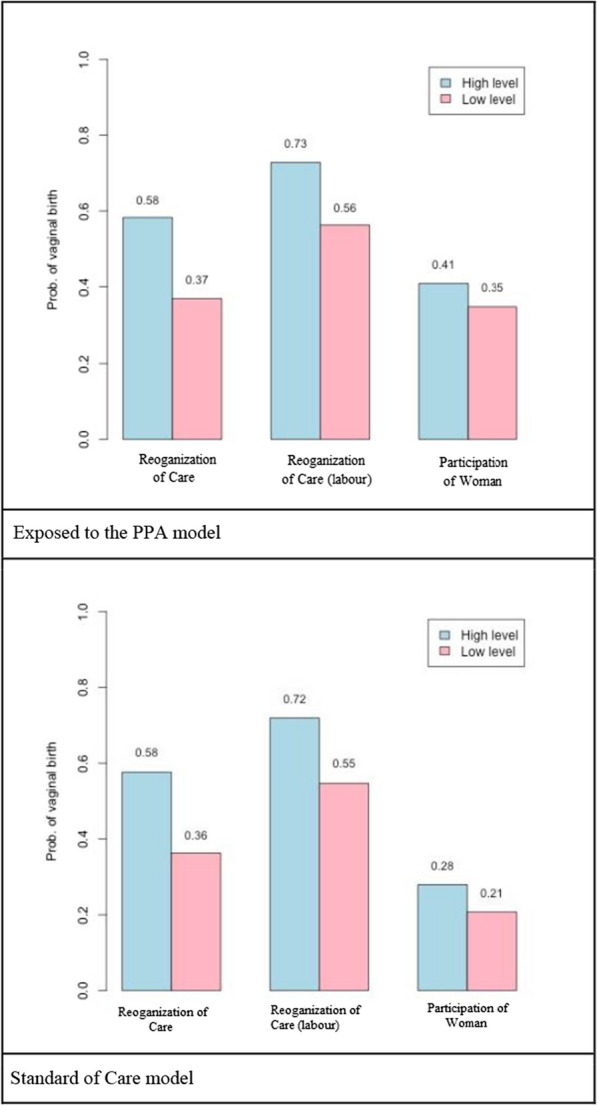
The probability of a woman having a vaginal delivery was 37.7% higher in women participating in the PPA. The most important component of the project that led to an increase in the probability of vaginal delivery was "Reorganization of Care", leading to a 73% probability of vaginal delivery among women in labor. The activity that had the greatest effect on the type of delivery was access to best practices during labor, with a 72% probability of vaginal delivery. Considering the 12 scenarios combining the different activities of the PPA, the best scenarios included: a non-scheduled delivery, access to information about best practices, access to at least 4 best practices during labor and respect of the birth plan, with an 80% probability of vaginal delivery in the best combinations.
PPA has been shown to be an effective quality improvement program, increasing the likelihood of vaginal delivery in private Brazilian hospitals.
巴西是剖宫产率(CS)最高的国家之一,私人部门的剖宫产率接近 90%。为了降低私人部门的剖宫产率,开展了一项名为“适当分娩项目(PPA)”的质量改进项目。该项目由四个主要部分组成:“治理”、“妇女参与”、“护理重组”和“监测”。本文旨在评估:(1)PPA 的哪些具体活动对妇女阴道分娩的可能性影响最大;(2)PPA 的哪个主要部分对阴道分娩的可能性影响最大;(3)结合实施 PPA 中计划的不同活动的哪些方案对阴道分娩的可能性影响更大。
评估了 12 家参与 PPA 的私人医院的样本。我们使用贝叶斯网络(BN)来捕捉非线性和复杂的因果关系。BN 整合了专家知识和妇女数据,以估计 26 个模型参数。将 PPA 评估应用于属于 Robson 分类 1-4 组的 2473 名妇女,她们分为两组:参加或不参加 PPA。
参加 PPA 的妇女阴道分娩的可能性高 37.7%。项目中导致阴道分娩可能性增加的最重要组成部分是“护理重组”,这导致分娩妇女阴道分娩的可能性增加了 73%。对分娩方式影响最大的活动是在分娩期间获得最佳实践,阴道分娩的可能性为 72%。考虑到结合了 PPA 不同活动的 12 种方案,最好的方案包括:非计划分娩、获得最佳实践信息、在分娩期间获得至少 4 种最佳实践以及尊重分娩计划,最佳组合中阴道分娩的可能性为 80%。
PPA 已被证明是一种有效的质量改进计划,增加了巴西私人医院阴道分娩的可能性。