Department of Public Health, Institute of Tropical Medicine, Antwerp, Belgium.
School of Public Health, Addis Ababa University, Addis Ababa, Ethiopia.
Reprod Health. 2024 Sep 4;21(1):129. doi: 10.1186/s12978-024-01850-w.
Worldwide, 10% of postpartum women experience postpartum depression, which can lead to diverse sequalae at individual, family, and societal levels. In sub-Saharan Africa, it is estimated that 17% of women experience depression in the postpartum period, which could be an underestimate as 48% of women in the region do not receive postnatal care (81% in Ethiopia and 51% in Guinea) and a large share of postpartum depression remains undiagnosed and untreated as a result. Globally, despite a critical evidence gap, there are growing reports of postpartum depression among women mistreated (disrespected and abused) during childbirth in health facilities, making a strong case to examine the association between mistreatment and postpartum depression. This study in Addis Ababa (Ethiopia) and Conakry (Guinea) uses a mixed methods design to 1) examine the link between mistreatment and postpartum depression, 2) explore the health system capacity to provide respectful maternity care and maternal mental health services, and 3) explore the experiences of women in accessing care and support for postpartum depression.
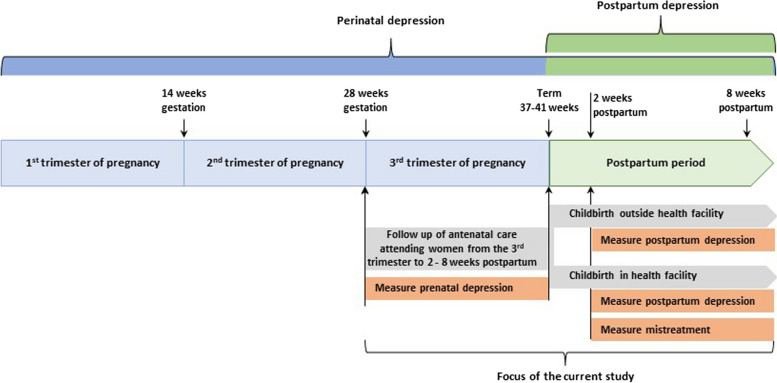
We will conduct a prospective longitudinal survey of women (434 in Addis Ababa and 408 in Conakry) from the third trimester of pregnancy to eight weeks postpartum and carry out in-depth interviews with key health system informants (20-25 in each city) and women who recovered from a clinically confirmed episode of postpartum depression (15-25 in each city). Quantitative data from the women's survey will be analysed using a multilevel mixed-effects model; qualitative data from key-informants will be analysed by using a hybrid thematic analysis approach, whereas data from women's in-depth interviews will be analysed using the phenomenological approach. The inclusion of two different settings in our study (Addis Ababa and Conakry) will enable us to apply a comparative health systems lens to explore the dynamics of respectful maternity care and maternal mental health services within the broader health systems of the two countries (Ethiopia and Guinea).
The findings from this study will inform actions aimed at mitigating the mistreatment of women in maternity settings and improving promotive, preventive, and treatment interventions for postpartum depression in Ethiopia and Guinea. The findings can also be extrapolated to other low-resource settings.
在全球范围内,有 10%的产后女性会经历产后抑郁症,这可能会给个人、家庭和社会带来各种后果。在撒哈拉以南非洲地区,据估计有 17%的女性在产后期间会出现抑郁症状,但这可能是一个低估的数字,因为该地区有 48%的女性没有接受产后护理(在埃塞俄比亚为 81%,在几内亚为 51%),而且由于缺乏诊断和治疗,大量产后抑郁症未被发现和治疗。尽管全球范围内存在严重的证据缺口,但越来越多的报告显示,在医疗机构中受到虐待(不尊重和虐待)的女性会出现产后抑郁症,这强烈表明需要研究虐待与产后抑郁症之间的关联。这项在亚的斯亚贝巴(埃塞俄比亚)和科纳克里(几内亚)进行的研究采用混合方法设计,旨在:1)研究虐待与产后抑郁症之间的联系;2)探讨卫生系统提供尊重产妇护理和产妇心理健康服务的能力;3)探讨女性获得产后抑郁症护理和支持的经历。
我们将对来自埃塞俄比亚亚的斯亚贝巴和几内亚科纳克里的孕妇(每个城市各 434 名和 408 名)进行前瞻性纵向调查,从妊娠晚期到产后八周,并对关键卫生系统知情者(每个城市 20-25 名)和从临床确诊的产后抑郁症中康复的女性(每个城市 15-25 名)进行深入访谈。对女性调查的定量数据将使用多级混合效应模型进行分析;对关键知情者的定性数据将使用混合主题分析方法进行分析,而对女性深入访谈的数据将使用现象学方法进行分析。我们在研究中纳入了两个不同的环境(亚的斯亚贝巴和科纳克里),这将使我们能够应用比较卫生系统的视角,探索两个国家(埃塞俄比亚和几内亚)更广泛的卫生系统中尊重产妇护理和产妇心理健康服务的动态。
这项研究的结果将为旨在减轻产妇环境中对女性的虐待行为以及改善埃塞俄比亚和几内亚产后抑郁症的促进、预防和治疗干预措施的行动提供信息。这些发现也可以推广到其他资源匮乏的环境中。