Tanaka Nobuyuki, Tomita Koichi, Itani Yoshihito, Kusuhara Hirohisa, Nakao Hitomi, Sueyoshi Yu, Okuda Shinnosuke, Shimizu Yuta, Hayashi Riku
From the Department of Plastic and Reconstructive Surgery, Kindai University Faculty of Medicine, Osaka, Japan.
Plast Reconstr Surg Glob Open. 2024 Sep 4;12(9):e6129. doi: 10.1097/GOX.0000000000006129. eCollection 2024 Sep.
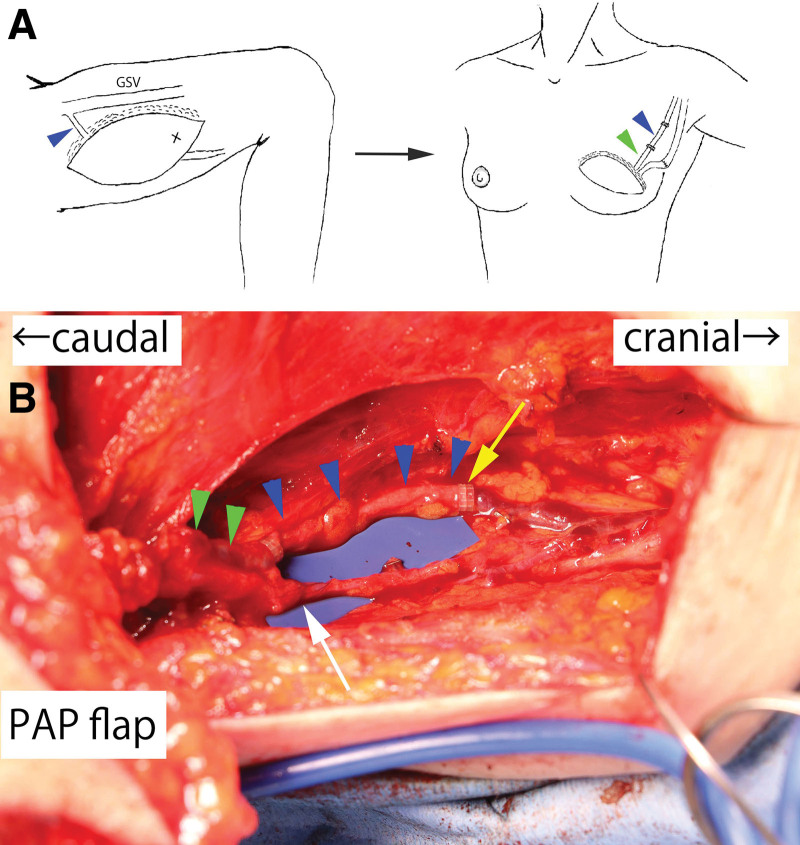
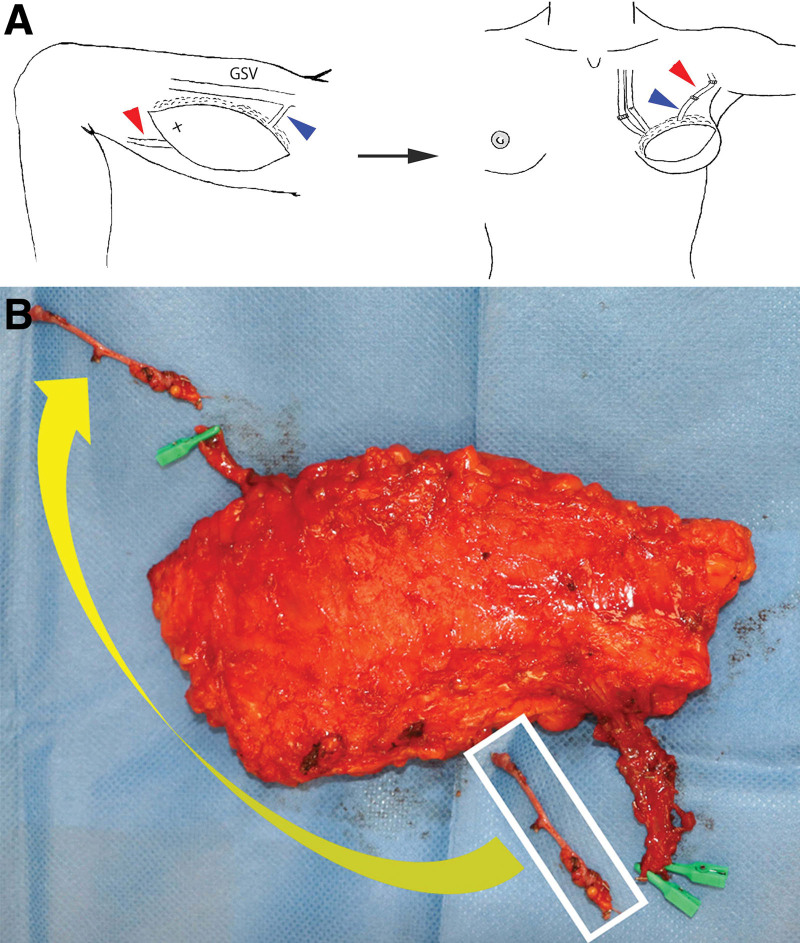
The profunda artery perforator (PAP) flap, commonly used for small- to medium-sized breast reconstructions, offers easy harvest and inconspicuous donor-site scars. However, its shorter vascular pedicle compared with the deep inferior epigastric perforator flap limits its reach to lateral recipient vessels. This often requires strategic placement of perforators at the flap's edge to extend reach, potentially causing congestion in the distal part of the flap. To address these challenges, using the posterior accessory saphenous vein (pASV) has proven effective. Using the pASV as a vein graft significantly extends the pedicle length of the PAP flap, enhancing anastomosis success with recipient vessels. Additionally, in cases of flap congestion, the proximal segment of the pASV can be used as an additional venous outflow pathway, while grafting the distal segment further extends its length. This dual approach improves overall flap viability and reduces venous congestion risks. This discussion highlights two cases demonstrating the innovative use of the pASV within the PAP flap. In case 1, the pASV extended the pedicle length, enhancing the flap's placement flexibility and facilitating anastomosis with thoracodorsal vessels. In case 2, the pASV served as a secondary venous outflow pathway, with the distal segment grafted to extend the proximal portion. This adaptation provided additional venous drainage and effectively managed positioning constraints imposed by recipient vessel locations. These examples illustrate the significant benefits of utilizing the pASV in PAP flap breast reconstructions, offering a novel strategy to improve viability and expand its use in complex scenarios requiring extended vascular reach.
股深动脉穿支(PAP)皮瓣常用于中小型乳房重建,具有取材方便和供区瘢痕不明显的优点。然而,与腹壁下深穿支皮瓣相比,其血管蒂较短,限制了其与外侧受区血管的吻合范围。这通常需要在皮瓣边缘有策略地放置穿支以扩大吻合范围,但可能导致皮瓣远端充血。为应对这些挑战,使用后副隐静脉(pASV)已被证明是有效的。将pASV用作静脉移植可显著延长PAP皮瓣的蒂长度,提高与受区血管的吻合成功率。此外,在皮瓣充血的情况下,pASV的近端段可作为额外的静脉流出道,同时移植远端段可进一步延长其长度。这种双重方法提高了皮瓣的整体存活率,降低了静脉充血风险。本讨论重点介绍了两个病例,展示了pASV在PAP皮瓣中的创新应用。在病例1中,pASV延长了蒂长度,增强了皮瓣的放置灵活性,并便于与胸背血管吻合。在病例2中,pASV作为次要静脉流出道,其远端段移植以延长近端部分。这种改良提供了额外的静脉引流,并有效应对了受区血管位置所带来的定位限制。这些例子说明了在PAP皮瓣乳房重建中利用pASV的显著益处,提供了一种新策略,可提高皮瓣存活率,并扩大其在需要延长血管吻合范围的复杂情况下的应用。