Jiang Ting, Weng Qianlin, Liu Ke, He Hongyi, Zhang Yuqing, Zhang Weiya, Doherty Michael, Xie Junqing, Yang Tuo, Li Jiatian, Yang Zidan, Chen Qiu, Long Huizhong, Wang Yilun, Wei Jie, Lei Guanghua, Zeng Chao
Department of Orthopaedics, Xiangya Hospital, Central South University, Changsha, China.
Department of Ultrasonography, Xiangya Hospital, Central South University, Changsha, China.
Lancet Reg Health West Pac. 2024 Aug 12;50:101169. doi: 10.1016/j.lanwpc.2024.101169. eCollection 2024 Sep.
Synovitis has long been considered a common and modifiable inflammatory feature of osteoarthritis (OA), but current disease-modifying anti-inflammatory treatments appear ineffective in OA clinical trials. Elucidating the temporal relationship between synovitis and OA could provide insight into the role of synovitis in OA.
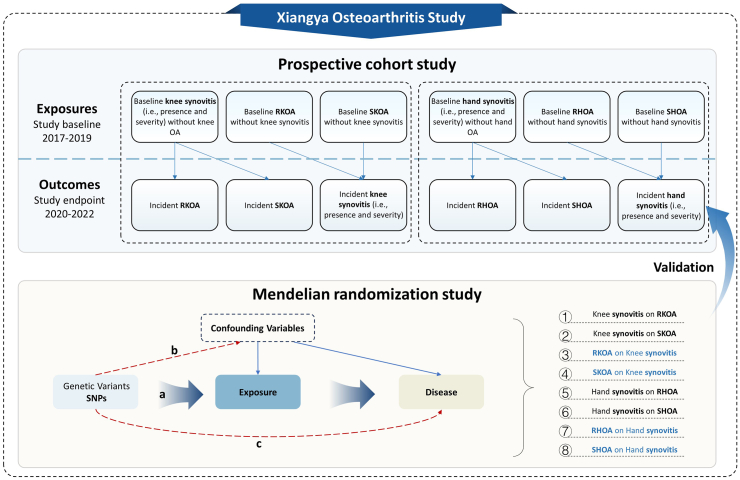
We conducted a prospective cohort study based on the baseline and three-year follow-up data from the Xiangya Osteoarthritis (XO) Study. We assessed bidirectional associations between ultrasound-detected synovitis and radiographic and symptomatic OA at knee and hand sites using generalized estimating equations. Additionally, we performed bidirectional Mendelian randomization (MR) analyses to test these hypotheses utilising whole-genome sequencing data in the XO population. Age, sex, body mass index, smoking, alcohol consumption, educational level, physical activity, and joint injury history were adjusted for these analyses.
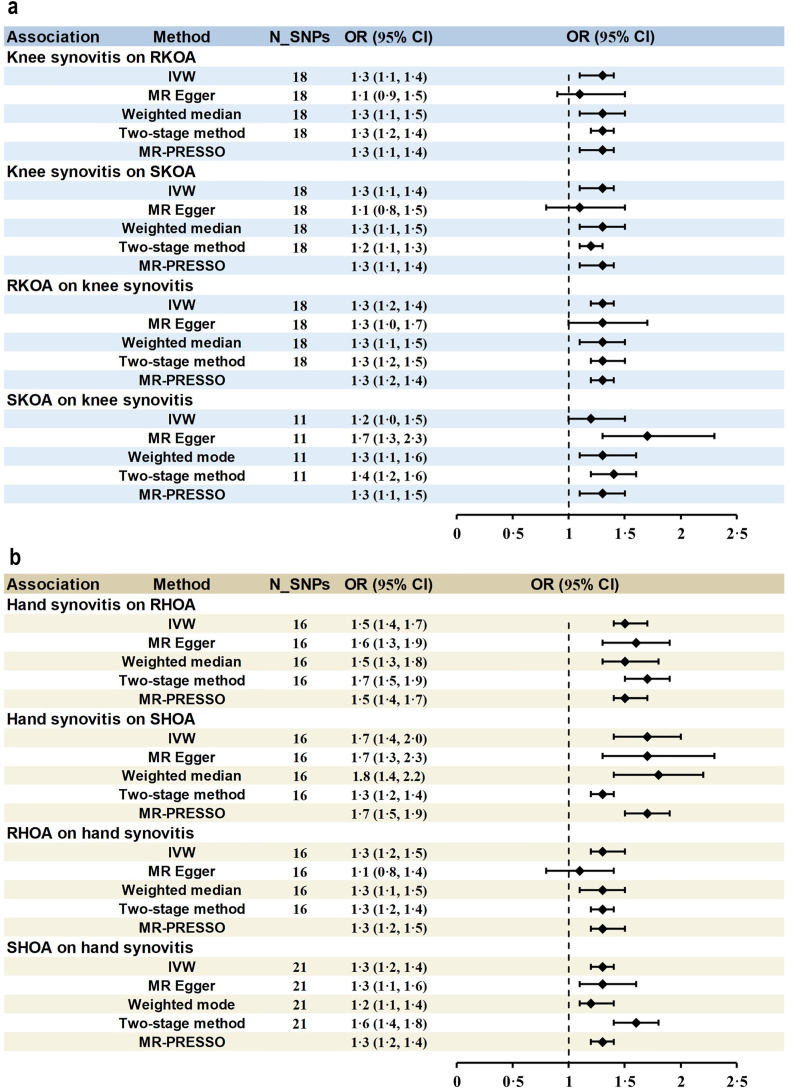
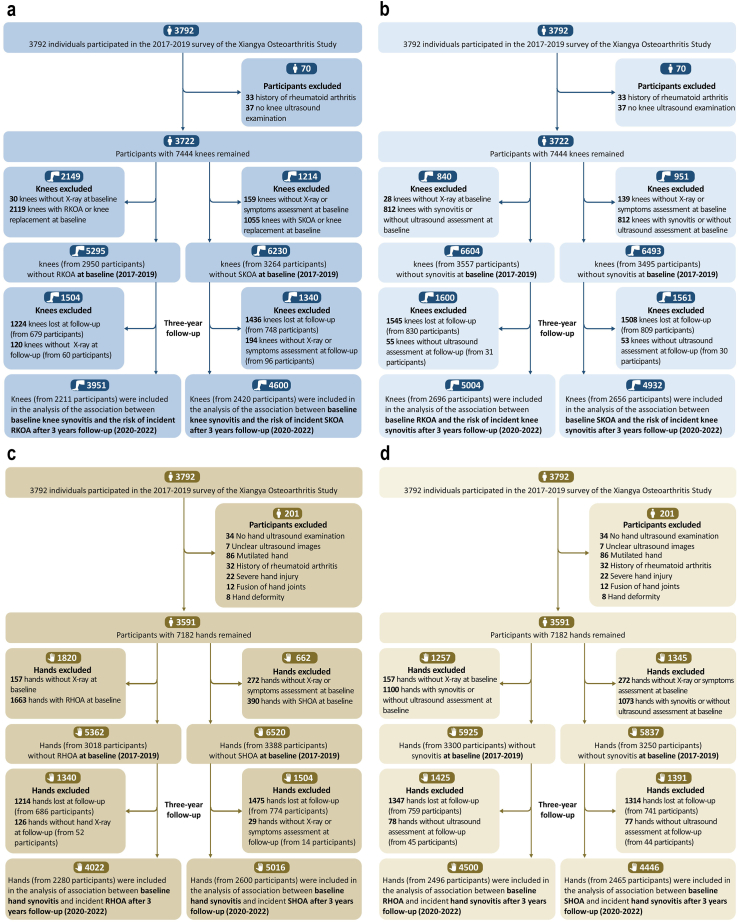
A total of 2211, 2420, 2280, and 2600 participants were enrolled for analyses of radiographic knee OA (RKOA), symptomatic knee OA (SKOA), radiographic hand OA (RHOA) and symptomatic hand OA (SHOA), respectively. The baseline synovitis (i.e., with synovitis vs. without synovitis) was associated with the incident RKOA (76/277 vs. 557/3674 knees), SKOA (49/387 vs. 287/4213 knees), RHOA (171/358 vs. 686/3664 hands) and SHOA (35/689 vs. 76/4327 hands), with adjusted odds ratio (aORs) of 2.2 (95% CI 1.7-3.1), 2.0 (1.3-2.9), 3.4 (2.7-4.4), and 2.4 (1.5-3.8), respectively. The baseline RKOA (with OA vs. without OA: 409/1246 vs. 481/3758 knees), SKOA (200/576 vs. 675/4356 knees), RHOA (192/778 vs. 410/3723 hands), and SHOA (41/162 vs. 548/4285 hands) were also associated with the incident synovitis, with aORs of 3.4 (95% CI 2.9-4.1), 2.7 (2.1-3.4), 2.3 (1.8-2.9) and 1.9 (1.2-2.8), respectively. These bidirectional associations were stronger when more active synovitis was compared with the reference group (all < 0.05). MR analyses further supported bidirectional associations that synovitis significantly increased the odds of incident OA at both sites and vice versa (all ORs ranged from 1.2-1.7).
Our population-based cohort study found novel evidence of a bidirectional association between synovitis and OA, which was further validated through MR analysis and suggested that the bidirectional association is likely causal. Our findings indicated that synovitis is both a risk factor and a consequence of the OA rather than solely a risk factor.
The National Key Research and Development Plan, the National Natural Science Foundation of China, the Key Research and Development Program of Hunan Province, the Natural Science Foundation of Hunan Province, the Central South University Innovation-Driven Research Programme, and the Fundamental Research Funds for the Central Universities of Central South University.
滑膜炎长期以来一直被认为是骨关节炎(OA)常见且可改变的炎症特征,但目前的疾病改善抗炎症治疗在OA临床试验中似乎无效。阐明滑膜炎与OA之间的时间关系有助于深入了解滑膜炎在OA中的作用。
我们基于湘雅骨关节炎(XO)研究的基线和三年随访数据进行了一项前瞻性队列研究。我们使用广义估计方程评估了超声检测到的滑膜炎与膝关节和手部的放射学及症状性OA之间的双向关联。此外,我们利用XO人群的全基因组测序数据进行了双向孟德尔随机化(MR)分析以检验这些假设。这些分析对年龄、性别、体重指数、吸烟、饮酒、教育水平、身体活动和关节损伤史进行了调整。
分别有2211、2420、2280和2600名参与者纳入了放射学膝关节OA(RKOA)、症状性膝关节OA(SKOA)、放射学手部OA(RHOA)和症状性手部OA(SHOA)的分析。基线滑膜炎(即有滑膜炎与无滑膜炎)与新发RKOA(76/277膝关节与557/3674膝关节)、SKOA(49/387膝关节与287/4213膝关节)、RHOA(171/358手部与686/3664手部)和SHOA(35/689手部与76/4327手部)相关,调整后的优势比(aORs)分别为2.2(95%CI 1.7 - 3.1)、2.0(1.3 - 2.9)、3.4(2.7 - 4.4)和2.4(1.5 - 3.8)。基线RKOA(有OA与无OA:409/1246膝关节与481/3758膝关节)、SKOA(200/576膝关节与675/4356膝关节)、RHOA(192/778手部与410/3723手部)和SHOA(41/162手部与548/4285手部)也与新发滑膜炎相关,aORs分别为3.4(95%CI 2.9 - 4.1)、2.7(2.1 - 3.4)、2.3(1.8 - 2.9)和1.9(1.2 - 2.8)。当将更活跃的滑膜炎与参照组进行比较时,这些双向关联更强(所有P < 0.05)。MR分析进一步支持了双向关联,即滑膜炎显著增加了两个部位新发OA的几率,反之亦然(所有OR值范围为1.2 - 1.7)。
我们基于人群的队列研究发现了滑膜炎与OA之间双向关联的新证据,该证据通过MR分析得到进一步验证,并表明这种双向关联可能具有因果关系。我们的研究结果表明,滑膜炎既是OA的一个危险因素,也是OA的一个后果,而不仅仅是一个危险因素。
国家重点研发计划、国家自然科学基金、湖南省重点研发计划、湖南省自然科学基金、中南大学创新驱动研究计划以及中南大学中央高校基本科研业务费专项资金。