Center for Interdisciplinary Research in Women's Health, School of Medicine, The University of Texas Medical Branch, Galveston.
Department of Obstetrics and Gynecology, The University of Texas Medical Branch, Galveston.
JAMA Netw Open. 2024 Sep 3;7(9):e2431807. doi: 10.1001/jamanetworkopen.2024.31807.
To inform the design and implementation of targeted interventions to reduce the future burden of human papillomavirus (HPV)-related cancers in Texas, it is necessary to examine the county and health service region (HSR) levels of (1) the proportion of children and teenagers aged 9 to 17 years who initiated and were up to date for HPV vaccination series and (2) HPV-related cancer incidence rates (IRs).
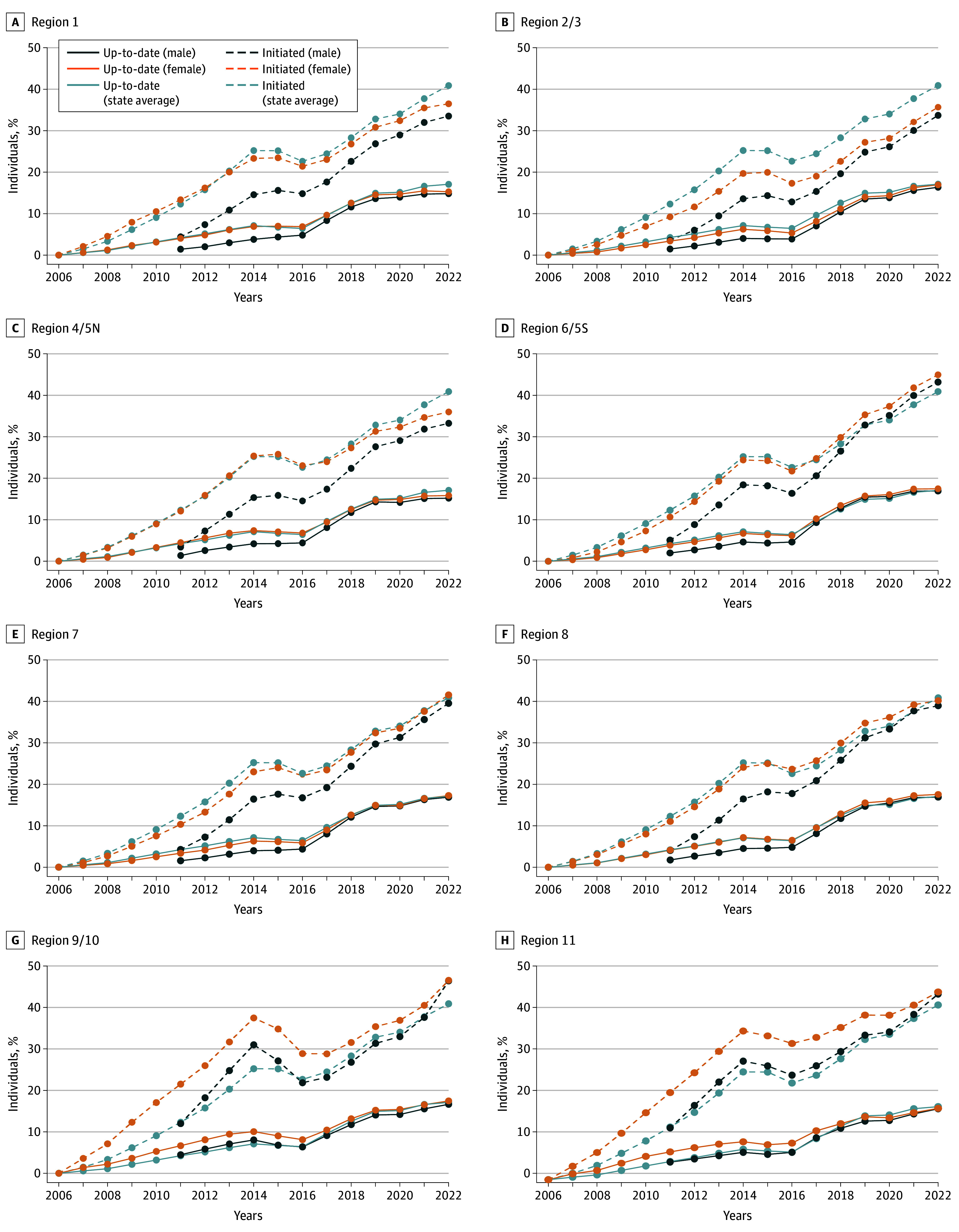
To evaluate temporal trends and geospatial patterns of HPV vaccination initiation and up-to-date status as well as HPV-related cancer rates at county and HSR levels in Texas.
DESIGN, SETTING, AND PARTICIPANTS: This population-based cross-sectional study used data from the Texas Immunization Registry, the National Cancer Institute's Surveillance, Epidemiology, and End Results Program database, and Texas Department of State Health Services annual population counts from 2006 to 2022. The analysis of HPV vaccination rates was conducted among children and teenagers aged 9 to 17 years; the analysis of HPV-related cancer rates was conducted among adults aged 20 years and older. Data were extracted between June and July 2023 and statistical analysis was performed from February to April 2024.
HPV vaccination initiation and up-to-date status rates and HPV-related cancer IR at county and HSR levels.
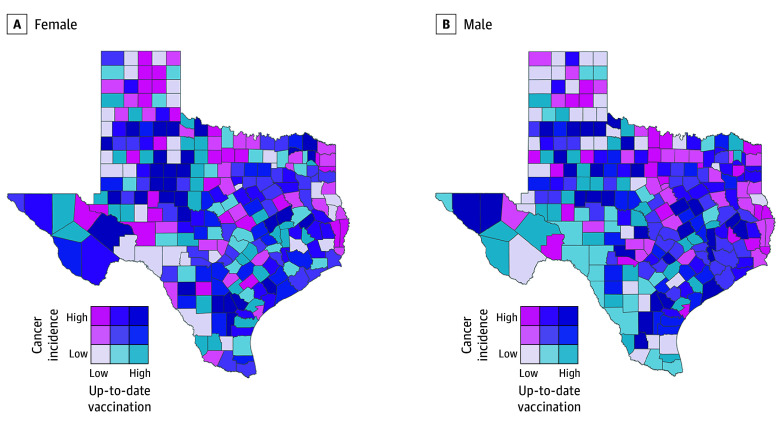
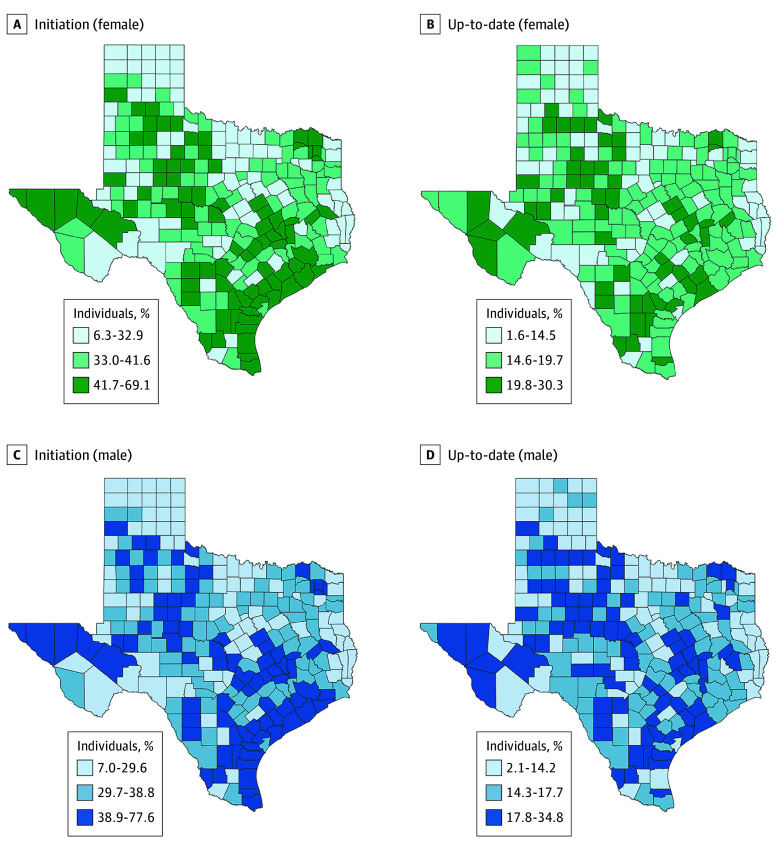
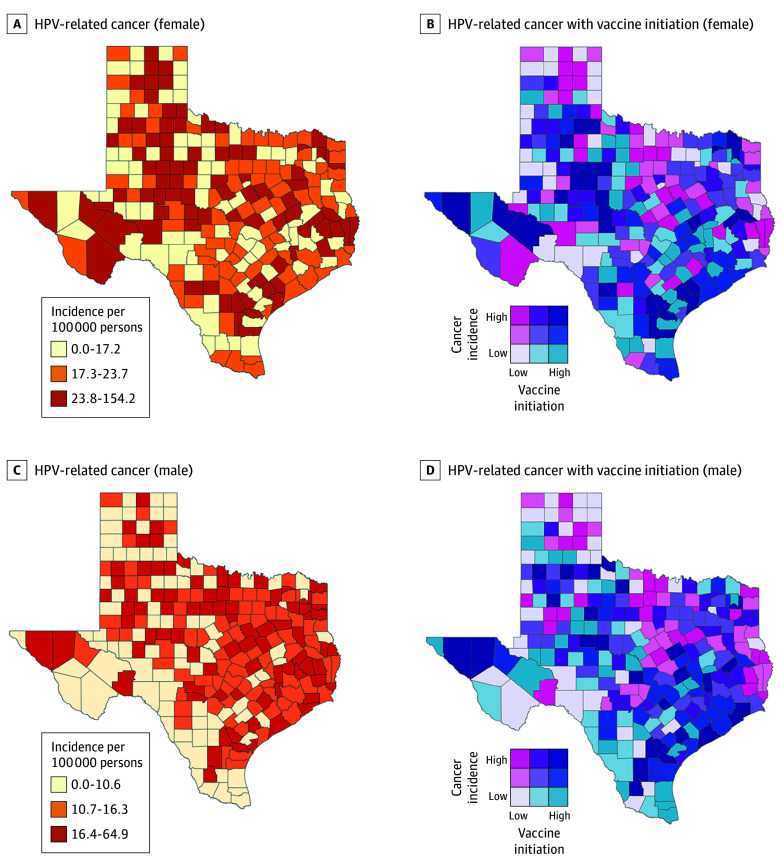
A total of 32 270 243 children and teenagers (65.8% female individuals and 34.2% male individuals) and 22 490 105 individuals aged 20 years and older (50.7% female individuals and 49.3% male individuals) were included. The mean 2021 to 2022 county-level HPV vaccination series initiation estimates ranged from 6.3% to 69.1% for female and from 7.0% to 77.6% for male children and teenagers aged 9 to 17 years. County-level vaccination up-to-date estimates were generally lower compared with those of initiation estimates and ranged from 1.6% to 30.4% for female and from 2.1% to 34.8% for male children and teenagers. The pattern of HPV vaccination rates stratified by sex were similar across counties and HSRs. The age-adjusted annual HPV-related cancer IR by county for years 2016 to 2020 ranged from 0 to 154.2 per 100 000 for female individuals and from 0 to 60.1 per 100 000 for male individuals. The counties located in North Texas, HSRs 2/3 and 4/5N, had lower HPV vaccination rates and higher IRs of HPV-related cancers for both female and male individuals compared with other regions.
In this study, the incidence of HPV-related cancers varied widely across the counties and HSRs of Texas. More counties in North Texas, HSRs 2/3 and 4/5N, had higher IRs of HPV-related cancers and a lower proportion of HPV vaccination rates than counties in other regions. Designing and implementing targeted interventions to increase uptake and completion of HPV vaccination series across counties with low HPV vaccination rates may help to reduce future the burden of HPV-related cancers.
为了设计和实施有针对性的干预措施,以减少德克萨斯州未来人乳头瘤病毒(HPV)相关癌症的负担,有必要在县和卫生服务区域(HSR)层面上评估以下方面:(1)9 至 17 岁儿童和青少年中开始和完成 HPV 疫苗系列接种的比例,以及(2)HPV 相关癌症发病率(IR)。
评估德克萨斯州 HPV 疫苗接种起始和最新状态以及 HPV 相关癌症率在县和 HSR 层面上的时间趋势和地理空间模式。
设计、设置和参与者:这项基于人群的横断面研究使用了来自德克萨斯州免疫登记处、美国国家癌症研究所的监测、流行病学和最终结果计划数据库以及德克萨斯州卫生服务部 2006 年至 2022 年的年度人口统计数据。HPV 疫苗接种率的分析是在 9 至 17 岁的儿童和青少年中进行的;HPV 相关癌症率的分析是在 20 岁及以上的成年人中进行的。数据于 2023 年 6 月至 7 月提取,统计分析于 2024 年 2 月至 4 月进行。
HPV 疫苗接种起始和最新状态率以及 HPV 相关癌症在县和 HSR 层面上的发病率。
共有 32270243 名 9 至 17 岁的儿童和青少年(65.8%为女性,34.2%为男性)和 22490105 名 20 岁及以上的个体(50.7%为女性,49.3%为男性)被纳入研究。2021 年至 2022 年,县一级 HPV 疫苗系列接种起始率的估计值范围为女性 6.3%至 69.1%,男性 7.0%至 77.6%。与起始率相比,县级疫苗接种最新率通常较低,女性为 1.6%至 30.4%,男性为 2.1%至 34.8%。按性别分层的 HPV 疫苗接种率模式在各县和 HSR 中相似。2016 年至 2020 年,按县划分的 HPV 相关癌症年龄调整后年发病率,女性为 0 至 154.2/100000,男性为 0 至 60.1/100000。与其他地区相比,位于北德克萨斯州、HSR 2/3 和 4/5N 的县,HPV 疫苗接种率较低,HPV 相关癌症发病率较高。
在这项研究中,HPV 相关癌症的发病率在德克萨斯州的县和 HSR 之间差异很大。与其他地区相比,北德克萨斯州、HSR 2/3 和 4/5N 的更多县 HPV 相关癌症发病率较高,HPV 疫苗接种率较低。在低 HPV 疫苗接种率的县设计和实施有针对性的干预措施,以提高 HPV 疫苗系列接种的覆盖率和完成率,可能有助于降低未来 HPV 相关癌症的负担。