Cancer Research Program, Research Institute of the McGill University Health Centre, Montreal, Quebec, Canada.
Biostatistics Consulting Unit, Research Institute of the McGill University Health Centre, Montreal, Quebec, Canada.
JAMA Netw Open. 2024 Sep 3;7(9):e2431722. doi: 10.1001/jamanetworkopen.2024.31722.
Metastatic breast cancer (MBC) poses a substantial clinical challenge despite advancements in diagnosis and treatment. While tissue biopsies offer a static snapshot of disease, liquid biopsy-through detection of circulating tumor DNA (ctDNA)-provides minimally invasive, real-time insight into tumor biology.
To determine the association between ctDNA and survival outcomes in patients with MBC.
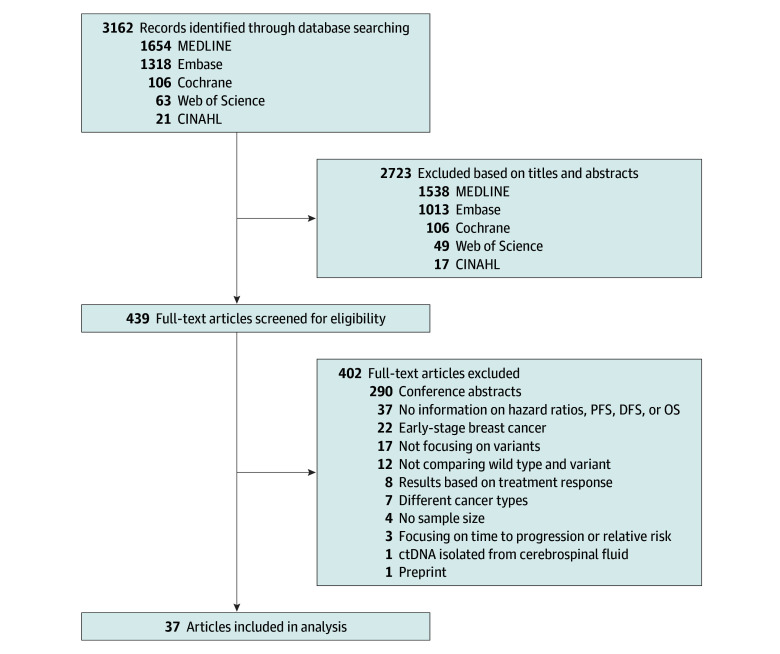
An electronic search was performed in 5 databases (CINAHL, Cochrane Library, Embase, Medline, and Web of Science) and included all articles published from inception until October 23, 2023.
To be included in the meta-analysis, studies had to (1) include women diagnosed with MBC; (2) report baseline plasma ctDNA data; and (3) report overall survival, progression-free survival, or disease-free survival with associated hazards ratios.
Titles and abstracts were screened independently by 2 authors. Data were pooled using a random-effects model. This study adhered to the Preferred Reporting Items for Systematic Reviews and Meta-analyses (PRISMA) reporting guideline, and quality was assessed using the Newcastle-Ottawa Scale.
The primary study outcome was the association between detection of specific genomic alterations in ctDNA with survival outcomes. Secondary objectives were associations of study methodology with survival.
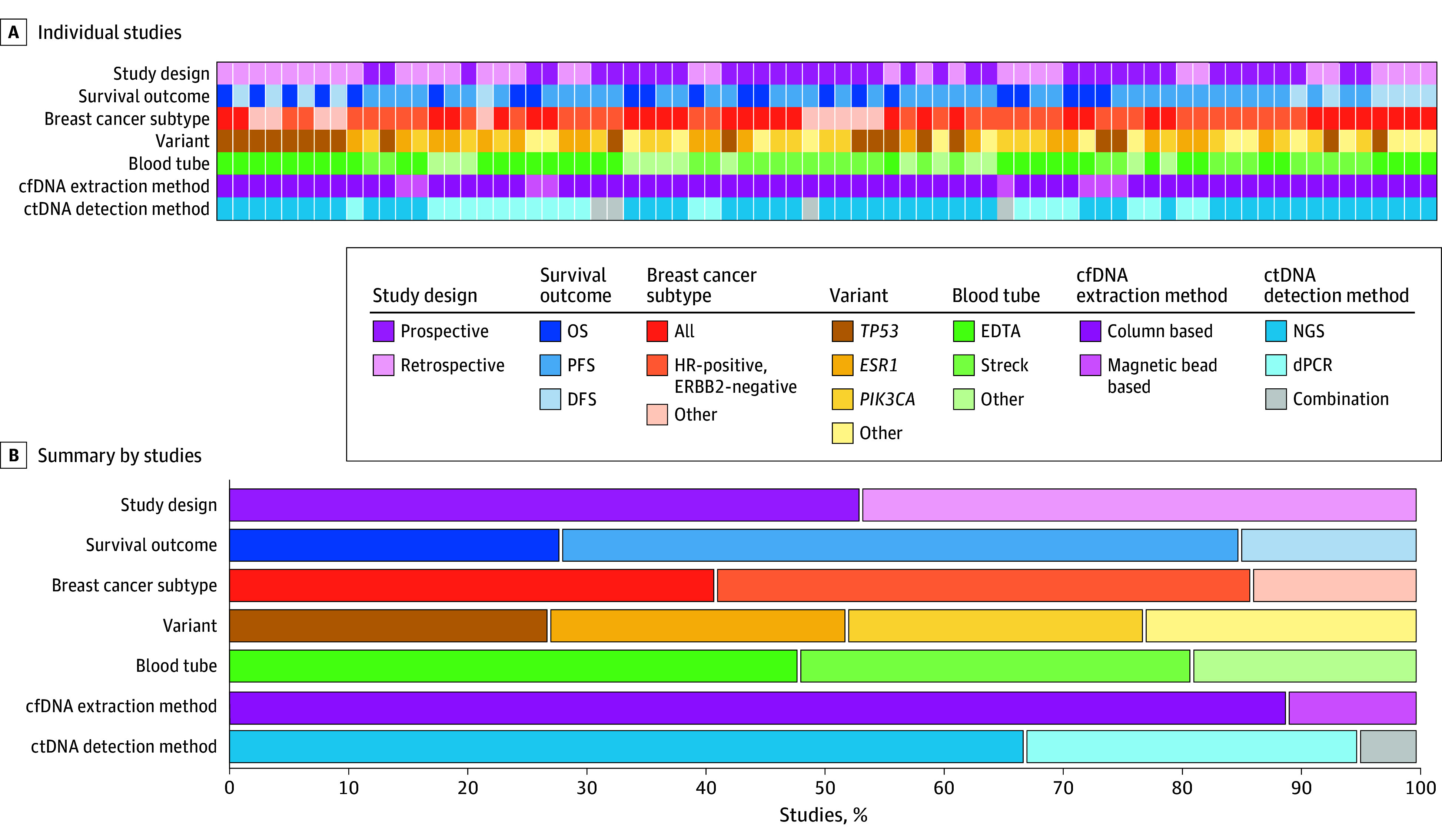
Of 3162 articles reviewed, 37 met the inclusion criteria and reported data from 4264 female patients aged 20 to 94 years. Aggregated analysis revealed a significant association between ctDNA detection and worse survival (hazard ratio, 1.40; 95% CI, 1.22-1.58). Subgroup analysis identified significant associations of TP53 and ESR1 alterations with worse survival (hazard ratios, 1.58 [95% CI, 1.34-1.81] and 1.28 [95% CI, 0.96-1.60], respectively), while PIK3CA alterations were not associated with survival outcomes. Stratifying by detection method, ctDNA detection through next-generation sequencing and digital polymerase chain reaction was associated with worse survival (hazard ratios, 1.48 [95% CI, 1.22-1.74] and 1.28 [95% CI, 1.05-1.50], respectively).
In this systematic review and meta-analysis, detection of specific genomic alterations in ctDNA was associated with worse overall, progression-free, and disease-free survival, suggesting its potential as a prognostic biomarker in MBC. These results may help guide the design of future studies to determine the actionability of ctDNA findings.
尽管在诊断和治疗方面取得了进展,转移性乳腺癌(MBC)仍然构成了重大的临床挑战。虽然组织活检提供了疾病的静态快照,但液体活检——通过检测循环肿瘤 DNA(ctDNA)——提供了对肿瘤生物学的微创、实时洞察。
确定 ctDNA 与 MBC 患者生存结局之间的关联。
在 5 个数据库(CINAHL、Cochrane 图书馆、Embase、Medline 和 Web of Science)中进行了电子搜索,并纳入了截至 2023 年 10 月 23 日发表的所有文章。
为了纳入荟萃分析,研究必须(1)包括诊断为 MBC 的女性;(2)报告基线血浆 ctDNA 数据;(3)报告总生存、无进展生存或无病生存,并附有相关风险比。
两位作者独立筛选标题和摘要。使用随机效应模型汇总数据。本研究遵循系统评价和荟萃分析的首选报告项目(PRISMA)报告准则,并使用纽卡斯尔-渥太华量表评估质量。
主要研究结局是 ctDNA 中特定基因组改变的检测与生存结局之间的关联。次要目标是研究方法与生存之间的关联。
在审查的 3162 篇文章中,有 37 篇符合纳入标准,报告了 4264 名年龄在 20 至 94 岁之间的女性患者的数据。综合分析显示,ctDNA 检测与较差的生存之间存在显著关联(风险比,1.40;95%CI,1.22-1.58)。亚组分析确定了 TP53 和 ESR1 改变与较差的生存之间存在显著关联(风险比分别为 1.58[95%CI,1.34-1.81]和 1.28[95%CI,0.96-1.60]),而 PIK3CA 改变与生存结局无关。按检测方法分层,通过下一代测序和数字聚合酶链反应检测 ctDNA 与较差的生存相关(风险比分别为 1.48[95%CI,1.22-1.74]和 1.28[95%CI,1.05-1.50])。
在这项系统评价和荟萃分析中,ctDNA 中特定基因组改变的检测与总体生存率、无进展生存率和无病生存率较差相关,这表明其可能作为 MBC 的预后生物标志物。这些结果可能有助于指导未来研究的设计,以确定 ctDNA 结果的可操作性。