Thiveos Lena, Kent Peter, Pocovi Natasha C, O'Sullivan Peter, Hancock Mark J
Department of Health Sciences, Faculty of Medicine, Health and Human Sciences, Macquarie University, Sydney, New South Wales, Australia.
Curtin School of Allied Health, Curtin University, Perth, Western Australia, Australia.
Phys Ther. 2024 Dec 6;104(12). doi: 10.1093/ptj/pzae128.
The objective was to investigate the effectiveness of cognitive functional therapy (CFT) in the management of people with chronic nonspecific low back pain (LBP) and explore the variability in available trials to understand the factors which may affect the effectiveness of the intervention.
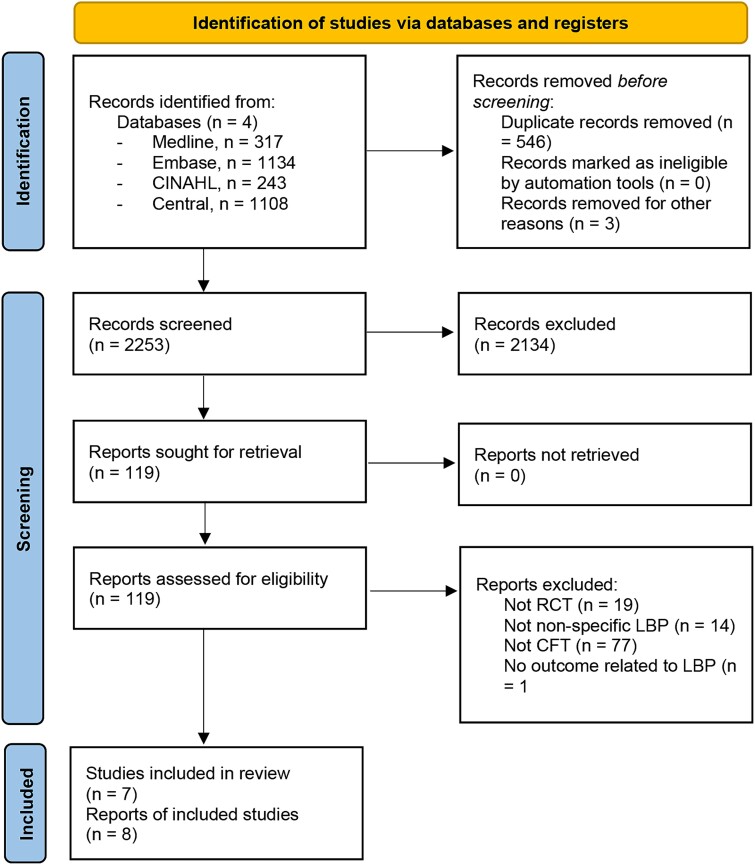
A systematic review with meta-analyses was conducted. Four databases were searched from inception to October 12, 2023. Randomized controlled trials investigating CFT compared with any control group in patients with nonspecific LBP were included. Mean difference and 95% CIs were calculated for pain, disability, and pain self-efficacy. Certainty of evidence was evaluated with the Grading of Recommendations Assessment, Development and Evaluation approach.
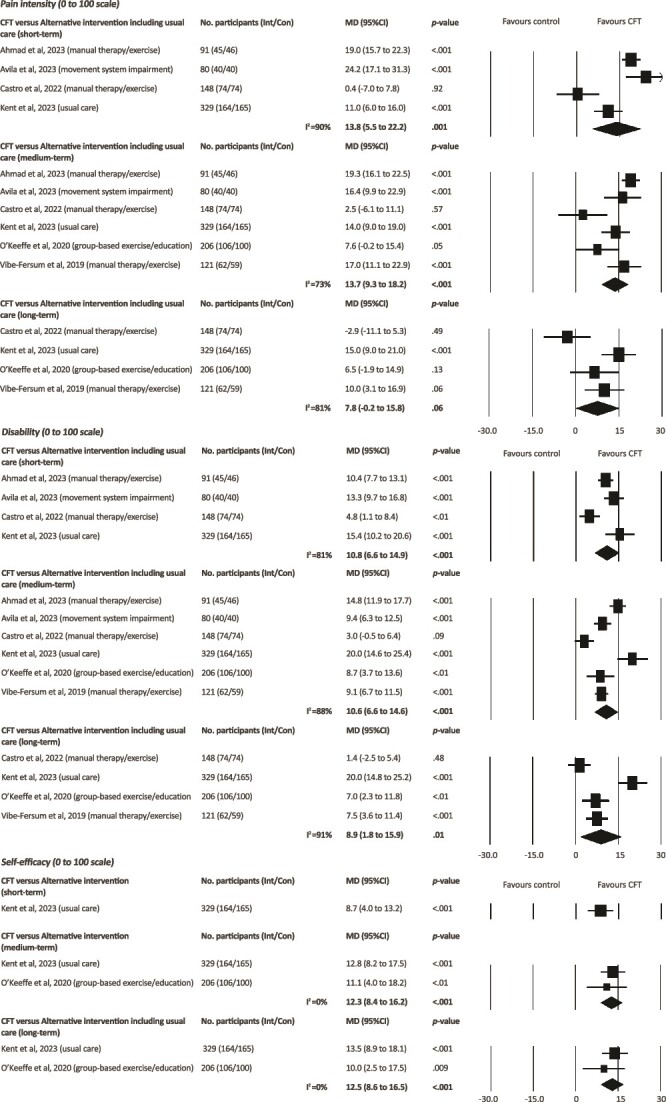
Seven trials were included. Low to moderate certainty of evidence was found that CFT was effective for disability at short, medium, and long term time points compared with alternate treatments, including usual care. Low to moderate certainty of evidence was found that CFT is effective for pain in the short and medium terms and probably in the long term. There was high certainty evidence CFT was effective in increasing pain self-efficacy in the medium and long terms. A single study found CFT was cost-effective compared with usual care. Variability was found in the training and implementation of CFT across the included trials, which may contribute to some heterogeneity in the results.
The results show promise in the use of CFT as an intervention likely to effectively manage disability, pain, and self-efficacy in people with chronic nonspecific LBP. The number of clinicians trained, their experience, and quality of training (including competency assessment) may be important in achieving optimal effectiveness.
This is the most comprehensive review of CFT to date and included investigation of between-trial differences. CFT is a promising intervention for chronic LBP and high-quality synthesis of evidence of its effectiveness is important for its clinical application.
本研究旨在探讨认知功能疗法(CFT)对慢性非特异性下腰痛(LBP)患者的治疗效果,并探究现有试验中的变异性,以了解可能影响该干预措施效果的因素。
进行了一项系统评价并荟萃分析。检索了四个数据库,检索时间从建库至2023年10月12日。纳入了比较CFT与非特异性LBP患者任何对照组的随机对照试验。计算了疼痛、功能障碍和疼痛自我效能感的平均差及95%可信区间。采用推荐分级评估、制定和评价方法对证据的确定性进行评估。
纳入了七项试验。发现证据确定性为低到中等,表明与替代治疗(包括常规护理)相比,CFT在短期、中期和长期时间点对功能障碍有效。发现证据确定性为低到中等,表明CFT在短期和中期以及可能在长期对疼痛有效。有高确定性证据表明CFT在中期和长期能有效提高疼痛自我效能感。一项研究发现与常规护理相比,CFT具有成本效益。在所纳入的试验中,CFT的培训和实施存在变异性,这可能导致结果存在一些异质性。
结果表明,将CFT作为一种可能有效管理慢性非特异性LBP患者功能障碍、疼痛和自我效能感的干预措施具有前景。接受培训的临床医生数量、他们的经验以及培训质量(包括能力评估)对于实现最佳效果可能很重要。
这是迄今为止对CFT最全面的综述,包括对试验间差异的调查。CFT是一种有前景的慢性LBP干预措施,对其有效性证据进行高质量综合对其临床应用很重要。